



In Lebanon’s crises, volunteers play a vital but often unseen role in supporting displaced communities and sustaining social resilience amid institutional collapse.
The unseen frontline: Lebanon’s volunteers in crisis
The unseen frontline: Lebanon’s volunteers in crisis
By The Beiruter | March 08, 2026

Reading time: 4 min
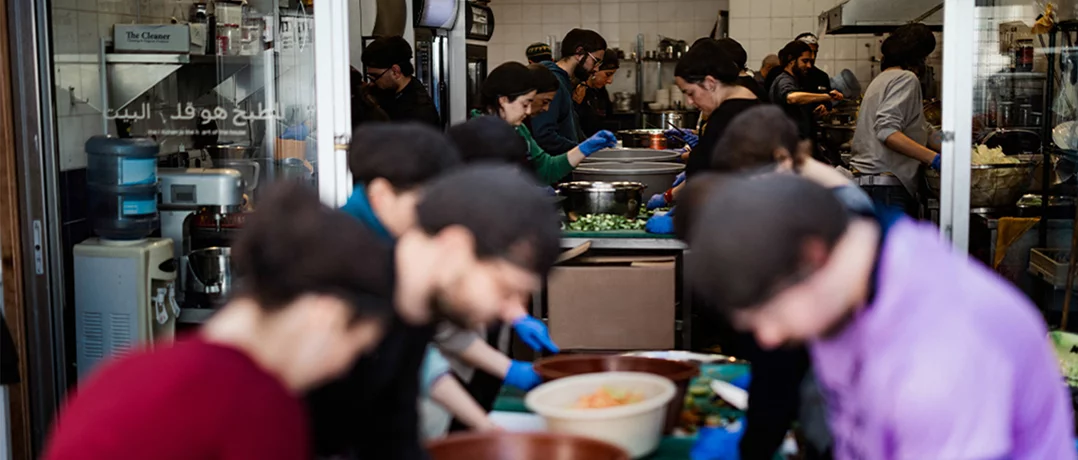
In Lebanon’s recurring crises, volunteers have once again stepped into the vacuum. Volunteers, young and old, organized and informal, step forward to clear debris, deliver meals, care for the displaced, and hold fragile communities together as shockwaves move through daily life.
Their work is rarely visible. It is exhausting, repetitive, and often carried out with limited resources. Yet it is precisely this persistence that keeps communities functioning when everything else feels uncertain. In a system strained by political paralysis and collapse, survival increasingly depends not on institutions, but on citizens who refuse to abandon one another.
This is the paradox of modern Lebanon: while institutions falter, society persists. It is ordinary people who continue to do the work of keeping the country standing. These volunteers carry hope, continuity, and, sometimes, survival itself.
Mariam Makki: Bringing food to children
Mariam Makki, social media influencer and business owner, describes the urge to do something, even when the world around her feels helpless. “I wanted to help people by bringing them food, and I want to learn cooking.” she says. Her efforts started small. She initially joined Nation Station, a local initiative, cooking alongside their team. But she quickly realized that simply spending time in a kitchen was not enough. “I felt like I was not really helping. I felt like I was not seeing the direct impact,” she admits.
Mariam then learned about more than 100 children now living in an abandoned school in Ramlet al-Bayda, many without daily access to food. “I feel responsible for the children because they don’t have Iftar meals every day,” she says. “There are more than 100 children, but I can provide for 50 for now. So yesterday I made meals for them and shared videos of it.”
Truth be told NGO: Feeding the displaced amid crisis
Since the last major bombings of Beirut, Yara Sayegh has been on the frontlines of Lebanon’s humanitarian crisis. As the founder of Truth Be Told NGO, she is one of the few organizers providing consistent support to those living on the streets. “Some of these people, the Beirut municipality is not taking care of them,” she explains. Truth Be Told is supplying hot meals, medications, hygiene essentials, menstrual products, diapers, and blankets.
Yara’s responsibility is immense. She tells The Beiruter, " Between Horsh Beirut and the horse tracks, we are providing meals and essential supplies to approximately 800 people each day. We have also extended support to around 300 displaced individuals in the Beirut area, supplying them with food and necessary items. " The NGO will also be opening their own kitchen in the coming days.
Chef Patrick Merheb: Cooking at scale
For Chef Patrick Merheb, the response to crisis begins in the kitchen. As part of a consulting firm that operates several restaurants across Lebanon, Merheb and his team have turned their central kitchen into a hub for large-scale food preparation for displaced communities.
“We gather donations and volunteers so we can produce meals and send them where they’re needed,” Merheb explains. “Every meal costs us around $1 to $1.20, so with relatively small contributions we’re able to feed a lot of people.”
The process is straightforward but demanding: donations fund ingredients, volunteers help cook, and the meals are then distributed to shelters, schools, and community centers hosting displaced families. “We’re being put in contact with several NGOs and organizations,” he says. “If anyone knows centers that need food or groups funding operations like this, we are ready to help.”
The people who step in
In times of war, the headlines are often dominated by destruction. But across Lebanon, another story exists. It is the story of people who refuse to look away. From volunteers cooking food for displaced children to activists distributing blankets on Beirut’s sidewalks and chefs turning commercial kitchens into relief centers, an informal network of solidarity has emerged to fill the gaps left by strained institutions and overwhelmed municipalities. Ordinary citizens have once again become the first responders.
Their efforts reveal something deeper about Lebanon’s social fabric. Even as conflict displaces families and deepens uncertainty, a parallel force continues to surface: a collective instinct to care, organize, and rebuild in real time. These volunteers may not appear in official briefings or military updates. Yet in moments of national emergency, they form an unseen frontline, one that sustains communities long after the bombs stop falling.
-
-

-
The Beiruter
-
