

A rare U.S. confirmation of weapons in orbit offers a glimpse into the expanding military role of space.
The U.S. acknowledges its weapons in space
The U.S. acknowledges its weapons in space
By The Beiruter | September 16, 2026

Reading time: 5 mins
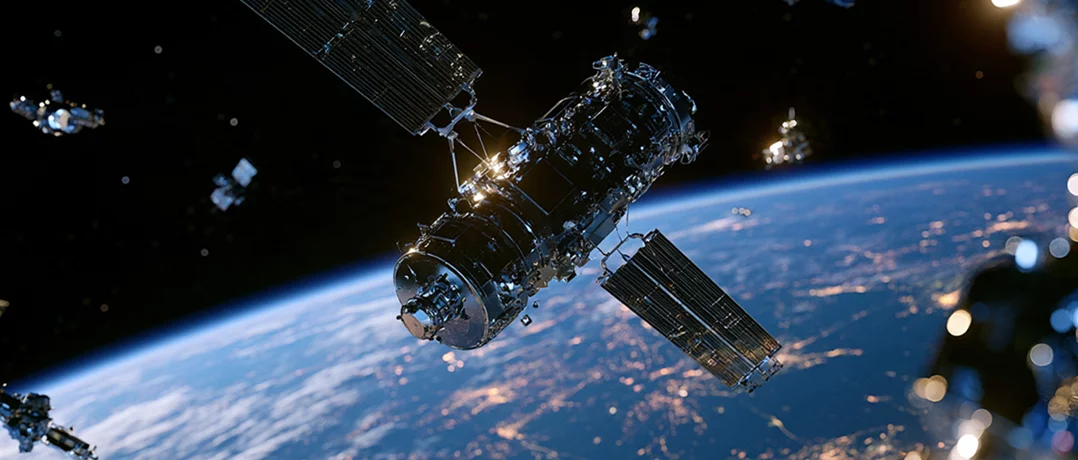
The United States has publicly acknowledged for the first time that it operates what Air Force Secretary Troy Meink called “on-orbit space control weapons,” making explicit a military capability Washington had previously kept largely out of public view. Meink offered no details about the weapons, including how many exist, where they operate or whether they can physically damage other spacecraft. But this disclosure comes as satellites become more deeply embedded in civilian life and warfare. More than 14,000 active satellites now orbit Earth, according to the U.S. Space Force’s July 2026 Space Threat Fact Sheet, supporting everything from communications and navigation to weather forecasting, financial transactions and military targeting. As dependence on those systems has grown, so has the military value of being able to protect them, interfere with them or disable them. Several countries have spent years developing precisely those capabilities. Russia, China and India have demonstrated anti-satellite capabilities, while a growing group of countries is investing in electronic warfare, orbital maneuvering (moving satellites close to other spacecraft) and other counterspace technologies. Washington’s announcement pulls into public view a contest that has already moved from research and testing toward operational military capabilities. Speaking at the Air, Space, and Cyber Conference in Maryland on Sept. 14, Meink said the Space Force had weapons already operating in orbit. “This is why the Space Force now has on-orbit space control weapons capable of defending the joint force against hostile adversary action,” Meink said in his keynote address. The wording was deliberately limited. Meink later told reporters that the phrasing had been “very well thought out,” but declined to say whether the weapons were kinetic, capable of physically damaging a target, or non-kinetic, such as systems that jam or interfere with it. Counterspace weapons are not new to the U.S. military. The Secure World Foundation’s April 2026 Global Counterspace Capabilities assessment identified three operational U.S. electronic-warfare systems, including the Counter Communications System, which can jam satellite communications uplinks, and its successor, Meadowlands. Until now, however, the publicly acknowledged operational systems have been based on Earth. Meink’s statement confirms that the U.S. military also has weapons operating in orbit. The disclosure arrives in an environment where several major powers have spent years developing ways to deny adversaries the advantages provided by satellites. China has tested spacecraft capable of operating close to other objects in orbit, known as “rendezvous and proximity operations.” The technology can be used to inspect or service satellites, but also potentially to interfere with them. The Secure World Foundation assesses that China may have an operational capability to attack satellites in low Earth orbit, where many communications and imaging satellites operate, using ground-launched missiles. Its ability to threaten satellites much farther away is less certain. Russia demonstrated a ground-launched anti-satellite weapon in November 2021 by destroying one of its own satellites and has also tested spacecraft designed to operate near others in orbit. More recently, in May 2026, four Russian military satellites approached a Western commercial radar-imaging satellite used by Ukraine, according to the Space Force’s July fact sheet. These capabilities are not limited to the United States’ principal competitors. The Secure World Foundation report dedicates assessments to 13 countries, with the United States, Russia, China and India placed in its category of states that have conducted destructive anti-satellite tests. Australia, France, Germany, Iran, Israel, Japan, North Korea, South Korea and the United Kingdom are assessed separately for counterspace technologies under development. Space conflict does not have to destroy a satellite to cause significant disruption. Modern armed forces depend on satellites to locate units, guide weapons, communicate and gather intelligence. Disrupting those functions can affect combat on Earth without destroying a satellite. Electronic warfare already provides a preview. The Secure World Foundation found that non-destructive counterspace capabilities were the only category being actively used against satellites in current military operations. It cited credible reports of Russian jamming and other electronic-warfare activity in Ukraine and Syria. Commercial satellites further complicate the boundary. SpaceX’s Starlink has become important to military communications during wartime, while commercial imaging satellites can provide intelligence once reserved for governments.Russia has publicly described some commercial satellites supporting military operations as potential targets, according to the Space Force fact sheet. A conflict in orbit could consequently reach civilian infrastructure even when the original objective is military. Washington’s decision to disclose its orbital weapons also marks a change in how the United States talks about military power in space. Meink argued that acknowledging capabilities could strengthen deterrence while keeping their technical characteristics secret. When asked about concerns that the disclosure might encourage competitors, he pointed to Russian and Chinese programs and said the United States needed to demonstrate that it could protect itself. Gen. Douglas Schiess, who became chief of space operations on Sept. 3, reinforced that rationale the following day in his first major address in the role, delivered at the same conference. Schiess told reporters that the decision to speak publicly was partly about deterrence, pointing specifically to Chinese and Russian capabilities, including the ability to grapple satellites and move them into different orbits. He also confirmed that Space Force personnel currently operate weapons in orbit, saying Guardians “operate on-orbit weapons that can defend the Joint Force against space-enabled attacks.” The shift does not mean that orbit has suddenly become militarized. Satellites have supported warfare since the Cold War, and anti-satellite technologies are almost as old as the Space Age itself. What has changed is the density of orbital infrastructure, the number of governments capable of threatening it and the willingness of the United States to publicly acknowledge weapons already operating there. As communications, navigation, and military operations become more dependent on satellites, conflict on Earth and competition in orbit are becoming harder to separate. Meink’s disclosure has made one part of that reality considerably more visible.What exactly did the United States reveal?
A contest already underway
The less visible space war
From secrecy to deterrence
-
-

-
The Beiruter
-
