



As US troops leave Iraq for the second time, a battered Iran may struggle to reclaim its old dominance.
The US leaves Iraq... again

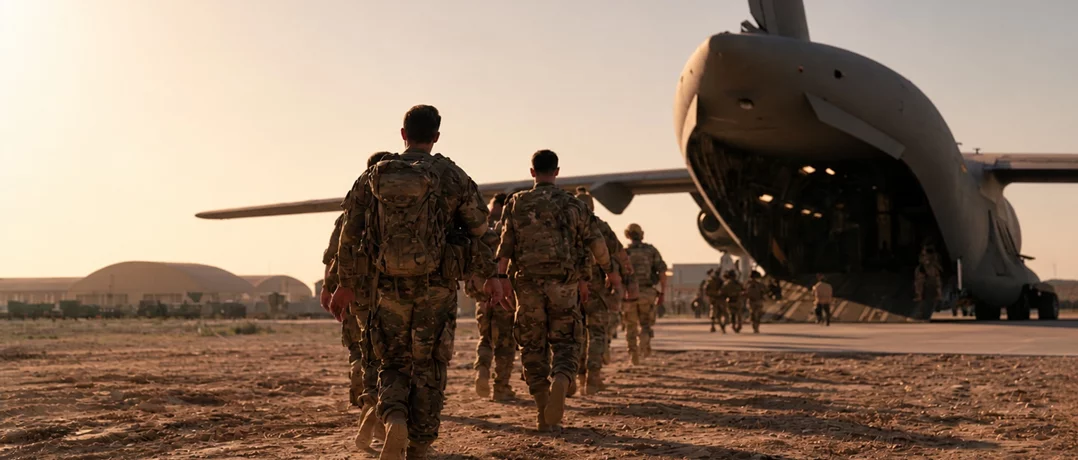
As the last US troops leave Iraq, Washington is replaying 2011, withdrawing from a country many fear cannot defend its own sovereignty and potentially leaving an opening for others.
But a war that has battered Iran’s economy and military may leave Tehran unable to rebuild the clout it once had, while the US retreat shifts the danger of Iranian retaliation squarely onto the Gulf states.
Iran’s moment in 2014
The US-Iran rivalry in Iraq began with the 2003 invasion. As Lahib Higel of the International Crisis Group puts it, for Tehran, the toppling of Saddam Hussein was both a threat and an opportunity. It put a vast American army on Iran’s western border, but it also removed an old enemy and brought to power Shia Islamist parties whose leaders had spent years in exile in Iran. Still scarred by the Iran-Iraq war of the 1980s, the Islamic Republic set out to pull Iraq into its orbit and block any American plan for regime change. It did so by cultivating Iraqi political parties and arming paramilitary groups.
The 2011 withdrawal gave that strategy room to grow. With US forces gone, Iran deepened its ties with Baghdad’s ruling parties. When the Islamic State swept across northern Iraq in 2014, Tehran-backed militias became the backbone of the Hashd al-Shaabi, or the Popular Mobilisation Forces, which was formed to fight the group. Iran came out of that war more embedded in Iraq’s security and political landscape than ever.
For more than two decades, Iraqi governments have tried to stay on good terms with both Washington and Tehran. With the two now in open conflict, that balancing act has made Iraqi territory a target for both sides. Baghdad has declared itself neutral, but it has been unable to keep the country out of the fighting.
Iraq’s attempt to protect itself
Prime Minister Ali al-Zaidi visited Washington to discuss economic cooperation. His next trip was to Tehran, where he and Iranian President Masoud Pezeshkian signed agreements on road freight and administrative cooperation, and on a long-planned railway linking Kermanshah to Baghdad via Khanaqin. They also agreed to draft a long-term strategic partnership. Trade between the two countries exceeds $12 billion a year, and Iraq remains heavily dependent on Iranian gas and electricity. Millions of Iranian pilgrims visit Najaf and Karbala each year.
Most importantly, Zaidi pledged that Iraq would not let its territory be used against Iran.
In his address to the UN General Assembly, Zaidi insisted that the state alone must decide on war and peace, and that all weapons must be held by constitutional institutions. He framed the end of the US’s mission as the start of a relationship based on trade, development and diplomacy. He also promoted the “Development Road” corridor linking the Grand Faw Port to Europe, inviting foreign investment and pledging anti-corruption reforms. Those are not the words of a government ready to be absorbed by Tehran.
Washington’s leverage survives the withdrawal
The departure of US troops does not mean the end of US influence. Since the 2003 invasion, Iraq’s oil revenues, which make up about 90% of the state budget, have been held at the Federal Reserve Bank of New York under an arrangement renewed by every US president since George W. Bush. In April, Washington blocked a shipment of about $500 million in cash to Iraq to pressure Baghdad over Iran-aligned armed groups, before later restoring it. That money had been generated from Iraq’s own oil sales. Washington’s significant sway over the country was on display in 2020, when the US reportedly threatened to cut Baghdad’s access to the funds after it asked US troops to leave, and Iraq backed down. Whatever ground Iran regains, it will have to contend with a US that can still squeeze Iraq’s finances.
Iraq’s oil also has to reach the market, and with the reopening of the Strait of Hormuz still a work in progress, that has been far from guaranteed. Before the war, Iraq exported about 3.3 million barrels per day (b/d) of crude from its southern oilfields, or roughly 93 million barrels a month. Exports fell sharply earlier in 2026 before recovering after Iran granted special transit allowances, and by August Iraq was shipping roughly 2.3 million b/d through the strait. In early October, Iraq’s state-owned Oil Tankers Company moved 2 million barrels in a single very large crude carrier.
The fact that Iraq’s recovery depended on Iranian permission is itself a reminder of Tehran’s leverage. Should the war resume and Iraq’s oil wealth go untapped again, the risk of domestic upheaval will rise, and with it the opportunities for armed groups to exploit the chaos.
A divided militia camp
Iran’s most direct instruments in Iraq are the armed groups loyal to it. Operating under the banner of the Islamic Resistance in Iraq, they have claimed attacks on US targets in Iraq and the Kurdistan Region since the war began. Groups such as Kata’ib Hizbollah and Harakat al-Nujaba have used Hashd bases and weapons for these attacks while remaining outside the prime minister’s chain of command. They have also widened their targets from military bases to diplomatic missions and energy facilities in Kurdistan and Basra.
Higel further suggests that, like Iran itself, these groups may claim victory simply by surviving the war intact, and hardliners such as Kata’ib Hizbollah and Kata’ib Sayyid al-Shuhada could become even more assertive in Baghdad. But the camp is less unified than it was. The 2020 killing of Qassem Soleimani and Abu Mahdi al-Muhandis removed the figures who held the Iran-aligned factions together. Since then, most Hashd groups have put electoral politics ahead of armed resistance.
Too weak to make a comeback?
The opening for Iran is real, but its capacity to exploit it is not what it was in 2011. Then, Tehran could pour money, weapons and advisers into Iraq at relatively little cost. Today it emerges from a war with the US and Israel that has battered its military and strained an economy already crippled by sanctions. Rebuilding its own defences and keeping its economy afloat will compete with any ambition to bankroll allies abroad.
Tehran saw its Iraqi allies as a primary security buffer and a last defense, which is why they stayed out of the June 2025 confrontation. Their entry into this war suggests Iran is in a position of survival, not expansion.
If anything, Iraq may now matter more to Iran as an economic lifeline than as a platform for projecting power. A sanctioned Iran needs Iraqi trade, Iraqi purchases of its gas and electricity, and the transport links agreed in July. That gives Baghdad some leverage of its own, and makes a return to the outsized Iranian dominance of the post-2011 years harder to achieve.
The Gulf might take the burden
With its troops gone, the US has far fewer targets within easy reach of Iran and its Iraqi allies. If Israel and the US strike Iran again, Tehran and its proxies will look for other ways to retaliate, and the most obvious targets are the Gulf states.
They have already borne the brunt of the cross-border attacks in this war, with strikes hitting civilian infrastructure and damaging their economies. A US that has pulled back from Iraq leaves them more exposed and more dependent on their own defences and on partners willing to stand with them. In that sense, the withdrawal can be read as a way for Washington to push the Gulf states further into Israel’s orbit, as the security partner of last resort against a common Iranian threat.
Not so easy for Iran
Iran will not be the only power testing the space the US leaves behind. Turkey has recently reached an understanding with Baghdad on preventing further Kurdish attacks. Israel, which critics have long accused of cultivating interests and influence in the Kurdistan Region, has a stake in keeping Iran from consolidating its position next door. These overlapping rivalries make it unlikely that any single outside power will dominate Iraq the way Iran did after 2011. The conditions have changed since the American withdrawal of 2011. Tehran is weaker, its Iraqi allies are divided between hardliners and politicians with a stake in the state, and Washington still controls Iraq’s oil revenues. Iran may regain a foothold, but rebuilding its old dominance will be far harder.
-
-

-
Peter ChouayfatiPolitical Analyst and Researcher
-
