

Pope Leo XIV positions the Vatican as a leading moral voice advocating human dignity, ethical safeguards, and accountability in artificial intelligence.
The Vatican’s AI awakening: Defending human dignity
The Vatican’s AI awakening: Defending human dignity
By The Beiruter | May 18, 2026

Reading time: 5 min
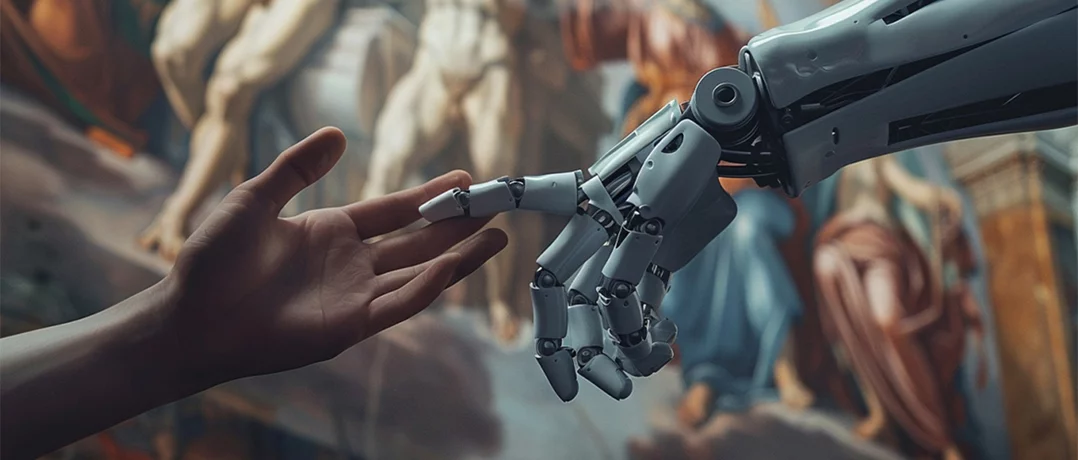
As Artificial Intelligence (AI) rapidly transforms economies, communication, education, and human interaction, global institutions are increasingly confronting the ethical dilemmas accompanying this technological revolution. Among the latest and most influential actors to enter this debate is Pope Leo XIV, who has placed the issue of artificial intelligence at the center of his emerging papacy. Through the creation of a new Vatican commission dedicated to AI and the anticipated publication of his first encyclical, the pontiff is signaling that the Catholic Church intends to play a major role in shaping the moral framework surrounding advanced technologies.
The Vatican’s initiative reflects growing concern that artificial intelligence, while capable of generating enormous benefits, may also threaten human dignity, labor rights, social cohesion, and ethical responsibility if left unchecked. By addressing AI through the lens of Catholic social teaching, Pope Leo XIV seeks to position the Church as a moral voice during what many observers describe as a new industrial revolution.
The Vatican’s new AI commission
The Vatican recently announced the establishment of a special commission on AI under the direction of Pope Leo XIV. According to the Holy See, the commission was created in response to the accelerating use of AI technologies and their potentially profound consequences for humanity.
The commission’s mission will be to coordinate the Catholic Church’s response to the ethical, social, cultural, and spiritual implications of artificial intelligence. Rather than treating AI solely as a technical innovation, the Vatican views it as a phenomenon capable of reshaping the foundations of human life and society.
Central to the Church’s concerns is the preservation of human dignity. Vatican officials stressed that technological innovation must remain focused on the human person rather than reducing individuals to data points, economic units, or algorithmic patterns. The initiative also demonstrates the Church’s desire to engage proactively with technological developments instead of reacting to them after social consequences have already emerged.
The creation of the commission follows years of increasing Vatican involvement in debates surrounding digital ethics, surveillance, automation, and online misinformation. Under Pope Leo XIV, however, the Church appears ready to elevate AI into one of the defining themes of the current papacy.
AI as the defining moral challenge of the century
Pope Leo XIV has repeatedly framed artificial intelligence not merely as a technological issue, but as a profound moral and anthropological challenge. Shortly after his election in May 2025, he stated that the Church had a responsibility to offer the “treasury” of its social teaching to confront AI-related threats to justice, labor, and human dignity.
His forthcoming encyclical, reportedly titled Magnifica Humanitas, or “Magnificent Humanity,” is expected to outline a comprehensive Catholic vision for the AI era. The document will likely draw parallels between today’s digital transformation and the Industrial Revolution of the 19th century.
This comparison is highly symbolic. By choosing the name Leo XIV, the pontiff deliberately evokes Pope Leo XIII, whose landmark 1891 encyclical Rerum Novarum defended workers’ rights during the rise of industrial capitalism. In much the same way, Pope Leo XIV appears determined to confront the disruptive effects of automation, algorithmic management, and machine-driven economies.
The Church fears that unchecked AI development could worsen inequality, eliminate jobs, centralize power in the hands of large corporations, and weaken human agency. Entry-level employment opportunities, creative professions, and even intellectual work are increasingly vulnerable to automation. For the Vatican, the question is no longer whether AI will transform society, but whether humanity can preserve ethical responsibility during that transformation.
Preserving “human voices and faces”
One of Pope Leo XIV’s most significant interventions on AI came during World Communications Day, when he urged communicators and technology developers to preserve “human voices and faces” in the digital age.
The pope warned against forms of communication that detach individuals from authentic human relationships. In an era increasingly dominated by algorithms, synthetic content, and virtual interactions, he emphasized that technology must serve truth and human connection rather than replace them.
This concern reflects broader anxieties about the “algorithmization” of daily life. Digital systems now shape news consumption, social interactions, political discourse, entertainment, and even personal identity. Many of these systems operate invisibly, influencing human behavior through recommendation algorithms, targeted advertising, and automated decision-making.
Critics argue that such technologies gradually redefine what societies consider normal, desirable, or morally acceptable. Pope Leo XIV’s warnings suggest that the Church fears humanity could slowly surrender independent judgment and critical thinking to automated systems designed primarily around efficiency, profit, and engagement metrics.
The pope also expressed particular concern for children and young people, warning that excessive dependence on AI could negatively affect intellectual and emotional development. He stressed that youth should be guided toward maturity, responsibility, and authentic human interaction rather than passive technological dependence.
The ethical risks of AI
Although the Vatican recognizes the enormous potential benefits of artificial intelligence, Pope Leo XIV has consistently highlighted the dangers of misuse. He warned that AI could be exploited for selfish interests, manipulation, conflict, and aggression.
These concerns extend beyond economic disruption. The Church has increasingly spoken about surveillance technologies, autonomous weapons, disinformation campaigns, and systems capable of amplifying social polarization. The Vatican also fears that excessive reliance on AI may weaken empathy, creativity, and moral reflection.
Underlying these warnings is a broader philosophical concern: machines can imitate human language and decision-making, but they cannot genuinely experience suffering, compassion, conscience, or spiritual responsibility. For the Church, allowing machines to dominate human judgment risks eroding the moral foundations of civilization itself.
The Vatican has therefore advocated for transparency, accountability, and human oversight in AI development. It previously supported the “Rome Call for AI Ethics,” which promoted human-centered technological innovation grounded in fairness and responsibility.
As AI continues to transform societies worldwide, the Vatican is positioning itself as a global advocate for ethical safeguards and human-centered development. Through his upcoming encyclical and broader public interventions, Pope Leo XIV is attempting to ensure that humanity does not become subordinate to the very technologies it has created.
In many ways, the Church views the AI revolution as the defining social challenge of the twenty-first century. Just as earlier generations confronted the consequences of industrialization, today’s world must determine how to balance technological advancement with the protection of human freedom, identity, and dignity. Pope Leo XIV’s message is ultimately clear: innovation should serve humanity, not replace it.
-
-

-
The Beiruter
-
