



Halloween, All Saints’ Day and All Souls’ Day in Lebanon.
The vigil that lost its feast

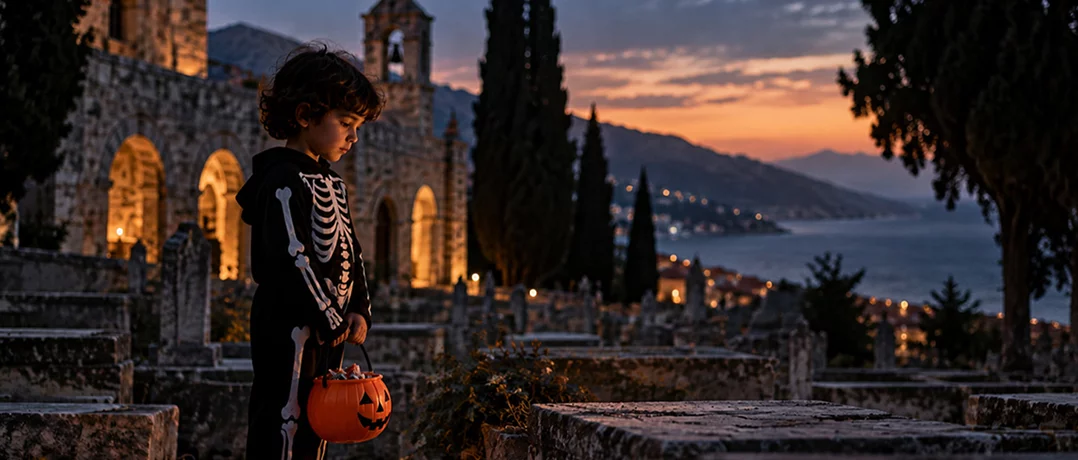
In an English town in the fifteenth century, a child knocks on a door on the last night of October. He is given a small spiced cake. In return he promises something: a prayer for the dead of that house. The custom was souling, the cakes soul cakes, and it was common enough for Shakespeare to mock a lover as “puling, like a beggar at Hallowmas.” Six centuries later the same child stands on a street in Achrafieh in a skeleton costume. He is given sweets. He promises nothing. The cake survived. The prayer did not.
That small reversal is the whole history of Halloween, and it runs opposite to the story we are told. The familiar version says the Church painted a feast of saints over a pagan Celtic night, Samhain. The historians say otherwise. Ronald Hutton traced the idea of Samhain as a “feast of the dead” not to any Celtic source but to James Frazer, who needed it to explain the ghosts. The three days themselves are Christian from the root: a chapel to all the saints in St Peter’s under Gregory III in the 730s, the feast fixed on 1 November across the Frankish empire in 835, a day for all the departed added by Odilo of Cluny around 998. The medievalist Beth Allison Barr says it flatly: Halloween is more Christian than pagan. What made the night pagan was not antiquity but commerce, and that happened in the last hundred years.
A Lebanese Christian notices something else. Our own Church, left to itself, never put its dead in November. The Maronite calendar remembers them in the three Sundays before Lent, the priests first, then the righteous and the just, then all the faithful departed. One Maronite priest put the contrast exactly: they have two days, we have three weeks. So the Lebanese believer stands inside two calendars of the dead: one Latin, one older and Syriac that waits for the edge of spring. Neither of them is Halloween. Both of them know what Halloween is for.
The plastic skeleton is nobody’s skeleton. It is death in the third person.
Philippe Ariès, the historian of how Europeans died, called the old way “tamed death”: one died at home, in bed, with the family in the room and the priest expected. Within a century that death was moved to the hospital, the body handed to professionals, the grief made private; he called this “forbidden death.” But what a culture forbids returns, and it returns as spectacle. A Danish sociologist has proposed a fifth stage for Ariès’s history and named it exactly that: spectacular death. The skeletons did not vanish. They moved from the cemetery to the storefront.
Pascal saw the mechanism three centuries early. Men, unable to cure death, misery and ignorance, resolved to make themselves happy by not thinking about them; he called this divertissement. Halloween is the most elegant diversion ever built: it lets you handle death’s costume so you never have to see death’s face. Heidegger named what the costume says. In everyday life, he wrote, death is something that happens to “one”, and this “one” is nobody. The plastic skeleton is nobody’s skeleton. It is death in the third person. The Church refuses the third person. On 2 November, in a Lebanese parish, the altar is left bare of flowers and the names are read out one by one, each with its الله يرحمو. That is the whole difference: death as an event, or death in the vocative.
Across those three days the Church is counting itself. The Catechism speaks of one Church in three states: pilgrims on earth, the dead being purified, the blessed in glory. The triduum lays the three on a calendar: the living keep vigil on the 31st, the glorified are honoured on the 1st, the purified are prayed for on the 2nd. The communion of saints is a calendar before it is a doctrine. And the saints are not a moral aristocracy; they are a country’s truest census. Lebanon has given the Church Charbel, Rafqa and Hardini; in October 2024 the Maronite Church added the Massabki brothers, three laymen of Damascus, the first of the Maronite laity ever canonised, the eldest a silk merchant and father of eight. Pope Francis called the uncounted rest “the saints next door.” The grandmother at the cemetery may be one of them.
Nor has Christian faith ever called death “passing away.” It calls it Pascha, passage, and claims the passage was forced open from the other side. Ephrem of Nisibis wrote hymns in which Death himself speaks and complains that the old Passover lamb used to fill his graves while this Lamb empties them. No one mocks death like that unless they have watched it lose. When Monica lay dying at Ostia she told Augustine not to trouble about where he buried her; she asked only to be remembered at the altar of the Lord. Christian memory of the dead is not sentimental. It is Eucharistic. The dead are not kept in photographs. They are kept at an altar, by name.
C. S. Lewis, preaching in Oxford in 1941, said that none of us has ever met a mere mortal, only “immortal horrors or everlasting splendours.” Halloween puts on the first. All Saints names the second. Both are telling the truth about the person beside you, which is why the night and the morning belong together, and why neither makes sense alone.
Lebanon does not need to import death to meet it. We buried the port on 4 August. We bury the wars every decade. We bury the diaspora’s dead when they come home from Sydney and São Paulo. Here الله يرحمو is punctuation, and food is still given عن روح the departed. Yet Halloween grows in Beirut anyway: windows in orange, costume shops full despite the collapse, and last year a party advertised for the night of 1 November, the feast itself partied through as if it were still the eve. One newspaper headline put it better than any sermon: come as you aren’t.
The pumpkin is hollowed out and lit from inside. The grain is buried and rises.
Stranger still, Lebanon already has a Christian night of masks. On the eve of 4 December, children dress up and go door to door singing that Barbara is running, and they are given a bowl of boiled wheat. The disguise hides a martyr fleeing for her faith; the wheat is there because the grain that falls into the earth and dies bears much fruit. Set the two feasts side by side and let them argue. The pumpkin is hollowed out and lit from inside. The grain is buried and rises.
None of this argues for banning the night. The Church did not take the vigil from the Celts; it made it, and it can have it back. Give the eve its morning. Let the child in the skeleton costume walk straight from the street into the Mass of All Saints without changing, and learn that the bones he is wearing have a name and a feast. On the second morning let him go with his grandmother to the cemetery and watch her stand there, wax on her fingers, and say the name she came to say. The cake was never the point. The prayer was.
-
-
-
Jean Paul BoutrosWriterEssayist and researcher. Studies in philosophy, theology, international affairs, and business.
-
