



A concise look at Pope Leo XIV’s farewell message to Lebanon, emphasizing his call for peace, unity, and renewed hope for a nation enduring crisis.
The visit that echoes beyond

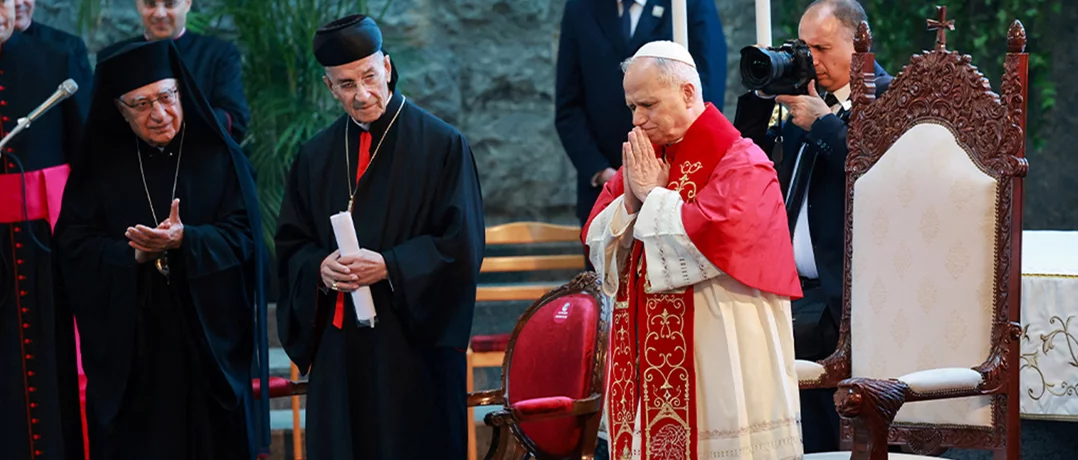
At 1:45 p.m. on 2 December 2025, Pope Leo XIV bid Lebanon farewell. Alas, his historic apostolic journey concluded as the Papal plane, carrying both the pontiff and his accompanying delegation, took off from the Rafic Hariri International Airport, heading back to the Vatican in Rome, Italy.
As was apparent in the people’s expressions, the Lebanese did not want the Pope to leave, but rather to remain and dwell among them in the “land of the Saints.” However, despite the bitterness of departure, the echoes of Pope Leo XIV’s visit will continue to reverberate for the future ahead, for as the pontiff assured during his final speech at the airport, “we are not leaving each other, rather, having met, we will move forward together.”
From here, as the central theme for the Pope’s journey was “Blessed are the Peacemakers” (Mathew 5:9), one must ponder on the crucial messages that this visit managed to convey to Lebanon and its people as well as the entire region.
Peace be upon you
The most obvious and paramount message that Pope Leo XIV sought to carry to Lebanon is none other than PEACE.
“Peace” and its derivatives (such as “peacemakers” and “peaceful”) had been mentioned over 60 times during the pontiff’s addresses throughout his visit, revealing its importance and necessity for the country and even the region as a whole. He reaffirmed this intention during his final speech at the airport, saying that
we hope to involve the entire Middle East in this spirit of fraternity and commitment to peace, including those who currently consider themselves enemies.
This statement seemed to be referring to two regional adversaries locked in never-ending conflict: Israel and Iran (along with its “Axis of Resistance,” which includes Hezbollah). The pontiff also seemed to be tackling the issue of the Israeli-Arab and the Israeli-Palestinian conflicts, especially following the recent Gaza War (2023-2025), hoping to reach a just and peaceful settlement.
However, one must note that Pope Leo XIV did not merely shed the light on “peace,” but resorted to a more proactive term: “peacemakers,” the motto of his apostolic journey. Peace cannot be fulfilled in the absence of those who seek it. It requires commitment and dedication from all relevant parties. The latter are all a vital component of the overall architecture that the Holy See pursues. Thus, peace is a shared responsibility.
Furthermore, the pontiff expressed his care and attention to those he was unable to visit during his journey, stating that
embracing all of you, I express my aspiration for peace, along with a heartfelt appeal: may the attacks and hostilities cease. We must recognize that armed struggle brings no benefit. While weapons are lethal, negotiation, mediation, and dialogue are constructive. Let us all choose peace as a way and not just as a goal.
His last words highlight the futility of war, as opposed to the peaceful means of settling any dispute. Even following the pontiff’s visit, he replied to the letter sent by Hezbollah during a press interview, claiming that “the Church has presented a proposal calling on the party to lay down its arms and pursue dialogue,” thus reaffirming his determination to “continue efforts to persuade the various Lebanese parties to renounce weapons and violence, and to engage in constructive dialogue that serves the interests of Lebanon and its people.”
A call to unity and reconciliation beyond differences
During his address in the presidential palace, Pope Leo XIV announced three characteristics of authentic peacemakers; one of them is reconciliation.
The pontiff recognized that the country has long suffered from “personal and collective wounds that take many years, sometimes entire generations, to heal.” Sectarian and political strife have enhanced the growing divide and impacted internal unity and cohesion amongst the Lebanese communities. For this reason, Pope Leo XIV warned that if these wounds were not treated, “it is difficult to journey towards peace.”
This explains the ecumenical and interreligious meeting that the pontiff insisted on holding at Martyrs’ Square in Beirut. The intended reconciliation can only be fulfilled through dialogue, mutual understanding and love, instead of clinging to one’s own ideas and “truth.” Reiterating Pope John Paul II’s infamous quote on Lebanon: “more than a country; it is a message of freedom and an example of pluralism for East and West,” the pontiff believed in “a reconciliation that, in addition to enabling us to live together, will teach us to work together for a shared future side by side.” Hence, there is no lasting reconciliation without a common goal, one that unites all Lebanese: an inclusive, peaceful and prosperous Lebanon.
From here, the Lebanese are called to address past grievances, reach mutual understanding (based on equality, justice and respect) as well as seek a common goal for the future to come. No party or community should feel marginalized or neglected but rather welcomed and embraced in the spirit of fraternity and humanity. In this regard, Pope Leo XIV reiterated his predecessor’s message:
forgiveness leads to justice, which is the foundation of peace.
Boasting Lebanese resilience, perseverance and youth
Lebanon has long suffered from various hardships throughout history. Despite these persisting challenges and the numerous arguments and temptations to leave, the Lebanese remained attached to their homeland, refusing to give in to despair. They are a people known for their resilience, perseverance and ability to find hope in the face of extreme adversity, a coping mechanism developed through years of misfortune.
In light of that, Pope Leo XIV stressed on the importance of the youth and their role as peacemakers. His meeting at the Maronite Catholic Patriarchal See of Bkerke brought around 15,000 young men and women from all over Lebanon, highlighting their vital place in his vision. This is especially true as the pontiff addressed the gathering by saying that “there is hope within you, a gift that we adults seem to have lost. You have time! You have more time to dream, to plan and to do good. You are the present, and the future is already taking shape in your hands! You have the enthusiasm to change the course of history!” The pontiff’s message resonated within the hearts and minds of the youth, given the mass emigration that has taken place in the past couple years; which has targeted primarily the youth (with a notable Christian portion). Pope Leo XIV affirmed the Vatican’s genuine interest regarding this matter, saying that the Church “does not want anyone to be forced to leave their country,” but rather “wants those who wish to return home to be able to do so safely.”
People of the land
Christians have been a centerpiece in Pope Leo XIV’s visit. This was revealed as the head of the Church unprecedently visited the modest yet powerful tomb of St. Charbel at St. Maroun Monastery in Annaya, kneeling before the humbleness and holiness of both the place and its hermit as well as proclaiming it as an international religious monastery.
Christians’ numbers in the Middle East have been decreasing over time, due to oppression, persecution, conflicts and crises. While Christians in Lebanon have also witnessed such decline, they nevertheless represent the last stronghold for Christianity in the region. It is from here that Lebanese President General Joseph Aoun firmly stated that “if the Christian presence disappears in Lebanon, the equation of the nation will collapse, and its justice will fall,” and “if Lebanon is disabled or altered, the alternative will inevitably be new fault lines across our region and the world, between all forms of extremism: ideological, materialistic, and even violent.”
The Pope’s visit thus sends a profound message to Lebanese and Middle Eastern Christians that their presence and role is ever more vital and influential. The region, being the cradle of the Abrahamic religions, must preserve its pluralism and diversity, given the risk on its identity and stability should homogeneity be pursued.
One must also underscore that the presence of Lebanese Christians can only be maintained through a continued effort and a strategic vision to ensure their continuity; stressing on unity. Negligence and futile conflicts (especially amongst one another) would only invite the scenario of Middle Eastern Christians’ status to the country; referring to their diminishing numbers and influence in countries they once held significant weight in (such as Syria, Iraq and Turkey). From here, there is an urgent call for Christians in Lebanon to adopt a proactive role, set aside shallow and trivial differences as well as unite their efforts to secure their rightful and historic place.
A light before the silence of the guns
Alas, many previously hoped the postponement of Pope Leo XIV’s visit to Lebanon, after the looming war ends. They believed that his message of peace would be more suitable in a post-war Lebanon, as opposed to a country reportedly heading towards a possible armed conflict. However, one might beg to differ. The significance of the Pope’s message could only resonate and carry profound influence in times of uncertainty and peril, bringing hope and light in the midst of darkness. In this regard, we might recall that the fruits of Pope John Paul II’s 1997 visit were not apparent, as one might presume, until later on; referring to the infamous Maronite Bishop’s Appeal in 2000 and the subsequent withdrawal of the Syrian occupation in 2005. Hence, Pope Leo XIV’s visit must be viewed in the same vein, hoping that its message bears fruits after the drums of war are finally silenced.
From here, as Lebanon secured its place as the pontiff’s first official apostolic journey abroad, its case and destiny will most certainly remain in the Vatican’s mind, heart and attention. Having witnessed the country’s hardships, needs and potential, the Holy See will accompany Beirut in its journey towards peace with utmost and sincere care. For as Pope Leo XIV addressed the Lebanese, “This is the dream entrusted to you; it is what the God of peace places in your hands. Lebanon, stand up! Be a home of justice and fraternity! Be a prophetic sign of peace for the whole of the Levant!”
-
-

-
The Beiruter
-
