

How displaced children in Beirut shelters continue learning and playing through improvised classes and activities organized by volunteers and NGOs amid Lebanon’s ongoing war.
The war’s interrupted classrooms

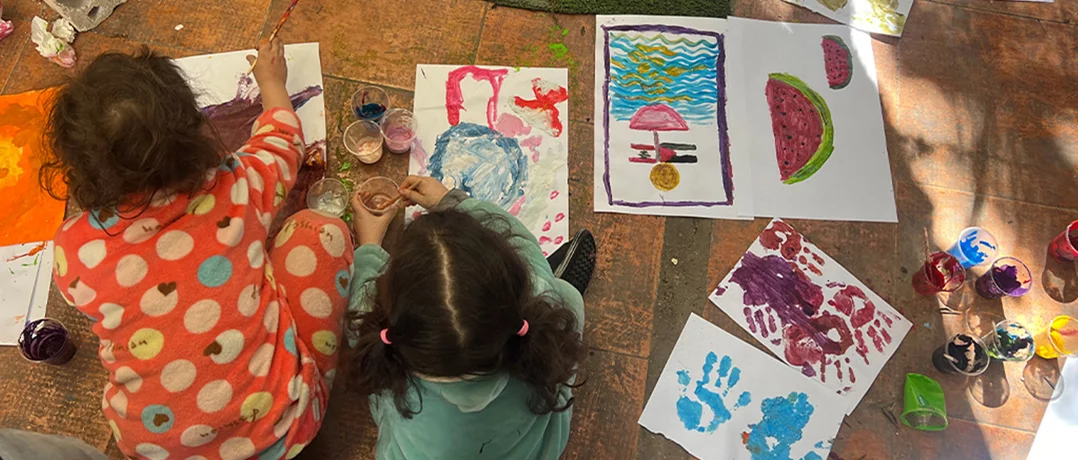
On a warm afternoon in Beirut’s Hamra neighbourhood, children sit cross-legged on the pavement with paintbrushes and pencils in hand. 5-year-old Leina is painting a set of stairs. Her older sister Zeina works carefully on a rose. And Aya has outlined a large purple heart. Around them, paintings of slices of watermelon, Lebanese flags, and mountain landscapes “from home” are scattered across the ground.
A few steps away, Sophia is walking a group of seven students through a series of addition and subtraction problems. Fatima, an 11-year-old from the south-eastern town of Houla, is particularly attentive to the equations on the board. She likes math, she explains, but her favourite subject is Arabic. Ali disagrees.
“Numbers are easy,” he says, “They always make more sense.”
For a moment, the scene in the courtyard could be mistaken for recess on any ordinary school day.
But the classrooms upstairs are filled with mattresses and blankets, and most of the children have not seen their schools, let alone their homes, in days. The latest round of fighting between Israel and Hezbollah has once again pushed Lebanon into war, sending families fleeing across the country under forced evacuation orders or out of fear of strikes.
The most recent statistics from Lebanon’s Disaster Risk Management Unit paint a sobering picture: more than 800,000 people have been displaced, with over 120,000 currently sheltering in schools and public buildings. In a country of roughly 5.8 million people, that means about 14 percent of the population is displaced.
For many of the children now gathered in the courtyard, the school has become both a classroom and temporary home.
Improvised classrooms
With classrooms now serving as sleeping quarters, volunteers have begun creating improvised learning spaces wherever they can. Education specialists often describe these efforts as improvised or temporary learning environments, a model widely used in conflict settings to help displaced children maintain routine when formal schooling is disrupted.
Upstairs and across the roof, new activities have emerged to keep the children engaged. One of them is athletic in nature: a kickboxing class led by Battoul, a two-time kickboxing champion in Lebanon.
Seven children stand before her, ranging in age from five to thirteen, as she guides them through a series of warm-up exercises. There’s jumping jacks, followed by crab walks from one wall to the other, and finally a sprint back and forth across the rooftop six times.
After the drills have concluded, Battoul begins demonstrating combinations, coaching them one-by-one “Higher, guard your cheeks,” she tells one of the participants, Mohammad. “Ok, good, yalla go!” He strikes her hand twice in concentration.
Battoul then turns to the entire circle of children, which has now grown to reach around 15 students and starts counting out the moves. “Wāḥid, tnēn, push kick!”
One student kicks so enthusiastically that he loses his balance and falls over. Moments later, the group briefly scatters to avoid an incoming basketball hurled by another student Abdul Rahim at the hoop on the edge of the roof. And to the left, a group of five girls playing hide and seek duck to keep clear of the shot.
It is only the second day that MMKIN, a Beirut-based NGO founded in 2010, has offered educational, art, and sports activities at the school. The structure of the sessions is still evolving.
“They have short attention spans, so we’re improvising!” Battoul explained.
Restoring routine
For the organizers running the initiative, the activities serve a purpose beyond simply keeping the children occupied. Under “normal” conditions, said Hala Habib, a board member and finance officer at MMKN, the organization offers academic support, psychosocial services, and vocational and technical education (VTE) across more than 100 public schools in Lebanon, focusing primarily on the country’s most vulnerable students.
But when the war began, those programs had to be rapidly reconfigured.
“When the war started, we had to shift really quickly,” said MMKN’s psychosocial support program manager, Yara Saba. Whereas educational support and art and drama therapy previously took place in structured classrooms led by professional teachers and trained art and drama therapists, conditions inside the shelter schools are different. With activities now run by a more diverse group of volunteers working with children across a wider range of ages, the sessions have shifted toward a more “unstructured” format, emphasizing creative outlets such as free drawing and movement-based games.
One such volunteer is Zeina, a Lebanese-Iranian clinical psychology student in her last semester at the American University in Beirut. Although she worked with MMKN before the war as part of an internship program, with classes now primarily online, she has begun volunteering on a more regular basis.
“It’s a meaningful use of my time,” she said, noting that even small activities can help life feel a bit more normal.
At the Hamra shelter school, the sessions are now held Monday through Thursday beginning at 11 a.m. Despite the improvised setting, the response from the children has been encouraging.
“The children are enjoying the activities. It helps them release energy and gives them a positive outlet,” Saba said.
Learning amid displacement
Across Lebanon, similar efforts are taking shape as organizations attempt to maintain some continuity in children’s learning during the war, echoing the emergency education responses seen at the outset of the 2024 escalation. During that period, humanitarian organizations and education partners such as Save the Children and the Norwegian Refugee Council set up temporary learning spaces in shelters and host communities as thousands of families fled their homes. Now, as the war continues to escalate, many of those same emergency education programs are being revived.
Research suggests these kinds of activities can play an important role for children living through conflict. A 2025 study published in the peer-reviewed journal The Arts in Psychotherapy found that even brief periods of structured play during displacement can help war-affected children regain a sense of safety while strengthening relationships with caregivers. More broadly, developmental research has long shown that play and creative activities support children’s emotional regulation, social skills, and resilience during periods of stress and upheaval.
Just ask the children now gathered on the roof. While Zeina’s favourite sport is swimming and Abdul Rahim prefers running, both agreed that kickboxing and basketball at the shelter school was a welcome change to their days indoors.
“It’s my first time doing kick-boxing,” Zeina said. “I want to try again tomorrow.”
For organizations like MMKN, the goal is not to replicate formal schooling but rather to preserve a sense of routine and engagement until students are able to return to their classrooms. For many children, these activities are the closest thing to a school day they have had since the war first broke out.
The cost of interrupted education
The consequences of disrupted schooling, however, can last long after the fighting ends.
Lebanon’s education system had already been under strain before the current war began, weakened by years of economic collapse, teacher strikes, and the COVID-19 pandemic. According to a UNICEF report released in February 2025, more than 500,000 children in Lebanon were already out of school even before the latest escalation of violence.
Education specialists warn that prolonged interruptions to schooling can carry lasting consequences. A 2023 report by UNESCO’s Global Education Monitoring (GEM) team found that extended school closures in fragile and conflict-affected settings often lead to steep declines in literacy and numeracy outcomes. Those losses are rarely evenly distributed, as students from lower-income households tend to fall the farthest behind, widening inequalities that can persist long after schools reopen.
With hundreds of schools now closed, damaged, or repurposed as shelters during the current conflict, those risks are once again unfolding across Lebanon. For displaced families living in collective shelters, the informal lessons and activities organized by volunteers and NGOs may be the only structured learning children encounter for weeks or months at a time.
Programs like the one run by MMKN have helped fill the gap, and the children have embraced the chance to paint, run, and learn again. But with this war showing few signs of abating, a central question remains. How much longer will these children be confined to schooling in shelters? For now, this is where the school day continues.
-
-

-
Katharine SorensenReporterSpecializing in global affairs, technology and economics, with a focus on on-the-ground investigative reporting.
-
