

Displacement in Lebanon has reconfigured daily life for children, affecting their schooling and safety and eroding any sense of stability.
The war’s youngest casualties

At the Jaber Ahmad Al Sabah school (JASS) in Hamra, cousins Domo’a and Lina linger in the fourth floor hallway, positioning themselves by the railing to take advantage of the afternoon sunlight that spills in. Both 17 years old, you would expect to find them at school on a Tuesday, learning trigonometry or maybe preparing for an upcoming exam.
But JASS is not their typical school, and neither is it a typical school day. In fact, nothing about Domo’a or Lina’s life at this moment could be described as typical.
Only thirty-six hours prior, both girls had fled their hometown of Chehabiyeh in Lebanon’s Saida district. They traveled twenty-two and twenty-four hours respectively by car with their families to Beirut in a journey that normally takes just two and half.
Cause of flight? Heavy Israeli strikes following rockets and missiles fired by Hezbollah, events which triggered a mass exodus from their village toward Lebanon’s capital.
As harrowing as their journey north was, it was not the first time Domo’a and Lina had been forced to flee their village. A year and a half earlier, when Israel invaded Lebanon in October 2024, they made a similar trip to Beirut with their families, spending just as many hours on the road to reach more secure accommodations. They even stayed at JASS then, for 66 days before it became safe to return home.
“This time, they moved up a floor!” Khiar, head of JASS’s displacement operations, joked. He had first met the girls during their prior displacement in 2024, when he also managed JASS’s emergency response activities. At the outbreak of the most recent war on Monday, he returned to his old post and continued coordinating the influx of displaced families.
Inside Lebanon’s shelters
Across Beirut, the scenes unfolding inside shelters like JASS reveal the scale of Lebanon’s new displacement crisis. JASS is one of 172 centers in Lebanon to receive displaced persons, according to data released by Lebanon’s Disaster Risk Management Unit. As of Wednesday afternoon, more than 65,000 displaced persons had been registered across the shelters, Lebanese Minister of Social Affairs Haneen Sayed said. Many of these shelters are schools, as their classrooms and hallways lend themselves easily to temporary dormitory use. In times of crisis, these schools work with the MoSA to manage relief distribution and verify registration of the displaced.
In addition to JASS’ coordination with the MoSA, Khiar explained that local organizations such as Ahla Fawda and Hadit Beirut have provided critical on-the-ground support, offering meals and hygiene supplies and organizing the daily Ramadan suhoor and iftar. Just a day earlier, UNICEF had also stopped by, delivering essential items and passing by every room to register the demographic makeup of the families they were hosting (# of children, persons with disabilities, etc).
The level of assistance, while admirable, is not sustainable, Khiar stressed. Many shelters are already operating at capacity and beginning to feel the strain on their resources. JASS itself is currently hosting 20 more displaced persons than its official allocation.
The use of schools as shelters furthermore places serious strains on Lebanon’s education system, and a dual disruption results: displaced children find themselves cut off from their schools, teachers, and classes, and are compelled to press pause on their regular education. At the same time, the children who typically attend these schools-turned-shelters are unable to continue their studies due to the schools’ repurposed role. It is a deeply destabilizing situation for all children involved.
On displacement’s edges
Yet not all displaced children end up at these shelters. There are those who never make the official displaced registry.
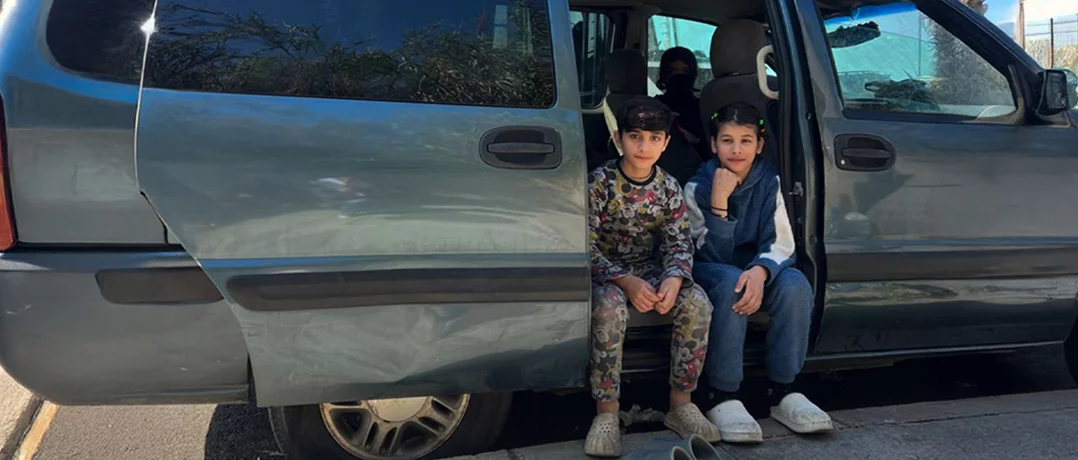
A fifteen-minute walk from JASS, Mohammad, Balsam, Yasmine, and Rafif sit in their family’s van along the Corniche, talking amongst themselves. At eleven years old, Mohammad is the most outspoken, introducing each of his three sisters and answering the questions with ease. He wears crocs and Mickey Mouse pajamas, the same pair he was wearing when his family left Dahiyeh the day before at 2:30am when the strikes first began.
They had fled in their van and headed to the Corniche, driving for four hours before they reached the waterfront. There, they joined hundreds of other displaced Dahiyeh residents who had made a similar trek.
As Mohammad chats animatedly, his parents Samer and Liliane watch on. They are seated on slightly torn, grey car seats which they had removed from the van to create a small sitting area next to the curb, and Samer is brewing some tea. Every night, he explains, the family of six pile into the van to sleep, arranging their bodies around their belongings and supplies.
At 2pm, the sun shines brightly over Beirut, offering a pleasant mid-afternoon warmth. But the last few nights have been cold, with temperatures reaching 50℉ /10℃. Liliane points to the blankets and extra jackets in the van.
“It’s not enough,” she says. “We get so cold sleeping at night.”
This, too, is not the first instance the family has found themselves on Beirut’s waterfront, pushed out from their homes by the repercussions of war. October 2024 had forced a similar overnight departure from Dahiyeh to this very stretch along the Corniche. Their story, like that of Domo’a and Lina, is one of a cycle of displacement, a repeating pattern that erodes any sense of stability, particularly for the kids.

Childhood under strain
The effect of war on children is not to be taken lightly. Its consequences are both immediate and long-term and accumulate with every new displacement.
A joint 2023 study by UNICEF and the London School of Economics found that children exposed to conflict are twice as likely to develop PTSD, three times more likely to develop anxiety disorders, and experience heightened separation anxiety and night terrors. The study furthermore documented that repeated exposure to explosions and displacement, two conditions Lebanon's children have endured extensively, raises cortisol levels in ways that hinder healthy brain development and long-term stress management.
As for the educational impact, a 2023 UNESCO report determined that children who lose one full academic year due to conflict see an average decline of 2-2.5 years in learning outcomes, meaning they fall more than one year behind after the initial year is lost. The same study noted that learning gaps widen over time, as many never fully meet standard literacy or numeracy benchmarks.
The displaced children of Lebanon are living that reality in real time. They are facing significant emotional and mental strain, not to mention the sustained interruption of their schooling.
In the absence of formal learning structure, these children take matters into their own hands, finding creative uses of their time. When not on Instagram or TikTok, Domo’a and Lina explain, they enjoy playing paddle in the school’s playground.
According to Khiar the two girls are “stars” on the paddle court, a statement which elicits smiles from them both.
Mohammad and his sisters, meanwhile, amuse themselves with running games along the Corniche or watching the waves crash against the rocks. Their laughter rings out across the waterfront, as they find delight in their improvised past-time.
Yet the children’s adaptability, while remarkable, is not a substitute for the safety and stability they deserve. Domo’a and Lina, like Mohammad, Balsam, Yasmine, and Rafif, and the thousands of other displaced children in Lebanon, should experience a childhood free from intermittent upheaval and the disruptions of war.
As the conflict continues to unfold across the Middle East, their stories serve as a reminder that war has a human cost. And that often a country’s most vulnerable population, its children, are the ones who bear the brunt of the fallout.
-
-
-
Katharine SorensenReporterSpecializing in global affairs, technology and economics, with a focus on on-the-ground investigative reporting.
-
