



Edma Abou Chdid, the first Lebanese woman to earn a medical degree, whose pioneering work transformed women's healthcare and opened the doors of medicine to generations of women.
The woman who changed medicine in Lebanon

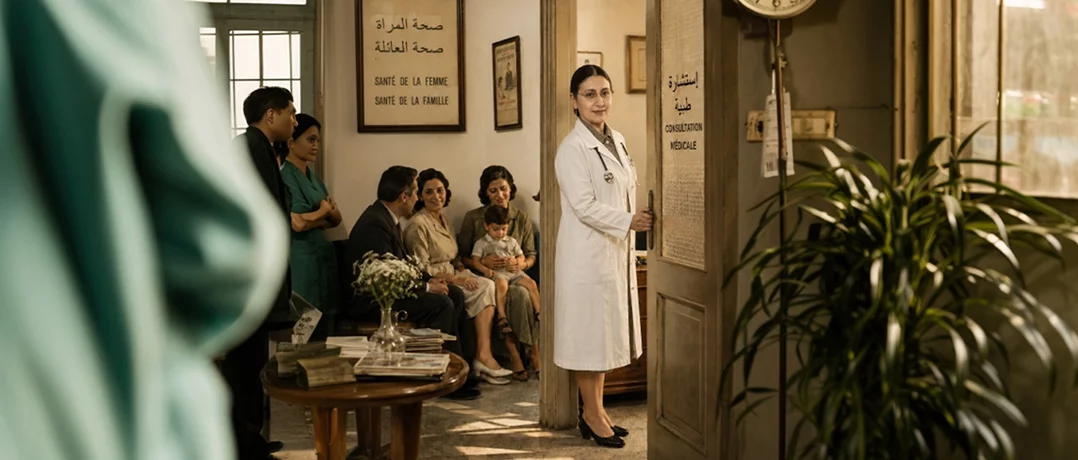
In the autumn of 1923, a fifteen-year-old Lebanese girl walked into her school principal's office with an announcement that seemed almost unimaginable for the time.
She wanted to study medicine.
The answer came without hesitation. Girls did not become doctors. Higher education for women remained rare in Lebanon, and medicine, with lecture halls filled almost entirely by men, was considered no place for a woman. The principal of the American School for Girls reportedly urged her to abandon the idea and instead wait for the husband her family would one day choose.
Edma Abou Chdid refused.
What followed would not only transform her own life but reshape the future of medicine in Lebanon. By becoming the country's first woman to earn a Doctor of Medicine degree, she opened a profession long closed to women, pioneered infertility treatment across the Middle East, and spent decades advancing women's health at a time when even discussing reproductive medicine publicly remained controversial.
A classroom that was never meant for her
Born in São Paulo, Brazil, in 1909 to a Lebanese family, Abou Chdid returned to Lebanon while still young. She grew up in a society where most girls were expected to marry rather than pursue higher education.
After graduating from school, she applied to the American University of Beirut (AUB). The obstacles appeared immediately.
Although she passed the entrance examinations, university regulations required medical students to meet a minimum age, which she had not yet reached. She reportedly added two years to her age to satisfy the requirement.
That was only the beginning.
The dean was unwilling to admit a single woman into a class of roughly seventy men. University officials agreed she could enroll only if another woman joined her.
For a moment, it seemed she had found a way in. Another prospective student from abroad was expected to arrive in Beirut and enroll alongside her. But when the ship reached port, the young woman never stepped ashore. She had chosen to remain in Palestine after meeting the man she would later marry.
Once again, Abou Chdid stood alone.
Rather than abandon her ambition, she appealed directly to the university. Convinced by her determination, the administration made an exception and admitted her as the medical school's only woman.
That single decision would change far more than one student's future.
In 1926, she earned a Bachelor of Arts from AUB, becoming one of its earliest female graduates. Five years later, in 1931, she broke another barrier by becoming the first Lebanese woman to earn a Doctor of Medicine degree.
For years, she remained the only woman in classrooms otherwise occupied entirely by men.
Transforming women's healthcare
With her medical degree in hand, Abou Chdid established one of Lebanon's earliest infertility clinics and joined the faculty of the AUB.
She challenged one of society's deepest assumptions by insisting that husbands and wives undergo medical evaluation alike, arguing that infertility was a medical condition affecting couples, not women alone.
For countless families, her clinic offered something medicine had rarely provided before: hope without blame.
Her reputation soon spread beyond Lebanon's borders. Patients traveled from across the Middle East, including members of several Arab royal families, seeking her expertise. As one of the region's leading infertility specialists, she helped establish Lebanon as a center for reproductive medicine and later served as Lebanon's national secretary to the International Fertility Association.
Her work transformed not only the treatment of infertility but also the way it was understood.
Fighting for women beyond the clinic
Abou Chdid understood that medicine could heal individuals, but lasting change required transforming the way society viewed women and their health.
In 1969, she helped establish the Lebanon Family Planning Association and became its first president. At a time when contraception remained socially taboo and legal restrictions discouraged public advocacy, the organization promoted maternal health, family planning and access to reproductive healthcare.
Abou Chdid built one of Lebanon's earliest family-planning movements. She launched public awareness campaigns, established free family-planning clinics, met with ministers and senior officials, and worked closely with the media to challenge long-standing misconceptions surrounding women's reproductive health.
Although she never succeeded in changing the law, she helped change the national conversation.
Determined to expand opportunities beyond the clinic, Abou Chdid also helped establish the Lebanese University Women's Association, serving as its first president and inspiring generations of women to enter universities and professions once considered beyond their reach.
A legacy measured in generations
Throughout her career, Abou Chdid earned numerous honors from Lebanon and international organizations in recognition of her contributions to medicine and women's rights.
She retired from medical practice in 1985 after more than half a century of service. In 1992, only months before her death, she was named International Woman of the Year by the International Biographical Centre in Cambridge and selected for inclusion in the World Who's Who of Women. She died on Oct. 11, 1992, at the age of 83.
Nearly a century after she first challenged convention, women entering Lebanon's medical schools no longer make headlines. They lead hospital departments, conduct pioneering research, perform life-saving surgeries and train the next generation of physicians.
Every Lebanese woman who has since entered a medical classroom has walked through a door Edma Abou Chdid was the first to open.
-
-
-
Michella RizkContent Manager/WriterFocusing on social affairs.
-
