



With up to 90% of natural catastrophe losses uninsured in emerging economies, rising premiums and coverage gaps threaten economic security and financial stability worldwide.
The world is running out of affordable insurance
The world is running out of affordable insurance
By The Beiruter | November 17, 2026

Reading time: 4 min
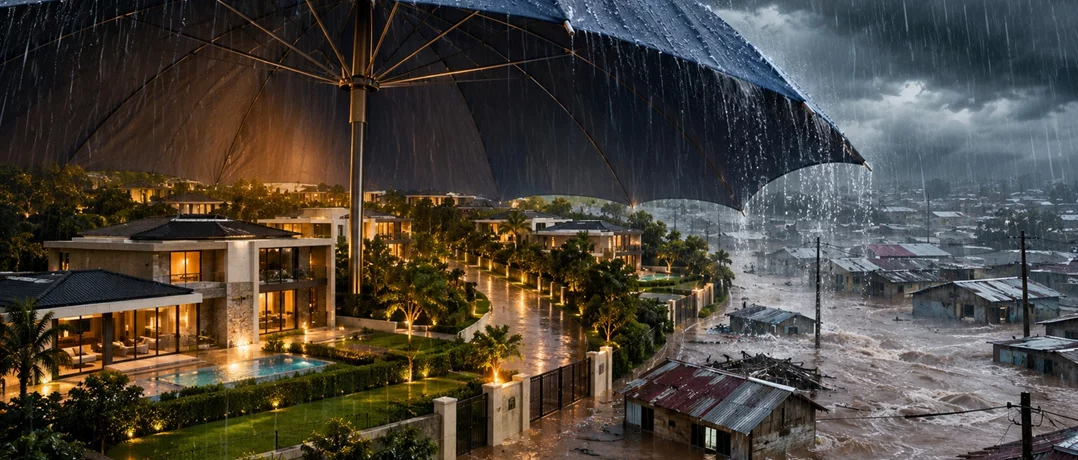
As natural disasters become more expensive, access to affordable insurance is becoming a critical determinant of economic security. Its availability can influence property values, business investment and government finances, while determining how effectively households and entire economies can recover from catastrophic losses. According to a March 2026 report by Swiss Re Institute, the research division of the Swiss-based reinsurance giant, between 80% and 90% of natural catastrophe losses in emerging economies remain uninsured, compared with 40% to 60% in developed markets. The disparity leaves countries with fewer financial resources bearing a disproportionate share of disaster recovery costs, even as the global insurance industry continues to expand. Yet the problem is not confined to developing economies. Rising premiums, changing risk assessments, and restrictions on coverage are raising concerns about the affordability of protection in wealthier markets as well. As insurers adjust to rising risks, the financial burden can shift toward households, businesses and governments least equipped to absorb it. Insurance markets are expanding, but growth in premiums does not necessarily translate into greater financial protection. The Organisation for Economic Co-operation and Development's (OECD) Global Insurance Market Trends 2026, published in November, found that non-life insurance premiums rose by an average of 8.7% in nominal terms and 4.1% after inflation in 2025 across reporting jurisdictions. These increases indicate that insurance costs are rising faster than inflation, adding to the cost of financial protection. One source of that pressure is the mounting cost of natural catastrophes. According to Swiss Re, global insured natural catastrophe losses reached $107 billion in 2025, continuing a long-term trend of annual increases estimated at 5% to 7% in real terms. Under this trajectory, insured losses could reach $148 billion in 2026 and $186 billion by 2030, driven largely by greater exposure in disaster-prone regions and changing natural hazards. Yet the pressures are not attributable to climate change alone. Swiss Re estimates that growing exposure, including the accumulation of buildings and infrastructure in vulnerable locations, accounts for more than 80% of the global upward trend in weather-related insured losses. For insurers, higher expected claims require corresponding adjustments in pricing and risk management. For customers, those adjustments can mean more expensive policies, larger deductibles, or less comprehensive protection. The disparity in insurance access is particularly pronounced between wealthy and developing economies. According to the OECD, total insurance premiums represented 6.7% of GDP in high-income jurisdictions in 2025, compared with just 0.7% in lower-middle-income jurisdictions. While much of the difference comes from life insurance, rather than catastrophe coverage specifically, the disparity underscores unequal insurance access. Limited coverage leaves households and businesses exposed to losses that can consume savings, interrupt operations and require borrowing. For governments with constrained budgets, disaster reconstruction can compete directly with spending on infrastructure, healthcare, and education. Even developed economies face substantial gaps. The European Insurance and Occupational Pensions Authority (EIOPA) reported in September 2026 that only around 25% of natural catastrophe losses in the European Union had been insured over recent decades. EIOPA identified several contributing factors, including consumers underestimating their exposure, concerns about affordability and expectations of government compensation. Rising premiums in high-risk areas can further discourage insurance purchases. The figures complicate the assumption that economic development automatically guarantees financial protection. Insurance may be widely available in national markets while remaining inaccessible or unattractive to households facing particular risks. The consequences of underinsurance can spread through an economy long after the immediate destruction has been assessed. When uninsured properties are damaged, homeowners may struggle to repay mortgages while financing reconstruction. Businesses can face interrupted revenues, damaged collateral, and additional borrowing requirements. Banks exposed to affected borrowers may subsequently experience deteriorating loan quality. The International Association of Insurance Supervisors examined these risks in its November 2025 research on natural catastrophe protection gaps, warning that uninsured losses can generate vulnerabilities across financial institutions and the wider economy. These pressures can influence investment even before a disaster occurs. Properties facing expensive or uncertain insurance coverage may become less attractive to buyers and lenders, while businesses considering projects in vulnerable regions must account for potentially substantial uninsured liabilities. Governments face difficult choices as the costs of insuring catastrophe risks rise. Subsidizing premiums can preserve access to coverage, but may impose growing demands on public finances. Leaving insurance entirely to private markets can instead expose vulnerable households and businesses to losses they cannot absorb. Public-private insurance arrangements offer one alternative, distributing certain catastrophe risks between insurers and the state. Yet these arrangements still require decisions about the allocation of costs and government guarantees. Reducing the underlying risks may offer a more sustainable response. Stronger building standards, flood defenses, improved land-use planning and investment in adaptation can limit future damage and help contain insurance costs. As disaster exposure grows, affordable insurance will influence not only how economies recover from catastrophes, but where households can live, businesses can invest and banks can lend. Without greater access to financial protection and more effective risk reduction, the economic consequences of disasters could become concentrated among those least able to bear them.The rising price of protection
An unequal market for security
When insurance gaps threaten financial stability
The limits of private protection
-
-

-
The Beiruter
-
