



Futurist Carsten Beck explores how embedded AI, a shifting world order, demographic change and economic constraints are reshaping the future and how leaders can prepare.
The World Megatrends and the future of Constrained Economy
The World Megatrends and the future of Constrained Economy
By Peter Thommen | October 07, 2026

Reading time: 5 min
«People look at megatrends and don't feel uncomfortable enough.» The marketing strategist and author John Grant said this during a strategic foresight project in 2005, and the observation has stayed relevant ever since. The term megatrend was popularised by futurist John Naisbitt in his 1982 bestseller Megatrends, and it has come to mean large, slow-forming shifts that, once in place, reshape society for years or decades.
There are, however, two areas where the discomfort is particularly real. The first is technology. Its impact on society has always been with us and repeatedly made the headlines: the internet, then social media and smartphones, the digitalisation and now AI. The latest wave, embedded AI, has become a megatrend in its own. The second is geopolitics, where globalisation is giving way to a world pulling apart. And both create huge uncertainty.
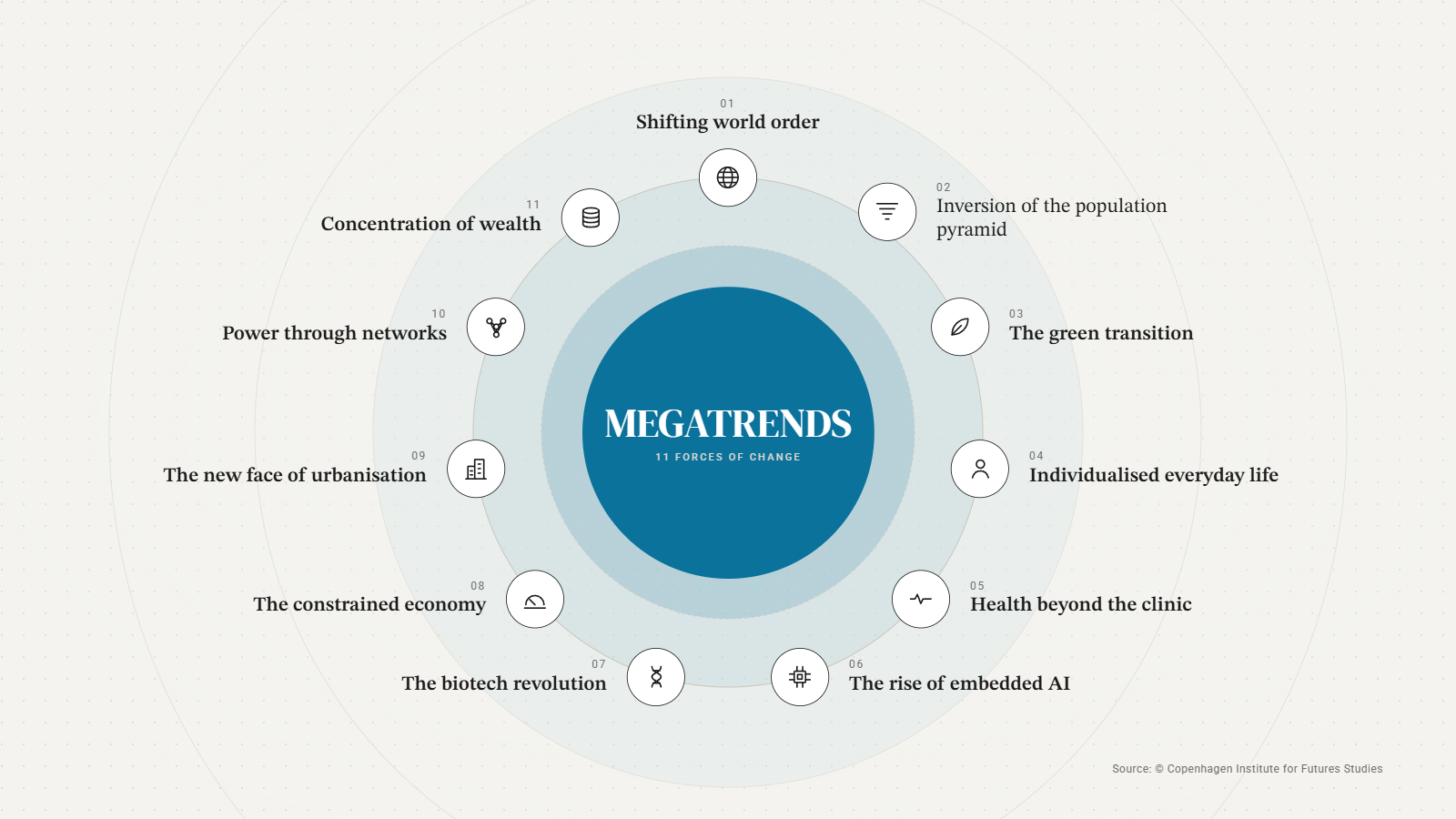
Now that everybody is talking about «the rise of embedded AI» and «the shifting world order», the Copenhagen Institute for Futures Studies (CIFS), an independent and world-leading non-profit futures think tank, has updated its megatrend framework. Carsten Beck, one of Denmark's most sought-after futurists and a prominent CIFS voice on megatrends, shared exclusively his insights with the Beiruter.
Fewer megatrends, not a simpler world
Carsten’s concern is that in everyday language almost anything popular gets called a megatrend. If everything is a megatrend, the word stops meaning anything. CIFS has therefore not only published its updated megatrends but also revisited the definition and how they are constructed. It now describes megatrends as «durable, directional structural forces» that persist for decades and reshape the conditions in which societies, individuals and organisations operate. To keep the term meaningful, every candidate must pass seven gates so that short-lived hypes and fashion trends do not qualify.
When the previous update in 2022 ended at 15 megatrends, Carsten's comment was: «One megatrend is that there are more and more megatrends.» Now there are 11. Does that make the world less complex? Not at all, he says. The number itself is one of the most difficult questions: what really belongs together, and what should be kept separate? The aim is to present and communicate the megatrends as clearly as possible. This time the choice was fewer. In demographics, for example, the two earlier megatrends «population growth» and «an ageing world» became one: «the inversion of the population pyramid», combining falling fertility, ageing, migration pressure and growing dependency burdens.
Two forces, many open questions
Has the world become more uncertain since the last update? Two megatrends suggest so. They can be seen as super-trends: they influence many of the others, and there is little doubt that they will heavily impact societies. Yet what they will mean is wide open. And when the outcome of forces that drive so many others is uncertain, the uncertainty spreads.
I. The shifting world order
The chapter opens with a line from UN Secretary-General António Guterres: «We are moving to a multipolar world, but we are not there yet.» The report describes the erosion of the US-led unipolar order and its replacement by an emerging multipolar one, in which no power holds uncontested authority over the rules, institutions and norms of international affairs. China's rise is central, but so are middle powers such as Türkiye, Singapore and India, which increasingly align with different sides depending on their interests.
“Military spending is growing worldwide, and technological leadership has become a rivalry. CIFS concludes that expected peace is giving way to a world where conflict, direct and indirect, is more persistent, though not inevitable. The outcome will be shaped not only by Washington, Beijing and Moscow, but by dozens of states hedging between them.”
Asked whether a world pulling apart is a countertrend to globalisation or the new megatrend, Carsten pointed to both developments. The US dollar is still the world's dominant currency, meaning that deglobalisation cannot simply be called a megatrend. What has no historical precedent, he adds, is private companies influencing geopolitics, mentioning Elon Musk's Starlink supporting Ukraine's defence as an example.
II. The rise of embedded AI
Generative AI is already being used to guide couples, inform medical decisions, help with parenting and keep lonely people company.
“CIFS sees AI moving from a tool to infrastructure, embedded in more and more of life, society and the economy. The result is a «reshuffling» of human and machine capabilities: AI lowers the economic value of individual tasks and triggers a revaluation of human competencies.”
AI companionship is still outside the norm. But norms around technology have shifted before. In an AI-mediated future, it is unclear what will become taboo and what will become acceptable.
The report notes that AI capabilities advance fast but unevenly, making simple extrapolation misleading. And infrastructure is designed and governed, so ownership matters. The future depends on choices between open and closed ecosystems, augmentation and passive dependence, distributed and concentrated control.
What both the shifting world order and embedded AI will mean is hard to predict, and both influence many other megatrends. Yes, the world has become more uncertain.
Where else the big shifts are
Carsten points to two further developments. The first is the move from «economic growth» to «the constrained economy». The world needs growth, he says, but whether it will come is increasingly open to question. The report asks whether rising public debt and underfunded pension systems will limit fiscal space and slow growth, particularly in ageing and highly indebted countries.
The second is «the green transition». The report ends this chapter on public resistance: costs are felt immediately, in fuel prices and lost choices, while benefits feel distant, so backlash follows. Farmers block highways, yellow vests fill the streets, and governments walk back commitments. None of this reverses the transition, the report says, but it shapes how it proceeds: slowly, unevenly and through friction. Carsten's question is how strong that resistance will grow.
What the megatrends tell us, and how to use them
The value of a megatrend is not that it tells us what will happen. It tells us which forces are becoming sufficiently structural that the question is no longer whether they exist, but what their consequences will be. AI becoming embedded in everyday life is no longer in serious question. What it will mean for jobs, relationships, productivity, competition and power is. The same applies to the shifting world order.to
Megatrends create awareness and, as these are societal movements, invite all to participate in shaping the future rather than simply reacting to it. The future of AI, for example, should not be left to the tech giants.
For leadership, this is about the third time horizon. Not about reacting to today, the first, and not about planning next year's budget, the second. It's about building the future over the next 5–10 years. Carsten’s s final remark was that Megatrends are too broad and too distant to translate directly into strategies and business plans. They feed into the trends that matter in each industry, market and geography. And they enable scenarios and decisions aligned with the shifts that shape the future.
The forces are clear. What they mean is not. Leaders will be judged by how well they prepare for that gap.
-
-

-
Peter ThommenColumnistFinance-rooted Futures Strategist with 30 years of international leadership experience at IKEA, including 25 years in C-level and board roles across Finance, Strategy and Global Business Services.
-
