



From Venezuela's vast reserves to the Strait of Hormuz and Europe's dependence on American diesel, the events of 2026 reveal how control over oil depends on far more than geological wealth.
The world's oil is not always where the power lies
The world's oil is not always where the power lies
By The Beiruter | October 11, 2026

Reading time: 6 min

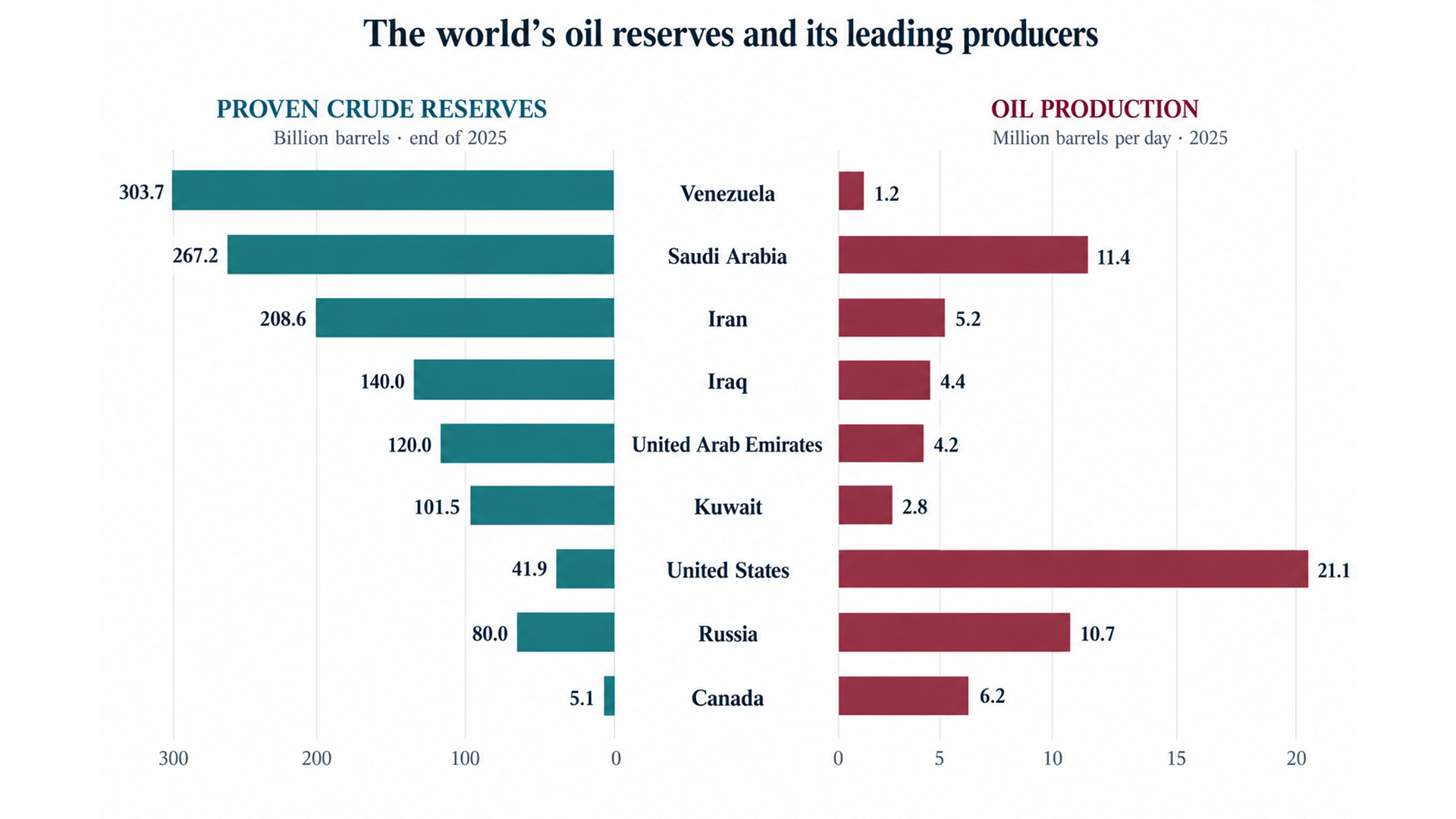
The world's largest oil reserves lie beneath Venezuela, but the United States has spent much of 2026 demonstrating that ownership of oil and control over its sale are not necessarily the same thing. Following the American operation that removed President Nicolás Maduro in January, Washington began asserting authority over Venezuelan oil sales and revenues. In August, a new agreement gave the US government an ownership stake and purchasing rights in a company granted access to 65 billion barrels of Venezuelan reserves. Yet converting those reserves into substantial new production could take years. Just two months after Maduro's removal, another confrontation would expose a different vulnerability in the global oil market: as the war involving Iran disrupted shipments from the Persian Gulf, the immediate concern was no longer how much oil lay underground, but how much could reach international buyers. Roughly one-fifth of global petroleum liquids consumption normally passes through the Strait of Hormuz, according to the US Energy Information Administration, making a narrow stretch of water indispensable to some of the world's largest oil producers and consumers. From Venezuela to the Persian Gulf, the events of 2026 have brought competing forms of control over the world's most important energy commodity into unusually sharp focus. Possessing oil, producing it and reliably delivering it to consumers are different forms of economic power, and they are not always held by the same countries. Beneath the world's oil-producing regions lies a remarkably uneven distribution of reserves. According to OPEC's Annual Statistical Bulletin 2026, Venezuela held 303.7 billion barrels of proven crude reserves at the end of 2025, followed by Saudi Arabia with 267.2 billion and Iran with 208.6 billion. Iraq held 140 billion, the UAE 120 billion and Kuwait 101.5 billion, giving the six countries more than one trillion barrels combined. Yet proven reserves do not guarantee production. Despite possessing nearly a fifth of the world's proven crude reserves, Venezuela produced only around 1.2 million barrels per day in August 2026, compared with approximately 14 million barrels per day of crude in the United States. The world's largest oil reserves are not necessarily held by its largest producers. Sources: OPEC, Annual Statistical Bulletin 2026 (reserves); Energy Institute, Statistical Review of World Energy 2026 (production). Figures are for 2025, except Venezuela’s August 2026 production. Canadian reserves exclude oil sands. Underinvestment, deteriorating infrastructure and sanctions have constrained Venezuelan production, but its vast reserves remain strategically valuable. Following Maduro's removal, Washington has sought a direct commercial role in their development and sale. Under the August agreement, North American Blue Energy Partners received 100-year concessions covering 17 oilfields. The US government secured a 35% stake in its parent company, alongside a guaranteed share of production and priority purchasing rights over additional output. Although sovereignty over Venezuela's reserves remains unchanged, the agreement gives Washington commercial influence over their development, even as substantial investment remains necessary. The United States has become the world's largest oil producer without possessing anything close to its largest reserves. The Energy Institute's Statistical Review of World Energy 2026 recorded American production of approximately 21.1 million barrels per day in 2025, including crude and other petroleum liquids. The shale industry has allowed the United States to achieve this position despite holding substantially smaller proven crude reserves than Venezuela or Saudi Arabia. Saudi Arabia's influence rests on a different advantage. Alongside its enormous conventional reserves, the kingdom’s extensive infrastructure and capacity to adjust production give it considerable influence over international supply. Russia, meanwhile, has maintained major export relationships despite Western sanctions, redirecting much of its oil toward Asian buyers following its invasion of Ukraine. Iranian oil has also continued to reach international markets under sanctions, particularly through sales to Chinese refiners willing to purchase discounted cargoes. Restrictions on financing, shipping and insurance have influenced both the buyers available to Tehran and the prices it can obtain. In an oil market increasingly governed by political restrictions as well as commercial demand, the ability to maintain access to buyers can be as consequential as the capacity to extract another million barrels. The world's most important oil-exporting region also contains one of its most consequential geographical bottlenecks. Saudi Arabia, Iraq, Kuwait and the UAE possess enormous reserves, but much of their production must travel through the Strait of Hormuz before reaching customers abroad. The US Energy Information Administration estimated that approximately 20 million barrels of petroleum liquids passed through Hormuz daily in 2024, equivalent to roughly one-fifth of global consumption. Saudi Arabia and the UAE operate pipelines that bypass the strait, but their capacity cannot replace the volumes normally transported through it. Since the Iran war began in February, attacks, shipping restrictions and damage to energy infrastructure have interrupted those flows. Although Middle Eastern exports have recovered substantially, Reuters reported on October 8 that shipments through Hormuz were averaging around 12 million barrels per day, approximately 80% of prewar levels. The effects are particularly acute for Asian economies, which purchase much of the Gulf's exported crude. China and India must secure sufficient volumes while also accounting for differences in crude quality, refinery requirements and the availability of shipping. The war's consequences have reached well beyond countries purchasing oil directly from the Persian Gulf. Europe, which reduced its dependence on Russian energy following the invasion of Ukraine, now faces shortages of refined fuels and pressure from another major supplier, the United States. The Energy Institute's 2026 review found that imports supplied approximately 86% of India's oil consumption in 2025, compared with 73% for China and 75% for Europe. In October, those vulnerabilities became an instrument of transatlantic diplomacy. The Trump administration warned France and Germany that they could face restrictions on American diesel exports unless they released emergency fuel inventories to help ease soaring prices caused by the Iran war. On October 2, the Group of Seven (G7), which brings together seven of the world's major advanced economies, agreed to coordinate the release of 100 million barrels of crude and diesel over four months, with an emphasis on making diesel available early. Trump subsequently withdrew the export-ban threat. France announced on October 7 that it would contribute 10 million barrels of diesel. The International Energy Agency later clarified that the G7 plan would draw on commitments already announced in March rather than represent an additional 100 million barrels. Europe had sought greater security by reducing dependence on Russia and purchasing more fuel from alternative suppliers, including the United States. Washington could nevertheless use its position as a major diesel exporter to pressure European governments over their emergency reserves. The episode illustrates a difficult trade-off for oil-importing economies. Diversifying suppliers reduces dependence on individual producers, but cannot eliminate exposure to shipping disruptions, refining constraints or political pressure. Even as Gulf exports recover, the crisis will force governments to weigh investments in storage, pipelines, refining capacity and diversified import contracts against the risk of future disruptions. For countries dependent on imported petroleum, energy security ultimately rests not on the quantity of oil available somewhere in the world, but on how reliably they can obtain the particular supplies their economies require.Where the oil is
Who supplies the market
How oil reaches consumers
Who depends on whom
-
-

-
The Beiruter
-
