

As Lunar New Year begins, the Year of the Fire Horse frames the Spring Festival as a time of renewal, movement, and intention.
The Year of the Fire Horse

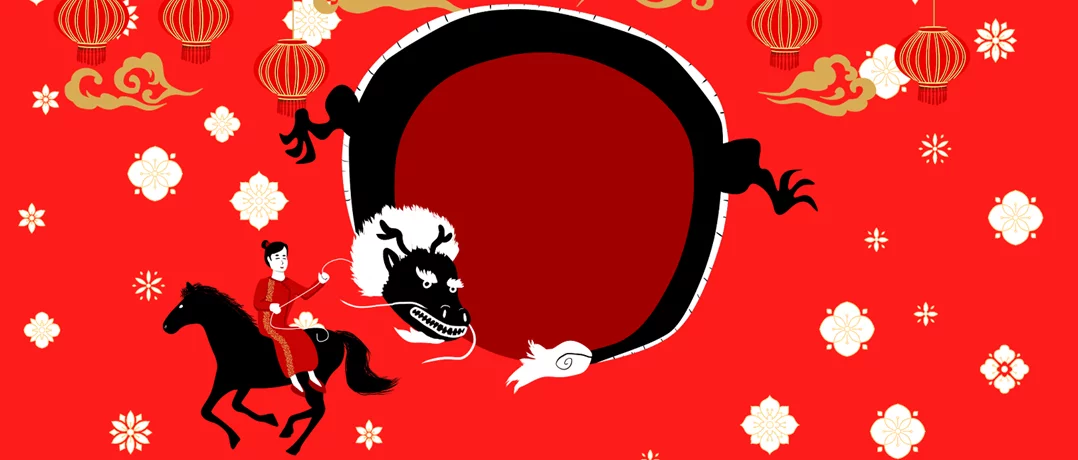
Illustration by Karim Dagher
Across China and in Chinese communities around the world, Lunar New Year begins. For 15 days, the world slows down to honor memory, ancestry, and renewal. This year, we gallop into the Year of the Fire Horse. But Lunar New Year is a philosophy disguised as a festival.
A calendar written in animals
The Chinese zodiac moves in a 12-year cycle: Rat, Ox, Tiger, Rabbit, Dragon, Snake, Horse, Goat, Monkey, Rooster, Dog, Pig. Each year pairs an animal, an earthly branch, with one of five elements, the heavenly stems: Wood, Fire, Earth, Metal, Water.
2026 is governed by Bing Wu, the Fire Horse. The Horse symbolizes movement, independence, stamina, and freedom. It is associated with momentum, travel, ambition, and restless energy. When paired with Fire, the element of passion, visibility, and transformation, the year intensifies.
Historically, Horse years are associated with social shifts, economic movement, and cultural acceleration. Fire adds drama, but also illumination. It burns away what is stagnant.
The monster called Nian
Like all meaningful traditions, Lunar New Year carries myth. The legend of Nian tells of a beast that emerged every New Year’s Eve to terrorize villages. With sharp teeth and horns, it thrived on fear, until an old man discovered its weakness.
Nian feared three things: The color red. Fire. And loud noise. Villagers began hanging red banners, lighting firecrackers, and wearing scarlet clothing. The monster never returned. Even today, red envelopes (hongbao), crimson lanterns, and explosive fireworks dominate the holiday.
The reunion dinner
On Lunar New Year’s Eve, families gather for what may be the most important meal of the year. Dumplings are served, for they resemble gold ingots. Longevity noodles are eaten uncut, symbolizing a long life. Each dish is a coded message to the universe: abundance, health, prosperity. But beyond symbolism lies something deeper. In modern China, the Lunar New Year migration is the largest annual human movement on Earth. Millions travel across provinces and continents to return home.
The temple and the stars
For many, the new year is also a time to consult the heavens. The Tai Sui, celestial deities aligned with Jupiter’s orbit, are believed to influence fortune in the coming year. Some zodiac signs may clash with the year’s ruling energy; others may harmonize with it. Visiting temples on the third day, known as “Red Mouth Day,” helps offset potential conflict. Whether taken literally or symbolically, the ritual reflects the human need to locate meaning in the stars. After all, we look up when we are unsure.
The people’s birthday and the lantern light
On the seventh day, communities celebrate “Renri”, the birthday of humanity, when the goddess Nuwa is said to have created people. It is a reminder that before we are divided by nation, language, or generation, we share origin. On the fifteenth day, the Lantern Festival closes the Spring Festival under the first full moon of the year. Lanterns float into the night, symbols of light overcoming darkness, winter giving way to spring. In ancient China, it was the only night young women could freely go out and meet potential partners. A rebellion disguised as festivity. Hope often hides inside celebration.
What the Fire Horse asks of us
A Fire Horse year is said to favor boldness, innovation, and personal independence, but it also warns against recklessness. Fire illuminates, but it also consumes. In 2026, the message feels timely. Move, but move wisely. Be visible, but be intentional. Chase ambition, but protect what matters. The Fire Horse reminds us that progress requires both speed and direction.
And perhaps that is why Lunar New Year endures, not only in China, but in Korea, Singapore, Malaysia, Vietnam, and across global diasporas. As the new moon rises on February 17, millions will light fireworks to chase away their own versions of Nian. And somewhere between the noise and the glow, between myth and astronomy, a truth remains: Every year gives us a chance to run differently.
-
-

-
The Beiruter
-
