



On February 17, 2026, a rare annular solar eclipse will create a “ring of fire” over Antarctica. Here’s what makes this celestial event unique, how it works, and why eclipses still captivate humanity.
The ‘Ring of Fire’ solar eclipse happening tonight!
The ‘Ring of Fire’ solar eclipse happening tonight!
By The Beiruter | February 17, 2026

Reading time: 3 min
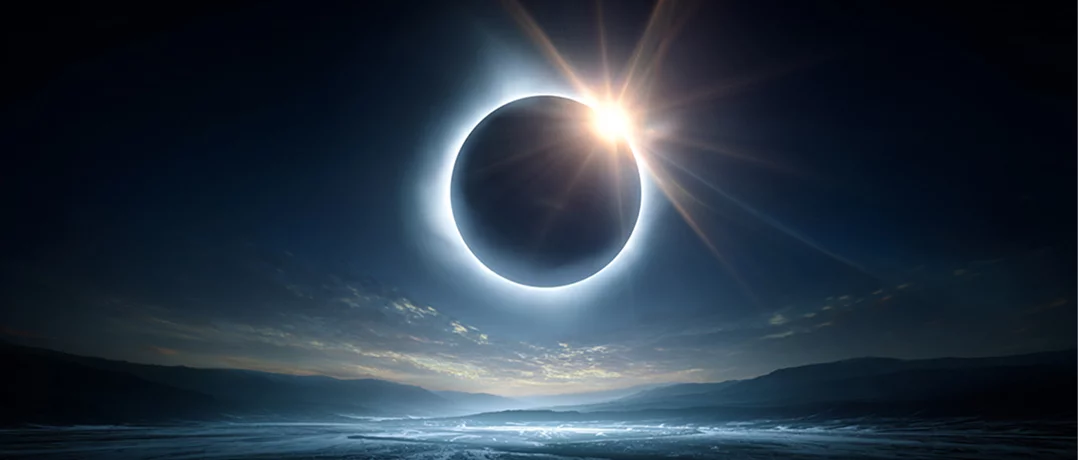
On February 17, 2026, the world will witness a rare celestial spectacle. An annular solar eclipse will carve a luminous path across Antarctica, creating what astronomers call the “ring of fire”, a bright halo of sunlight suspended around the Moon’s dark silhouette. The phenomenon is brief, lasting just over two minutes at its peak. But like most rare cosmic events, its impact far outlives its duration.
What makes this eclipse different?
Unlike a total solar eclipse, where the Moon completely blocks the Sun, an annular eclipse happens when the Moon is slightly farther from Earth in its orbit. That extra distance makes it appear smaller in the sky, just small enough that it cannot fully cover the Sun. Instead, a thin, blazing circle of sunlight remains visible around the edges.
The result is dramatic:
A glowing ring that appears almost artificial, suspended against the sky. It is this effect that has earned the eclipse its nickname: the “ring of fire.” The annular phase is expected to last around two minutes and twenty seconds at maximum.
Expert opinion
To better understand the science behind the February 17 annular solar eclipse, The Beiruter spoke with environmental expert Doumet Kamel, who explained the phenomenon in simple terms. “This is part of the natural planetary cycle,” Kamel said. “A solar eclipse occurs when the Moon moves between the Earth and the Sun.”
In the case of an annular eclipse, he explained, the Moon is positioned at its farthest point from Earth in its orbit. Because of that distance, it appears slightly smaller in the sky. “When the Sun is behind the Moon, the Moon does not fully cover it,” he said. “The Moon is smaller than the Sun from our perspective, so a ring of sunlight remains visible around it.”
According to Kamel, eclipses are purely astronomical events. “It does not affect human beings, living organisms, or the environment,” he said. “It is simply a visual phenomenon, a sight to behold.”
When asked whether the eclipse would be visible from Lebanon, Kamel noted that visibility depends on both geographic positioning and weather conditions. “In Lebanon, especially with thick cloud cover, it may not be visible,” he explained. “Weather plays a major role in whether we can observe such events.”
Kamel stressed one key piece of advice: “My advice is not to look directly at the Sun.” Even during an eclipse, looking at the Sun without proper protective eyewear can cause serious and permanent eye damage.
Why events like this still captivate us
Eclipses have always carried symbolic weight. Ancient civilizations saw omens. Scientists see orbital mechanics. The rest of us see something harder to name, a reminder of scale. In a world saturated with artificial light and constant notifications, a rare alignment of celestial bodies still manages to command silence. Even if the “ring of fire” burns over Antarctica, far from our horizon, the reminder is universal: the sky is still capable of surprise.
-
-

-
The Beiruter
-
