

A closer look at Mike Huckabee’s remarks and the renewed debate over “Greater Israel,” tracing its roots, regional backlash, and implications for sovereignty and Middle East stability.
The “Greater Israel” controversy reignited

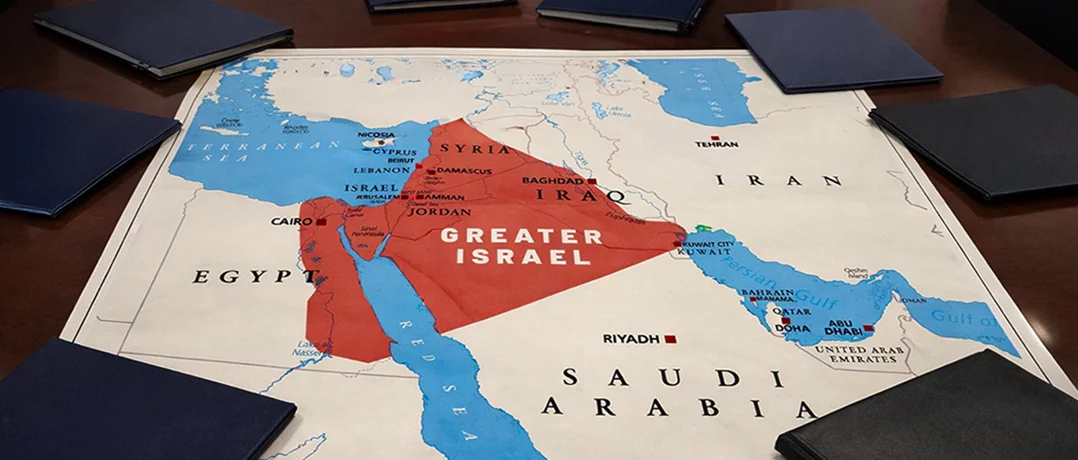
Recent remarks by the United States (US) Ambassador to Israel Mike Huckabee have ignited a diplomatic storm across the Middle East.
In an interview with conservative commentator Tucker Carlson, Huckabee suggested that “it would be fine” if Israel were to take control of land stretching across much of the Middle East, invoking biblical references to territory promised to the descendants of Abraham. Although he later characterized his statement as somewhat hyperbolic and insisted that Israel was not actively seeking territorial expansion, the damage had already been done. Arab and Muslim states swiftly condemned the comments, describing them as inflammatory, legally baseless, and threatening to regional stability.
Beyond the immediate controversy, Huckabee’s remarks revived a long-standing and deeply contentious concept: “Greater Israel.”
What is “Greater Israel”?
The concept of “Greater Israel” has varied interpretations. In its broadest form, it derives from biblical passages describing land promised to Abraham’s descendants “from the river of Egypt to the Euphrates;” Genesis 15 in the King James Version (KIV) clearly states, “In the same day the LORD made a covenant with Abram, saying, Unto thy seed have I given this land, from the river of Egypt unto the great river, the river Euphrates.” In modern political discourse, it has been used by some nationalist and religious Zionist movements to advocate retaining or expanding Israeli control over territories captured in the 1967 Six-Day War (also referred to as “Naksa,” which saw Israel swiftly seizing Arab territories from Egypt, Jordan, Syria, and Palestine) and, in more expansive visions, beyond.
Historically, figures such as Theodor Herzl (an Austro-Hungarian Jewish journalist and the father of modern political Zionism, advocating for the establishment of a Jewish state referenced expansive territorial aspirations in early Zionist writings. After the 1967 war, movements advocating permanent control over the West Bank and Gaza gained traction.
The idea re-emerged periodically in political rhetoric, including statements by members of Israel’s current governing coalition. In August 2025, Israeli Prime Minister Benjamin Netanyahu publicly stated that he felt “very much” connected to the vision of “Greater Israel,” though interpretations of his remarks vary. For some proponents, the term refers narrowly to maintaining control over territories occupied in 1967; for others, it evokes a far broader geographical scope.
Significance and consequences
The significance of Huckabee’s comments lies not merely in their content but in their source. As the official representative of Washington in Tel Aviv, his words are inevitably interpreted as reflecting, or at least influencing, US foreign policy. At a time when ceasefire negotiations in Gaza remain delicate and tensions simmer along Israel’s borders with Lebanon and Syria, such statements risk inflaming already volatile dynamics.
The backlash was swift. Governments including the KSA, Egypt, Jordan, Kuwait, Oman, and the United Arab Emirates (UAE) denounced the remarks. Regional organizations such as the League of Arab States (LAS) and the Organization of Islamic Cooperation (OIC) described the comments as extremist and contrary to international law. Egypt characterized them as a “blatant violation” of legal norms, reaffirming that Israel has no sovereignty over occupied Arab territories.
Arab governments argue that invoking religious justifications for territorial claims risks transforming political disputes into civilizational conflicts. When borders become framed as matters of divine mandate rather than negotiated settlement, the space for compromise narrows dramatically.
These reactions reflect more than diplomatic indignation. They reveal deep-seated anxieties about territorial integrity and sovereignty. In a region marked by wars, shifting borders, and fragile state institutions, rhetoric suggesting expansion across recognized international boundaries evokes existential concerns.
The imperative of rejecting expansionist ideologies
The controversy surrounding Huckabee’s remarks highlights a broader normative issue: the rejection of expansionist and ideological projects not grounded in international law. Modern international order rests on the principles of territorial integrity and the self-determination of people. Any claim to sovereignty based primarily on ancient texts or theological interpretation stands in contrast with these norms. From here, The Beiruter reached out to Lebanese historian Dr. Issam Khalife to better understand and analyze these statements and emerging dynamics.
Khalife notes
such remarks reflect longstanding expansionist ambitions within the Zionist right, which historically draw on Biblical and Talmudic narratives.
While Israel’s demographic limitations make such territorial expansion unrealistic, he believes that these myths (documented by Israeli academics like Shlomo Sand, who highlighted claims of a “land from the Nile to the Euphrates”) continue to influence ideological narratives.
Hoping that Trump and Washington’s foreign policy do not fully align with that of Israel in the coming period, Khalife added:
What’s remarkable here is that such statements were made by the US ambassador
Khalife also argued that Lebanon and the broader Arab world must address this threat through strategic and intellectual means rather than reverting to sectarian or tribal divisions. The Lebanese state, supported by international allies, must defend its sovereignty, independence, and borders against any potential threat, regardless of its origin. Khalife notes as well that the founding figures of Zionism, including Bernard Lewis, have historically sought to reshape the region along tribal and clan lines.
Is there an official Israeli policy concerning fulfilling this project?
Despite recurring references in political discourse, there is no formal Israeli government policy declaring an intention to establish a state stretching from the Nile to the Euphrates. Israel’s official positions have evolved through wars, treaties, and diplomatic negotiations. The Sinai Peninsula was returned to Egypt under the 1979 Camp David Accord (the peace treaty between Cairo and Tel Aviv), and Israel withdrew from Gaza in 2005 in light of its Disengagement Plan as well as from Lebanon in the year 2000 (although the Shebaa Farms, and Kfarchouba Hills remain contested).
However, policies regarding settlement expansion in the West Bank, legalization of outposts, and administrative integration of certain territories have fueled perceptions of de facto annexation. While some ministers advocate maximalist visions, others highlight security considerations over ideological expansion.
Thus, “Greater Israel” functions less as a formal state doctrine and more as a symbolic and ideological reference point within segments of Israeli politics.
To conclude, for Palestinians, the prospect of annexation undermines aspirations for statehood. For Lebanon, Syria, Jordan, and others, expansive territorial rhetoric threatens their sovereign identity. Even for Israel, pursuing such visions would likely entail perpetual conflict and international isolation. Ultimately, safeguarding Lebanon’s national interests requires proactive political and civic engagement, rather than passive reliance on external forces, highlighting a collective responsibility to counter expansionist ambitions while maintaining stability in the region.
-
-

-
The Beiruter
-
