



Lebanon’s bread bundle has evolved from a heavily subsidized staple into a reflection of the country’s economic collapse, tracing the impact of currency devaluation, wheat shortages, war, subsidy cuts and rising production costs from 2019 to today.
Through crisis and war: The journey of Lebanese bread
Through crisis and war: The journey of Lebanese bread
By Jessica Habchy | October 09, 2026

Reading time:
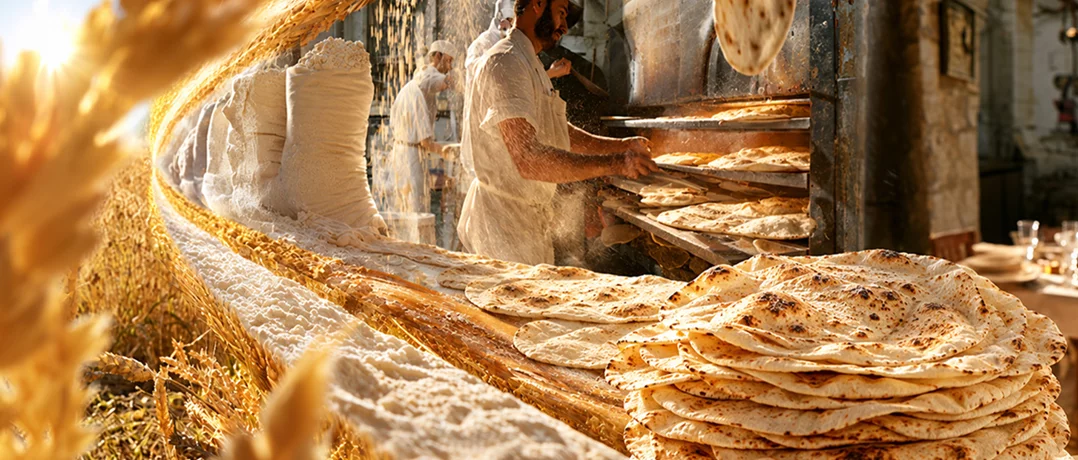
For years, the Lebanese bread bundle was one of the few basic goods the state tried to protect from the full force of the country’s economic collapse. But since 2019, it has passed through almost every crisis Lebanon has faced: the fall of the lira, subsidy policies, fuel shortages, bread queues, the Beirut port explosion, the war in Ukraine, rising production costs and, more recently, renewed regional conflict.
In 2019, a 900-gram bundle sold for LBP 1,500. Today, it weighs 780 grams and costs LBP 80,000. Between those two numbers is not simply a story of inflation, but the journey of one of Lebanon’s most essential staples through years of crisis and war.
When the crisis reached the bakery
When Lebanon’s financial crisis erupted in late 2019 and the Lebanese pound began losing value, wheat was initially shielded from the full impact of the collapse.
The Central Bank subsidized the foreign currency needed to import wheat, allowing importers to obtain dollars at a rate far below the parallel-market rate. The goal was to prevent the cost of one of the country’s most basic food products from rising at the same speed as the exchange rate.
Bread became one of the products the state tried hardest to protect.
But that protection came at an increasing cost. As the crisis deepened, Lebanon gradually began withdrawing subsidies from a range of imported goods, while wheat remained among the commodities still supported.
Then came the August 4, 2020 Beirut port explosion, which destroyed the country’s main grain silos and sharply reduced its storage capacity.
Lebanon became even more dependent on a continuous flow of wheat imports, at a time when its financial system was already struggling to secure hard currency.
Less than two years later, another crisis hit.
Russia’s invasion of Ukraine in February 2022 disrupted international grain markets and placed Lebanon under additional pressure. Ukraine and Russia had been major sources of wheat for Lebanon, making a war in the Black Sea an immediate concern for a country heavily dependent on imported food.
What had started as a currency crisis was now becoming a question of food security.
The summer of bread queues
By 2022, the Lebanese bread bundle had become one of the clearest symbols of the crisis.
Long queues formed outside bakeries as shortages and uncertainty over subsidized flour intensified. For many Lebanese, buying bread was no longer only about whether they could afford it. At times, the question was whether they could find it at all.
Images of people waiting outside bakeries became part of everyday life.
The pressure eventually led to international intervention. In 2022, the World Bank approved a $150 million Wheat Supply Emergency Response Project to finance wheat imports and help maintain access to affordable Arabic bread.
The programme offered temporary protection at a moment when the Lebanese state could no longer finance the old subsidy system on its own.
But the support was never meant to last indefinitely.
As the World Bank-financed programme neared its end, Lebanon gradually moved away from broad wheat subsidies. The price of bread became increasingly linked to the real cost of importing wheat and producing the final bundle.
The logic that had governed bread for decades was changing.
As President of the Association of Mill Owners Ahmad Hoteit puts it today: “Subsidies need money, and there is no money.”
From LBP 1,500 to LBP 80,000
The transformation becomes clearest when today’s bread bundle is compared with the one sold before the crisis.
President of the Federation of Bakery Syndicates in Lebanon Nasser Srour explains to The Beiruter that the price of Lebanese bread is not set arbitrarily, but through a mechanism agreed upon between the Ministry of Economy and Trade and the federation. The calculation takes into account the dollar exchange rate, raw-material prices and production costs, whether they rise or fall.
According to Srour, a bread bundle weighing 900 grams cost LBP 1,500 in 2019, around one dollar at the time.
Today, the bundle weighs 780 grams and costs LBP 80,000.
The change in the final price reflects a much broader increase in the cost of producing bread.
Srour says the price of a ton of flour has risen from $330 in 2019 to $550 today. A ton of diesel increased from $580 to $1,475, while sugar rose from $350 to $630 per ton.
Packaging costs climbed as well. A ton of nylon increased from $1,800 to $2,900, while a box of yeast went from $21 to $29.
The bread bundle may be a simple product, but producing it depends on a long chain of costs.
Flour represents around 40 percent of the bundle’s cost, according to Srour, while diesel and electricity account for another 22 percent.
Together, flour and energy therefore make up around 62 percent of the total cost.
The remaining portion is divided among sugar, yeast, nylon, wages, maintenance, transport and other expenses.
That means bread prices are affected by far more than the global price of wheat.
Every rise in diesel, electricity, salaries, packaging or transport can eventually find its way into the cost of the bundle.
Srour gives one example: when diesel prices declined during an earlier period, the price of the bundle fell from LBP 75,000 to around LBP 70,000.
The relationship also works in the opposite direction.
Bread, he explains, is no longer insulated from the cost structure surrounding it. Its price moves with flour, energy, raw materials and production expenses.
Before the flour reaches the bakery
The cost of bread begins long before the dough reaches an oven.
At the milling stage, wheat is only the first part of the equation.
Hoteit tells The Beiruter that the price of wheat is the main component in the cost of flour, but mills also pay for electricity used in grinding, labour, laboratory tests and analysis, bags, customs clearance at the port, insurance and machinery maintenance.
According to Hoteit, wheat prices have increased over roughly the past year and a half from around $220 per ton to $330.
This means that even before flour reaches the bakery, it has already absorbed a range of costs extending from international commodity markets to electricity and port clearance in Lebanon.
Demand, however, has also changed.
Hoteit says flour consumption has declined in Lebanon, particularly following the departure of a large number of Syrians to their country amid war and crises in Lebanon. Syrians, he notes, had represented a major source of bread consumption.
Lebanon is now consuming around 20,000 tons of wheat per month, according to Hoteit.
Despite years of concern over wheat availability, he says supply is currently stable.
Imports have not stopped as long as Lebanon’s ports remain open, he says, while strategic stocks held at mills are sufficient for around two and a half months.
The bakery’s share
At the final stage of the chain, bakeries themselves argue that the selling price should not be confused with profit.
Antoine Seif, President of the Syndicate of Bakery Owners in Mount Lebanon, tells The Beiruter that the bakery’s net profit on a Lebanese bread bundle ranges between 5 and 6 percent.
The price of flour, he says, remains the single biggest factor in determining the price of the bundle.
Seif says bakeries coordinate continuously with the Ministry of Economy and Trade, and that pricing is determined in close coordination with the ministry.
He also points to the weight of operating costs.
“We, as bakeries, have major expenses,” he says.
The cost of producing bread does not end with flour. Ovens need energy, workers need salaries, machinery needs maintenance and bread needs to be transported and packaged before it reaches consumers.
But bakeries are facing another problem: weakening demand.
Seif says demand for Lebanese bread and other bakery products has declined by around 10 to 15 percent over the past five to six months because of the economic situation.
That decline carries its own significance.
Bread is traditionally among the last products households cut from their spending. A fall in demand therefore points to the extent of the pressure on Lebanese consumers.
For Seif, this is precisely why the bread bundle must be handled carefully.
“Lebanese bread is an essential element in the life of the Lebanese citizen,” he says, stressing the need to continue producing it without affecting people’s basic livelihood.
Bread after subsidies
The end of large-scale subsidies marked another turning point in the journey.
For years, public support acted as a buffer between international prices and Lebanese households. When wheat prices or the exchange rate moved, the state absorbed part of the difference.
Today, that buffer is much smaller.
Bread remains regulated, but its price is far more closely connected to real production costs.
That means the price of the bundle is now exposed to movements in wheat, fuel, electricity, wages, shipping and packaging.
It is also exposed to events far beyond Lebanon.
Srour says costs are affected by the exchange rate and wages, but also by the war in the Black Sea, higher freight and shipping costs, insurance and security risks.
A conflict thousands of kilometres away can therefore eventually affect what a Lebanese family pays at the bakery counter.
And Lebanon’s own wars add another layer of uncertainty.
Transport disruption, security risks and higher insurance costs all become part of the chain that begins with wheat and ends with bread.
The journey from field to table has become increasingly vulnerable to every shock along the way.
The cost of keeping bread on the table
The journey of Lebanese bread since 2019 has mirrored the journey of the economy itself.
It began with a currency collapse and a subsidy system designed to keep wheat affordable. Then came the Beirut port explosion and the destruction of the grain silos.
The war in Ukraine disrupted global wheat markets and exposed Lebanon’s dependence on imports. Bread queues followed, international financing stepped in, and subsidies were gradually withdrawn.
More recently, the U.S.-Iran war and wider regional escalation added pressure through higher fuel and transport costs.
Today, those pressures are felt directly at the bakery counter. At LBP 80,000 and 780 grams, the bundle reflects not only the cost of flour, but also energy, labour, packaging, shipping and other production expenses.
Yet bread still carries a significance beyond its price.
For Srour, the equation remains a balance between the citizen’s right to obtain bread at a fair price and the bakery’s ability to cover the cost of producing it, while protecting food and social security.
Bread is still on the table, but it no longer tells the same story. What was once a basic constant has become a record of almost seven years of economic shocks.
-
-

-
Jessica HabchyJournalist
Focusing on economy and social affairs.
-
