



Lebanon and Syria are advancing plans to restore cross-border rail connectivity, reviving a long-dormant project with significant regional trade potential.
Toward a Lebanon-Syria rail corridor

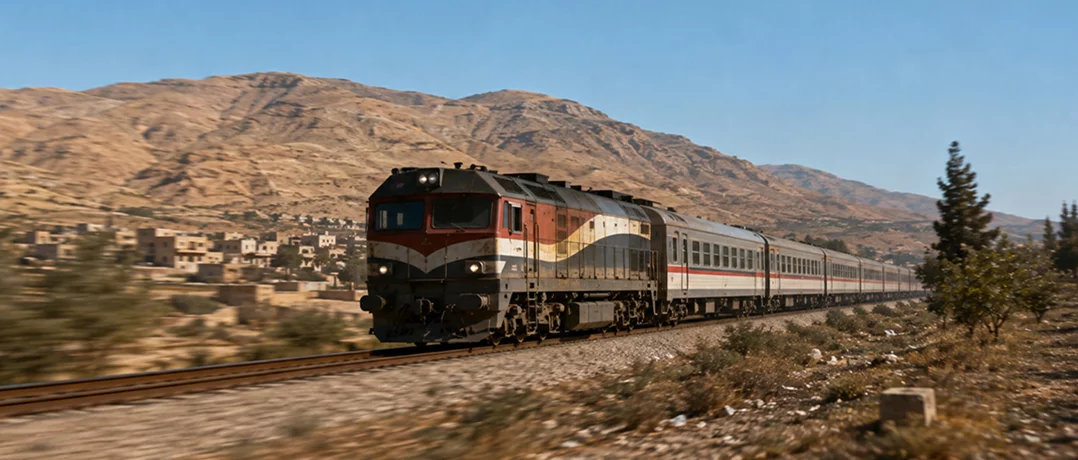
After years of inactivity, Lebanon’s railway sector is once again attracting official attention as Beirut and Damascus seek to restore cross-border rail connectivity. During a recent official visit to Syria, Lebanese Minister of Public Works and Transport Fayez Rassamny and his Syrian counterpart, Dr. Yarub Badr, discussed practical steps to revive railway links between the two countries, with particular emphasis on reconnecting the Port of Tripoli to the Syrian railway network through the Tripoli-Abboudiyeh line.
In an interview with The Beiruter, Ziad Chaya, Director General of Lebanon’s Railway and Public Transport Authority, outlined the current status of the initiative, the steps already undertaken, the challenges ahead, and the project’s long-term economic significance.
Preparatory work already underway
According to Chaya, authorities have already initiated several concrete measures to lay the groundwork for reviving the railway connection.
Among the first steps was the signing of a cooperation protocol between the Railway and Public Transport Authority and the Board of Directors of the Port of Tripoli. The agreement reflects the central role the northern port is expected to play should railway freight services resume.
At the same time, the authority commissioned a comprehensive feasibility study to evaluate the technical, economic, and operational viability of restoring the Tripoli-Abboudiyeh railway line. The study has been entrusted to engineering consultant Rafik Khoury and is expected to produce detailed recommendations, including the terms of reference that will eventually serve as the basis for launching international tenders.
Chaya explained that cooperation with Syria will be essential throughout the process, noting that Lebanese authorities are awaiting further engagement with their Syrian counterparts to coordinate the reconnection of the railway infrastructure across the border.
The bilateral discussions in Damascus also resulted in the formation of a joint technical committee that will oversee the next phase of cooperation.
Funding remains dependent on the study
Despite growing political interest in the project, Chaya confirmed that no financing mechanism has yet been secured.
He stressed that discussions remain focused on the feasibility assessment rather than funding arrangements. Only after the study is completed will both countries be able to evaluate project costs and determine the most appropriate financing options.
The absence of committed funding reflects the early stage of planning. Rather than seeking financial commitments before understanding the project’s technical requirements and expected economic returns, Lebanese and Syrian authorities are prioritizing a detailed assessment of the railway infrastructure, rehabilitation needs, and operational feasibility.
Once these studies are finalized, both governments expect to conduct a joint evaluation before moving toward implementation.
A commercial link with regional potential
While public discussion has often described the railway as a future regional transport corridor, Chaya offered a more measured assessment.
He stressed that the project’s primary value lies in facilitating commercial freight movement rather than creating a transit corridor in the traditional geopolitical sense.
If successfully restored, the railway would reconnect Lebanon to Syria’s rail network through Homs, enabling freight transported from the Port of Tripoli to continue toward other regional destinations where railway infrastructure exists.
Although the project remains in its preliminary stages, Chaya believed that such a network could support commercial exchanges and eventually restore Lebanon’s access to regional rail networks extending through Syria toward Jordan, Saudi Arabia, and Turkey. Direct railway access to Iraq, however, would depend on the future expansion or rehabilitation of Syria’s railway network toward the Iraqi border.
Nevertheless, he asserted that the project possesses strong economic potential by improving logistics, lowering transportation costs, and increasing the competitiveness of the Port of Tripoli as a regional gateway for cargo.
The concept closely aligns with discussions held during Minister Rassamny’s visit to Damascus, where both sides explored integrating the Lebanese-Syrian railway within broader regional logistics networks linking the Eastern Mediterranean with Arab markets.
Technical challenges viewed as manageable
Although reviving railway infrastructure that has remained dormant for decades inevitably presents engineering and logistical difficulties, Chaya does not view these obstacles as insurmountable.
He acknowledged that certain modifications and logistical preparations will be required before operations can resume. However, he described these adjustments as manageable rather than fundamental impediments to the project. The priority remains completing the feasibility study, after which authorities intend to prepare tender specifications for the rehabilitation works.
Perhaps most notably, Chaya expressed confidence that financing would become easier to secure once the technical studies are completed and a clearly defined project is presented to potential donors or investors.
This optimism echoes remarks made by Syrian Transport Minister Yarub Badr following the Damascus meetings, during which he stated that enhanced cooperation between Lebanon and Syria could help attract donor financing for joint infrastructure projects.
Joint technical committee to inspect railway line
While no definitive completion date has been set for the feasibility study, Chaya indicated that work is progressing according to an operational timetable.
He revealed that the joint Lebanese-Syrian technical committee established after the Damascus meetings is expected to visit Lebanon within days to conduct a field inspection of the railway route.
The visit will allow engineers and technical specialists from both countries to assess the condition of the existing infrastructure firsthand, identify rehabilitation requirements, and coordinate future planning.
Such site inspections represent one of the first tangible forms of bilateral technical cooperation since discussions on reviving the railway gained renewed momentum.
Rebuilding connectivity one step at a time
The revival of Lebanon’s railway network remains a long-term undertaking rather than an immediate infrastructure project. Technical studies, cross-border coordination, financing arrangements, and procurement processes must all be completed before reconstruction can begin. Nevertheless, recent discussions between Lebanon and Syria signal a renewed political commitment to restoring a transport link that has remained inactive for years.
For now, the focus remains on careful planning and technical preparation. If the current momentum continues and feasibility findings prove favorable, the railway could eventually become an important component of Lebanon’s broader efforts to modernize its transport infrastructure and re-establish its role within regional commercial supply chains.
-
-

-
The Beiruter
-
