

Tracing the evolution of the 2026 direct Lebanon-Israel talks from ceasefire stabilization to implementing U.S.-brokered security framework amid unresolved challenges.
Tracing the 2026 direct Lebanon-Israel talks

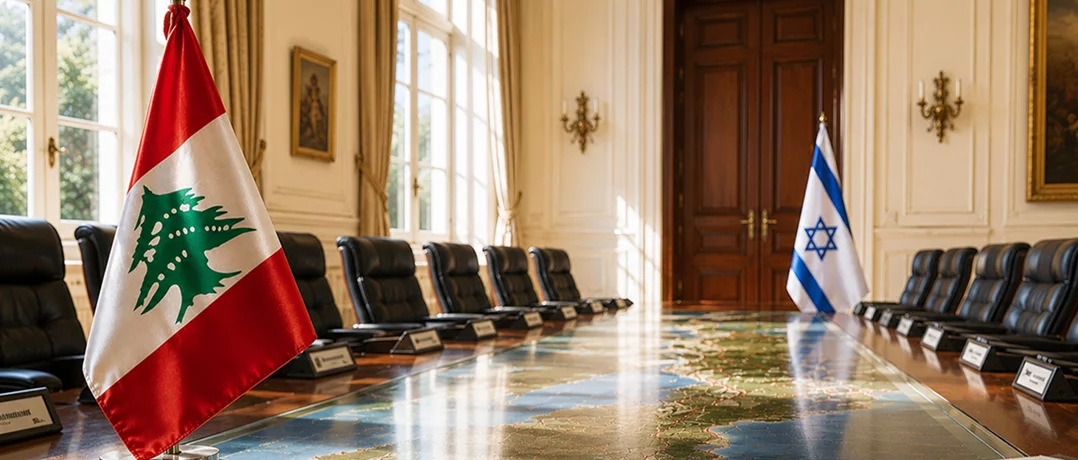
The direct negotiations between Lebanon and Israel in 2026 represent the most sustained and ambitious diplomatic engagement between the two countries to date. Conducted under United States (U.S.) mediation, the talks have gradually evolved from crisis management following months of military confrontation between Tel Aviv and Hezbollah into an effort to establish a structured security framework for southern Lebanon and the broader relationship between the two parties.
With the upcoming round of negotiations in Rome, scheduled between 4-6 August 2026, it becomes valuable and essential to revisit the previous rounds held in both the U.S. and Italy to better understand where the negotiations began and how far diplomatic efforts have reached.
First round of Washington talks (14-16 April 2026)
The first round of negotiations was held in Washington several months after intense military confrontations along the Lebanese-Israeli border. Sponsored by the U.S., with Lebanese Ambassador to the U.S. Nada Hamadeh leading the Lebanese delegation, the talks primarily focused on halting hostilities and creating mechanisms to monitor a ceasefire.
The discussions resulted in an initial truce that reduced immediate tensions and established the foundations for continued dialogue. Although the agreement addressed only urgent security concerns, its significance lay in reopening direct negotiations between the two sides under American sponsorship; a first since the 1990s.
Rather than attempting to resolve long-standing political disputes, the first round sought to stabilize the security environment sufficiently to allow diplomacy to continue.
Second round of Washington talks (23 April 2026)
The second round concentrated on reinforcing the ceasefire and discussing the expansion of the Lebanese Armed Forces (LAF) deployment in southern Lebanon.
Negotiators explored mechanisms designed to reduce cross-border incidents while strengthening communication channels through American mediation. The outcome was an extension of the truce and an agreement to maintain continuous diplomatic engagement despite significant disagreements over broader security issues.
At this stage, negotiations remained largely defensive, focusing on preventing renewed escalation rather than pursuing comprehensive security arrangements.
Third round of Washington talks (14-15 May 2026)
By May, negotiations had expanded beyond ceasefire management to broader security discussions intended to prevent future military confrontations. This time, however, the Lebanese delegation was led by former Ambassador Simon Karam, who had been appointed by President Joseph Aoun (in consultation with Prime Minister Nawaf Salam and Parliament Speaker Nabih Berri) in December 2025.
A central topic became the role of the LAF in assuming greater responsibility throughout southern Lebanon. For the first time, negotiators also discussed preliminary concepts for transitional or “pilot zones” that could eventually serve as testing grounds for future security arrangements.
Although no formal agreement emerged regarding these proposals, the discussions represented an important conceptual shift from temporary de-escalation toward designing a longer-term security framework.
Fourth round of Washington talks (2-3 June 2026)
The fourth round marked one of the most intensive phases of negotiations. Following two intensive days of high-level trilateral negotiations in Washington, Lebanon and Israel announced a U.S.-brokered agreement aimed at implementing the ceasefire reached on 16 April 2026. According to a joint statement issued by the Lebanese and Israeli delegations, the agreement included “the complete cessation” of Hezbollah’s military attacks against northern Israel as well as its operatives’ evacuation from the South Litani Sector.
Furthermore, at the center of the proposed agreement lied the concept of advancing the swift “creation of pilot zones in which the Lebanese Armed Forces will take exclusive control of the territory to the exclusion of all non-state actors,” under the guidance of the U.S. At that stage, the proposed pilot zones included Zawtar al-Sharqiyah, Zawtar al-Gharbiyah, and Beaufort Castle.
While disagreements remained regarding implementation, the pilot zone concept evolved from a theoretical proposal into the centerpiece of subsequent negotiations.
Fifth round of Washington talks (23-26 June 2026)
The fifth round represented the most consequential stage of the negotiations.
Unlike previous discussions, which concentrated primarily on principles, this phase focused on operational implementation. Negotiators addressed the geographical boundaries of pilot zones, possible timelines for phased Israeli withdrawals, verification mechanisms, and American oversight.
These discussions culminated in a 14-point framework agreement signed on 26 June. The framework established a phased approach whereby the LAF would gradually assume exclusive security responsibility within designated pilot areas, notably in areas such as Froun and Zawtar al-Gharbiya in southern Lebanon, while Israel would conduct staged redeployments from Lebanese territory. American-supervised working groups were created to oversee implementation, while future progress became linked to measurable verification mechanisms rather than political declarations alone.
Another significant element was Provision 13, which called upon both Lebanon and Israel to adopt “good faith measures.” These included refraining from hostile actions in international political and legal forums, cooperating in the recovery of human remains, and facilitating the release of detainees. Although less visible than military provisions, this clause sought to reduce confrontation beyond the battlefield by addressing diplomatic and legal disputes that have long accompanied the conflict.
First round of Rome talks (14-15 July 2026)
The sixth round of negotiations, held on 14-15 July 2026 at the U.S. Embassy in Rome, marked a significant transition in the diplomatic process; only days prior to President Aoun’s visit to the U.S. on 21 July 2026. For the first time since negotiations began, talks were held outside Washington, reflecting a shift from drafting agreements to managing implementation.
The Rome discussions focused primarily on translating the June framework agreement into operational measures. Negotiators concentrated on identifying specific pilot zones where phased Israeli withdrawals could begin alongside the deployment of the LAF.
The talks concluded with a preliminary understanding on establishing two experimental areas; one located within Israeli-controlled territory and another adjacent to Israeli positions in southern Lebanon. Consequently, as a direct result of discussions held in Rome, pilot operations began soon afterward in the villages of Froun, Srifa, and Zawtar al-Gharbiya.
Nevertheless, major disagreements remain unresolved. Lebanon continues to insist on a clear timetable for a complete Israeli withdrawal, as well as the disarmament of Hezbollah and all other non-state armed groups. Hezbollah, meanwhile, continues to reject calls for disarmament. As for Israel, it maintains that further withdrawals must remain linked to verified security arrangements addressing Hezbollah’s military presence.
-
-

-
The Beiruter
-
