

What to know about the Trump-Xi summit.
Trump and Xi face off in Beijing

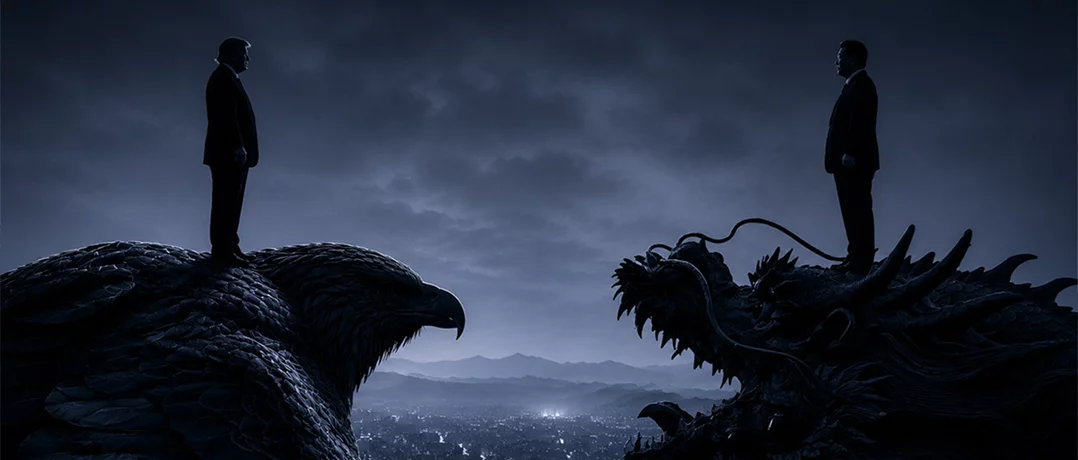
United States (U.S.) President Donald Trump arrived in Beijing for his first presidential visit to China since returning to office, receiving an elaborate state welcome from Chinese President Xi Jinping at a moment of mounting geopolitical and economic uncertainty. The visit, described by both sides as strategically significant, unfolded amid intensifying global tensions stretching from East Asia to the Middle East, while relations between Washington and Beijing remain burdened by deep mistrust and fierce competition.
Trump traveled to China accompanied by a high-profile delegation that reflected the economic and technological priorities of the summit. Among the senior officials joining him were Secretary of State Marco Rubio, Treasury Secretary Scott Bessent, and Trade Representative Jamieson Greer. The delegation also included influential business leaders such as Elon Musk (Tesla), Jensen Huang (Nvidia), Tim Cook (Apple), Kelly Ortberg (Boeing), and Larry Fink (BlackRock), underscoring the central role of artificial intelligence, semiconductors, electric vehicles, trade, and investment in the bilateral relationship.
While both governments publicly emphasized stability and dialogue, neither side entered the summit expecting a transformative breakthrough. Instead, the primary objective appeared to be preventing strategic rivalry from escalating into open confrontation.
Contentious and delicate files on the summit agenda
Trade and tariffs
Trade remained the central issue dominating discussions between Trump and Xi. Economic tensions have escalated sharply since Trump’s return to office, particularly after Washington imposed sweeping tariffs under the so-called “Liberation Day” measures. Beijing responded with retaliatory tariffs and restrictions on rare earth exports critical for advanced technologies, defense industries, and electric vehicle production.
Although both governments reached a temporary trade truce in late 2025, the structural disputes remain unresolved. Washington is demanding broader Chinese purchases of American agricultural goods, beef, aviation equipment, and energy exports, while also pressing for fairer market access and reduced American dependence on Chinese supply chains. Beijing, meanwhile, seeks relief from tariffs and export restrictions while resisting what it views as U.S. efforts to contain China’s industrial and economic rise.
Trump promoted the summit as economically productive, highlighting Chinese commitments to purchase Boeing aircraft and additional American products. However, investors reacted cautiously because the meetings failed to produce a comprehensive trade settlement. Discussions over establishing a bilateral “Board of Trade” aimed at managing future disputes reflected both sides’ desire to avoid another tariff war, though analysts continue to describe the current climate as a fragile economic détente rather than a lasting, sustainable resolution.
Technology, artificial intelligence, and semiconductor competition
Technology and artificial intelligence (AI) represented another major point of tension. The U.S. continues tightening restrictions on exports of advanced semiconductors and chipmaking technologies to China, arguing that unrestricted access could strengthen Beijing’s military and AI capabilities. The presence of Nvidia CEO Jensen Huang in Trump’s delegation fueled speculation that semiconductor access and AI cooperation featured prominently in the talks.
For China, technological self-sufficiency has become a national security priority. Beijing has invested heavily in domestic semiconductor manufacturing, robotics, renewable energy, and artificial intelligence industries in an effort to reduce dependence on Western technologies. While discussions reportedly included AI safety mechanisms and concerns about autonomous military systems, no meaningful breakthrough emerged. The technology dispute increasingly reflects a broader struggle over industrial leadership, strategic influence, and control over the next generation of global innovation.
Taiwan: The most dangerous flashpoint
Taiwan remained the most politically sensitive issue discussed during the summit. Beijing considers the self-governed island an inseparable part of China and insists reunification is non-negotiable, while the U.S. continues supporting Taiwan’s defense capabilities under longstanding American law and through its “strategic ambiguity.”
Xi warned Trump that mishandling Taiwan could push both countries toward “clashes and even conflicts,” underscoring the issue’s importance in bilateral relations. Tensions have intensified under Taiwanese President Lai Ching-te, whose political movement favors preserving Taiwan’s separate democratic identity. Beijing accuses his administration of encouraging separatism, while Taiwan insists its future should be determined by its own people.
Washington’s continued arms sales to Taiwan remain a major source of Chinese frustration. Although American officials reaffirmed that U.S. policy remains unchanged, concerns persist in Taipei that Taiwan could become entangled in broader negotiations between Washington and Beijing.
Iran, energy security, and the strait of Hormuz
The ongoing conflict involving Iran added another strategic dimension to the summit. The war has disrupted global energy markets, threatened shipping through the Strait of Hormuz, and intensified fears of wider economic instability.
Washington hoped Beijing would use its influence with Tehran to help restore maritime stability and reduce regional tensions. China remains one of Iran’s largest oil buyers and economic partners, giving it significant leverage. Trump stated that both leaders shared similar concerns regarding regional stability and reopening shipping routes, though Beijing avoided openly aligning itself with American regional objectives.
China instead called for ceasefire negotiations and diplomatic solutions while continuing to protect its strategic relationship with Iran. The issue highlighted China’s expanding global role, as Beijing is increasingly expected to influence crises beyond Asia while balancing its energy interests against its broader geopolitical competition with the U.S.
Zhongnanhai: Diplomacy inside China’s secretive leadership compound
One of the summit’s most symbolic moments came when Xi invited Trump to Zhongnanhai, the heavily guarded leadership compound adjacent to Beijing’s Forbidden City. Foreign leaders rarely receive invitations to the former imperial garden, making the visit especially significant.
Trump and Xi walked together through landscaped gardens lined with roses and ancient trees before holding discussions over tea and a working lunch. Trump reportedly praised the beauty of the roses, while Xi promised to send him seeds from the garden.
The setting carried deep political symbolism. Zhongnanhai has served as the center of Chinese political authority since the establishment of the People’s Republic of China (PRC) in 1949. Often compared to the White House or the Kremlin, the compound combines imperial heritage with modern Communist Party power.
By welcoming Trump there, Xi sought to project confidence, continuity, and personal diplomacy. The carefully staged imagery presented China as a civilization-state deeply rooted in history while simultaneously asserting its place at the center of global politics.
The “Thucydides Trap” and the fear of great-power conflict
One of the summit’s most intellectually significant moments occurred when Xi referenced the “Thucydides Trap,” invoking the ancient Greek historian Thucydides and the rivalry between Athens and Sparta; which realists (especially offensive realists, such as Pr. John Mearsheimer, resort to).
The theory suggests that when a rising power challenges an established one, fear and strategic competition often lead to war; as what occurred during the Peleponesian War. Xi’s remarks carried clear implications for modern U.S.-China relations, with China emerging as a rising global power while the United States seeks to preserve its dominant position.
By invoking the concept, Xi appeared to send both a warning and an appeal. On one hand, he cautioned against policies that could push both countries toward confrontation, particularly over Taiwan. On the other hand, he suggested that history does not necessarily have to repeat itself if both sides manage competition responsibly.
The reference elevated the summit beyond immediate disputes over tariffs or trade balances. It framed the broader challenge confronting both nations: how to coexist as rival superpowers in an increasingly fragmented international system.
Ultimately, the meetings in Beijing were less about resolving disputes than about managing them. As competition intensifies across economics, technology, military strategy, and geopolitical influence, the ability of the U.S. and China to avoid falling into the “Thucydides Trap” may become the defining challenge of international politics in the 21st century.
-
-

-
The Beiruter
-
