



Trump’s “Project Freedom” in the Strait of Hormuz frames a maritime intervention as humanitarian, amid fragile U.S.-Iran ceasefire tensions.
Trump launches “Project Freedom” in Hormuz

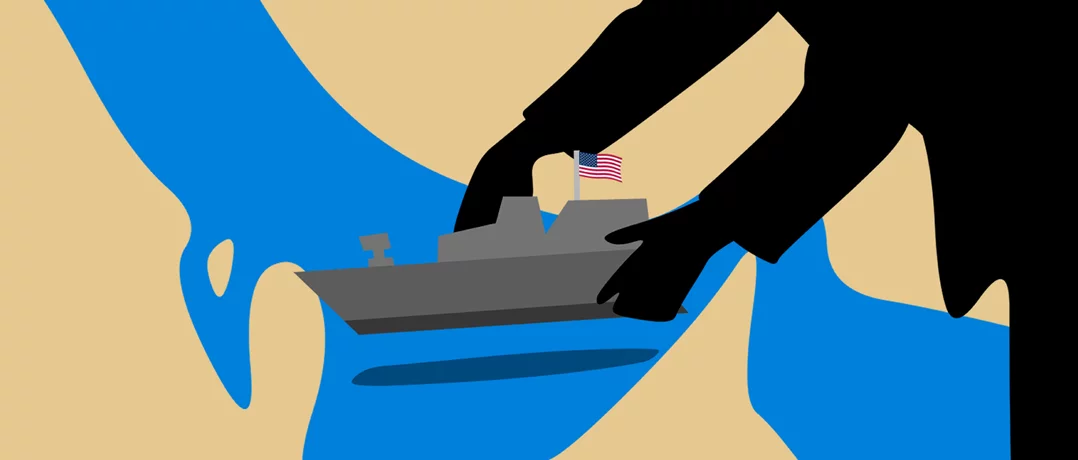
United States (U.S.) President Donald Trump announced the launch of a new American-led maritime operation in the Strait of Hormuz, describing it as a humanitarian mission aimed at “liberating” hundreds of commercial vessels stranded in one of the world’s most strategically vital waterways. The operation, which Trump named “Project Freedom,” was scheduled to begin today and comes amid a fragile ceasefire between Washington and Tehran following months of military confrontation, naval blockades, and regional instability.
While the United States framed the initiative as an effort to protect neutral commercial shipping and prevent a humanitarian crisis aboard stranded vessels, Iran interpreted the move as a direct challenge to its influence over the strait and warned that any American intervention would violate the existing ceasefire understandings. Nevertheless, the aforementioned initiative marks more than a tactical naval deployment.
Trump strategically frames operation as “humanitarian” mission
The rhetorical foundation of “Project Freedom” is deliberately dual use. On one hand, Trump highlights civilian distress: stranded crews, supply shortages, and disrupted global trade. On the other, he coupled those remarks with a sharp warning that interference will be met “firmly.” This blending of humanitarian justification with coercive signaling reflects a long-standing pattern in U.S. maritime doctrine, where freedom of navigation operations often carry implicit strategic messaging.
In a lengthy statement published on his Truth Social platform, Trump said several countries had requested American assistance to evacuate ships trapped in the Strait of Hormuz during the ongoing crisis. According to the president, many of the vessels belong to states that are not directly involved in the conflict between the U.S. and Iran.
Trump argued that the mission was intended to protect innocent commercial operators and civilian crews facing worsening humanitarian conditions after being unable to safely navigate the waterway for weeks. He stated that many ships were suffering shortages of food, medical supplies, and essential resources needed to maintain healthy living conditions for thousands of sailors stranded aboard.
By portraying the initiative as a response to “neutral and innocent” states, Washington positions itself as a global guarantor of maritime order. Indeed, the U.S. is asserting that no regional actor (particularly Iran) can unilaterally restrict access to an international chokepoint. It appears determined to reopen global trade routes while simultaneously pressuring Tehran into accepting broader political and security concessions.
How the “Freedom Project” will work
Although Trump initially provided few operational details, American military officials later outlined the broad structure of the mission. The U.S. Central Command (CENTCOM) confirmed that American forces would support the operation using more than 100 aircraft, guided missile destroyers, unmanned systems, and approximately 15,000 service members.
Despite the scale of the deployment, U.S. officials clarified that the mission would not necessarily involve direct naval escorts for every commercial vessel. Instead, American warships will remain positioned throughout the region to respond rapidly if Iranian forces attempt to target or obstruct merchant shipping.
The U.S. Navy will also provide commercial ships with intelligence and navigation guidance regarding the safest maritime routes through the strait, particularly areas believed to be free of Iranian naval mines.
This design creates deliberate ambiguity. It avoids the legal and political implications of full-scale convoy protection while still asserting dominance over the operational environment. However, the lack of clearly defined engagement thresholds increases the likelihood of miscalculation. A single incident involving a commercial vessel could rapidly escalate into direct military confrontation.
Furthermore, Washington is reportedly working to establish an international coalition (reviving the “coalition of the willing” phenomenon), which could include the United Kingdom (U.K.) and France, to support maritime security operations and reassure global markets that commercial navigation can resume safely. While eager to avoid direct confrontation, the scale of the deployment signals that Washington is preparing for the possibility of escalation should tensions spiral out of control.
Iran rejects American maritime intervention
Tehran reacted swiftly to Trump’s announcement. Ebrahim Azizi, chairman of the Iranian parliament’s National Security and Foreign Policy Committee, warned that any American interference in what he described as the “new maritime order” in the Strait of Hormuz would constitute a violation of the ceasefire.
From Tehran’s perspective, the new American maritime initiative risks undermining ongoing diplomatic efforts by shifting pressure back toward military confrontation. Iranian officials fear that even limited U.S. naval operations could evolve into a permanent strategic presence designed to weaken Iran’s leverage in the Gulf.
Fragile diplomacy overshadowed by threats
The announcement of “Project Freedom” comes at a delicate moment in negotiations between Washington and Tehran. Despite a temporary ceasefire that has reduced direct fighting, both sides continue to exchange accusations and threats.
Trump recently confirmed that he had rejected aspects of Iran’s latest 14-point peace proposal, saying he was “not satisfied” with Tehran’s conditions. The Iranian proposal reportedly includes demands for sanctions relief, war reparations, withdrawal of American military pressure, and a new security framework governing the Strait of Hormuz; however, without resolving the core issue of their dispute: Tehran’s contentious nuclear program.
At the same time, Trump warned that the U.S. could resume military strikes if Iran “misbehaves,” reinforcing concerns that the ceasefire remains highly unstable. While the United States insists on restoring unrestricted navigation through the strait, Iran sees control over Hormuz as one of its few remaining strategic bargaining tools after months of military and economic pressure.
In this context, “Project Freedom” functions as both a bargaining instrument and a pressure mechanism. It signals that while diplomacy remains active, the U.S. is simultaneously willing to reshape facts on the ground.
However, any prolonged disruption will continue to threaten and worsen global energy prices, shipping costs, inflation, and broader economic instability. As a result, many governments are likely to support efforts aimed at restoring commercial navigation, even if they remain wary of becoming directly involved in another Middle Eastern confrontation.
Hence, the coming days may determine whether the operation succeeds in reopening one of the world’s most important trade routes peacefully or whether it triggers a new cycle of military escalation between Washington and Tehran.
-
-

-
The Beiruter
-
