



Morocco controls 70% of the world’s phosphate, an irreplaceable mineral which the future of agriculture and green energy depends on, as American and Chinese reserves are slowly depleted. China has spent the past decade deepening investments and moving manufacturing to the country — is the United States now realizing the need to follow suit?
Trump's Morocco pivot exposes US-China phosphate rivalry
Trump's Morocco pivot exposes US-China phosphate rivalry
By Soraya Johnson | July 08, 2026

Reading time: 6 min
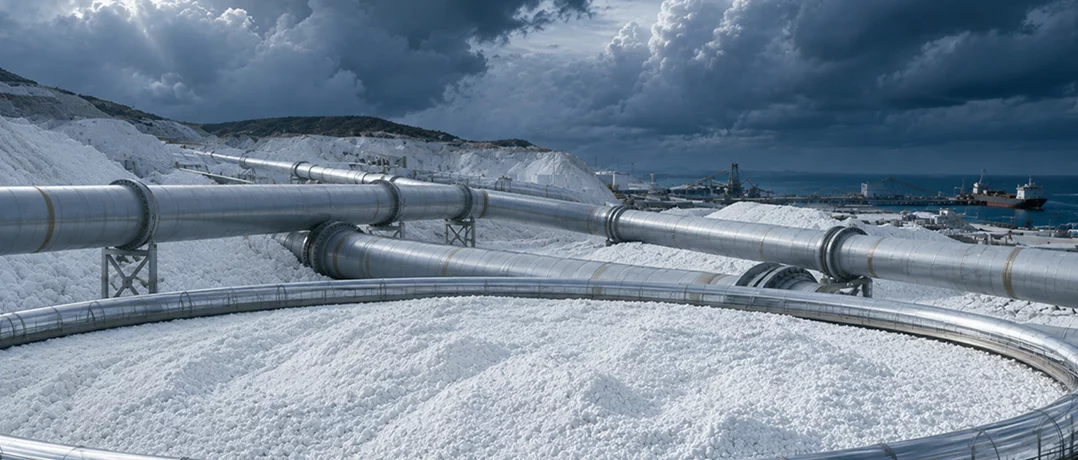
Despite being otherwise known for mounting high tariffs, President Donald Trump made two unusual decisions on June 29th, 2026: first, to proclaim a national emergency over a specific agricultural mineral, phosphate fertilizer, and second, to temporarily suspend duties on Morocco alone. The country's share of American phosphate fertilizer imports collapsed from 72% in 2019–2020 to just 2% by 2020–2023 per a Texas A&M University report, as the U.S. imposed countervailing duties; Moroccan fertilizer imports will likely rise again with Trump's new tariff suspension.
The White House cited globally heightened fertilizer prices as prompting the change, a disruption widely tied to the ongoing Strait of Hormuz crisis. In 2026, the American Farm Bureau Federation found that seven in ten US farmers reported concerns about fertilizer affordability. However, rather than a simple reaction to current events, the move is part of an overdue refocusing on phosphate and Morocco as matters critical to American security.
Morocco’s emerging phosphate monopoly makes it an irreplaceable node in one of the world's most vital supply chains, essential for feeding the globe's growing population and powering the green energy revolution. While fellow leaders in phosphate production - China and the United States - have reserves that will be empty by 2058 and 2062 respectively at current rates, Morocco is home to 70% of the world's phosphate, able to mine the mineral for another 1,300 years according to the London School of Economics.
By resuming the phosphate trade with Morocco, the United States is returning its attention to a country that China has been rapidly deepening its investments in for a decade. Whether Morocco will successfully balance the demands of two competing great powers as their needs for phosphate grows more dire, or will become the battleground of the world’s next devastating resource war, hinges on the actions of today.
Phosphate: rising demand, falling reserves
Phosphate is the only fertilizer ingredient in finite supply, and it is necessary for global food security. Mined as phosphate rock, it is mixed into commercial fertilizers that allow crops to flourish. As growing populations require more food, demand for phosphate fertilizer is ballooning, rising roughly 3% a year. All efforts at innovating a phosphate replacement have failed: as noted in the 2026 USGS mineral resources report, “there are no substitutes for phosphorus in agriculture.”
Phosphate is also a critical component of lithium iron phosphate (LFP) batteries, which power electric vehicles at a lower cost than cobalt-based alternatives. LFP battery adoption is accelerating: the technology constituted 55% of EV batteries sold in 2025 as reported by the International Energy Agency, up from 50% in 2024, and is regarded as the future of affordable EVs. Phosphate availability is especially concerning to China’s EV industry, which produces 98% of the world’s LFP batteries.
As phosphate demand compounds, Morocco’s importance likewise grows. Both the US and China will be looking to Morocco for its phosphate as their own reserves become depleted.
The US and Morocco
Morocco is one of the oldest US allies, having been the first nation to recognize American independence in 1776. It was designated a Major Non-NATO Ally in 2004, and the two countries maintain close defense cooperation. Trade ties are similarly strong: among Morocco's FTAs with 62 countries, its agreement with the United States is one of the strongest. The US ran a growing $3.7 billion trade surplus with Morocco in 2025 while imposing a comparatively low 10% tariff rate on Moroccan goods.
In recent years, Morocco has slipped out of the United States’ strategic focus. In 2021, the American phosphate giant Mosaic, which reports controlling 75% of U.S. phosphate fertilizer production, complained that Morocco’s state-run phosphate company OCP Group was being unfairly subsidized and therefore constituted unfair competition, resulting in countervailing duties being imposed later that year. This resulted in heightened domestic fertilizer prices, the halting of the phosphate fertilizer trade with Morocco, and the United States garnering nearly all its phosphate imports from Peru, a country with only 210 million metric tons of phosphate total - as opposed to Morocco’s 50 billion.
The 2027 US National Defense Authorization Act foreshadowed the pivot back to Moroccan phosphate that Trump’s suspension now signals. It outlines the tightening of US-Moroccan defense relations and the securing of phosphate supply chains as key strategic priorities. The renewed focus on Morocco in Washington is a belated move to catch up to China, which has spent the past decade deeply embedding itself in Morocco.
China and Morocco
China’s massive electric vehicle industry, projected to reach US$579.2bn in revenue this year according to data analytics platform Statista, is incredibly vulnerable: its affordability edge depends on LFP batteries, of which China produces 98% worldwide, but LFP manufacturing depends on depleting Chinese phosphate reserves. Its EV industry is further undercut by skyrocketing tariffs blocking its entrance to Western markets: in 2024, the EU imposed a 45% tariff and the US levied a 100% tariff on Chinese electric vehicles, which increased to a 145% blanket tariff on all Chinese goods under the Trump administration.
Morocco has branded itself as the phosphate-rich gateway between the East and the West that cures both of the Chinese EV industry’s ailments: first, investment solves China’s eventual phosphate shortage, promising essential access to a mineral needed for its continued industrial success. Second, it provides a backdoor to Western markets through FTAs with the US and the EU. Simply trading finished goods from China through Morocco isn’t enough to circumvent duties, as the West's tariff rules-of-origin requirements demand that goods be “substantially transformed” in third-party countries for duties not to be levied. Morocco’s phosphate wealth and the manufacturing of the batteries by Chinese firms on Moroccan soil allow companies to claim that the goods are made in Morocco, even as Chinese firms profit.
This strategic partnership, initiated with Morocco’s 2017 entrance into China’s Belt and Road Initiative, has resulted in tens of billions of Chinese investment flooding into Moroccan economic free zones, including China’s co-creation of Morocco’s Tanger Tech City, which opened in 2023 and specializes in battery manufacturing. All points of China’s LFP battery supply chain - from phosphate mining to EV manufacturing - are beginning to operate in Moroccan free zones.
The future of US-China rivalry in Morocco
LFP batteries have yet to overtake cobalt-based ones in American and European markets due to heightened tariffs, but leading automakers like Tesla and Ford, along with battery makers such as South Korea's LG Energy Solution, have all announced shifts toward LFP and are reallocating manufacturing capacity accordingly. Some Western-aligned firms are building in Morocco to sidestep their own governments' efforts to decouple supply chains from China. Others are building capacity in the West instead, with Ford announcing its plans for BlueOval Battery Park in Michigan, the first automaker-backed LFP plant in the United States. Either way, both trends point to an increased need for the West to play catch up: in the shift to LFP battery production, and more broadly, in securing access to Moroccan phosphate.
Trump's recent tariff suspension on Moroccan phosphate is pointedly temporary: as outlined in the June 29th White House proclamation, tariff-free treatment for Moroccan phosphate fertilizer imports will last only until "8 months after the date of this proclamation or the termination of the emergency declared," whichever comes first. However, a permanent strategic pivot is needed to secure supply chain access. For the United States to ensure affordable fertilizer access and prevent Chinese dominance of the global EV supply chain, it is time the US refocuses its investments in Morocco.
-
-

-
Soraya JohnsonJunior research/writer
Focusing on political analysis, economic trends, and investigative reporting.
-
