



Ankara's conditional withdrawal from its only base outside Iraqi Kurdistan could signal a shift in its relations with Baghdad, but analysts warn that Iran-backed militias and unresolved security questions may stand in the way.
Turkey agrees to hand over Bashiqa base

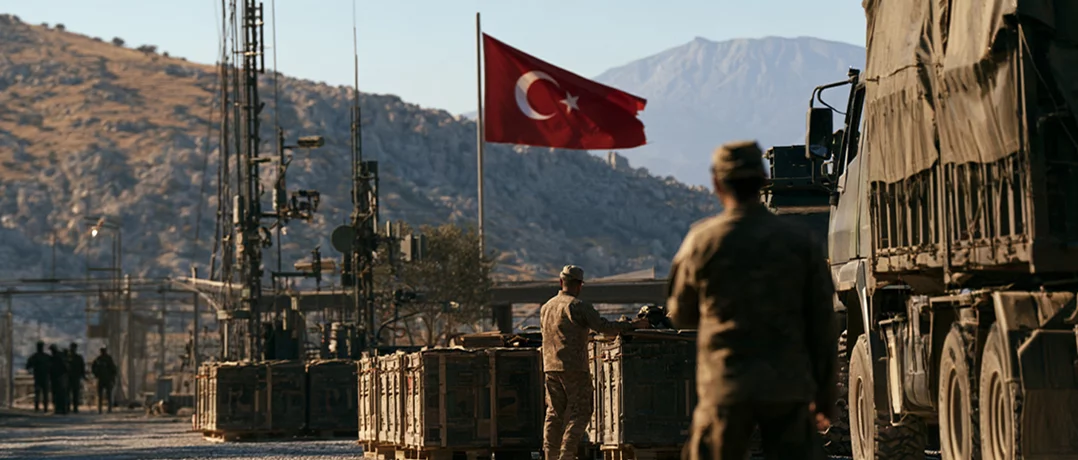
Turkey has agreed to gradually hand over control of a military base in northern Iraq to the Iraqi army, in a deal that could mark the start of the end of four decades of Turkish military presence in parts of the country.
The agreement came out of a meeting between Turkish President Recep Tayyip Erdogan and Iraqi Prime Minister Ali al-Zaidi on the sidelines of the UN General Assembly in New York. Both leaders pledged to deepen security cooperation, with Turkey committing to transfer the Bashiqa base near Mosul to Iraqi control. In return, Baghdad pledged to deal with armed groups in the Sinjar region that Ankara considers a threat.
A contested base
Turkey established the Bashiqa base in 2015 under an agreement with the Kurdistan Regional Government (KRG), with the aim of training local forces to fight ISIL. In 2016, Turkey deployed additional troops there without Baghdad's permission, prompting Iraq's parliament to call the soldiers an “occupying force” that violated Iraqi sovereignty.
Ankara has long argued that the base is essential to its national security and to operations against the Kurdistan Workers' Party (PKK), which it classifies as a terrorist organisation. Tensions eased after a landmark 2025 deal between Ankara and the PKK, after which the group announced its dissolution and held a symbolic disarmament ceremony.
The agreement also comes as US troops complete their withdrawal from northern Iraq this month, potentially leaving a vacuum regional powers could capitalise on.
A conditional withdrawal
In an interview with Al Jazeera, Omer Ozkizilcik, a non-resident senior fellow at the Atlantic Council, described the arrangement as conditional. Turkey, he said, has accepted a long-standing Iraqi demand in exchange for Baghdad resolving the situation in Sinjar, where the Sinjar Resistance Units (Yekîneyên Berxwedana Şengalê or YBS), which Ankara regards as the PKK's local branch, remain active.
Turkey is aligning its own security interests with Iraq's domestic debate over putting all weapons under state control and removing foreign forces. Ankara wants Baghdad to settle the Sinjar issue in the same way Damascus dealt with the Syrian branch of the PKK, and will leave Bashiqa only once the disarmament there has been completed. Turkey maintains several other bases closer to its border with the Kurdistan Region, which are far more complicated and sophisticated than Bashiqa.
Trading military presence for economic influence
The deal also comes alongside commitments to expand trade, investment and the Development Road project. Bilateral economic ties have grown over the past few years through memoranda of understanding and trade agreements. Back in November 2025, Turkey and Iraq signed a first-of-its-kind framework agreement channelling revenues from Iraqi oil exports to Turkey into water projects built by Turkish firms. Ankara calls it the largest infrastructure investment in Iraq's history, and it aims to ease a long-running dispute over the Tigris and Euphrates.
With the Strait of Hormuz closed to Iraq, Baghdad increasingly sees Turkey as a long-term alternative trade route, with direct trade growing over the past six to eight months, partly bypassing the KRG. For instance, Turkey and Iraq signed five agreements during Ali al-Zaidi's visit to Ankara, including a deal on rail and road transport via the Ovakoy-Fishkhabur border crossing and a framework for developing Iraq's transport infrastructure in exchange for natural resources.
Turkey appears to be changing how it exercises power in Iraq rather than withdrawing, shifting towards commercial influence. Expanded trade, pipelines and oil exports through Turkey could stabilise Iraq and reduce its dependence on Iran.
The relationship will likely remain contentious in the near term, with disputes over water, the remaining bases and pipelines still unresolved.
Why Iraq now matters more to Ankara
Beyond the immediate security calculations, three broader pressures help explain why Iraq has moved up Turkey's list of priorities.
The first is Iraq's potential to become a battleground in the confrontation between Iran, Israel and the United States. Iran-backed militias operate on Iraqi soil and play a significant role in regional dynamics. For Ankara, this makes Iraq more than a neighbour: it is a strategic buffer and an arena in which Turkey must carefully manage its relationship with Tehran over security, political influence and connectivity projects. These concerns have grown sharper since the outbreak of the war on Iran.
The second is the "Turkey without terror" agenda. Because the PKK's main bases, logistics and operational depth are concentrated in northern Iraq, and in the Kurdistan Region of Iraq above all, any attempt to settle the decades-long conflict must involve Iraqi territory. This holds whether Ankara pursues a military solution or a political process. Baghdad's expanding counterterrorism cooperation, together with the KRG’s role on the ground, has made Iraq essential to Turkey's efforts to reshape its domestic security and political environment.
The third is the growing rivalry between Turkey and Israel. Israeli Prime Minister Benjamin Netanyahu has claimed that a new "Sunni axis" is emerging, a framing that places Ankara firmly in Israel's sights. Both countries are building alliances and signing military agreements with their neighbours. Each is also positioning itself as a key energy and trade corridor linking European and Asian markets. The rivalry is most visible in Syria, where Ankara backs President Ahmed al-Sharaa's government while Israel continues to strike Syrian territory and infrastructure in violation of its sovereignty.
Taken together, these pressures have turned Iraq from a peripheral concern into one of the central pillars of Turkey's regional strategy. The Bashiqa handover and the commitments on Sinjar suggest that Ankara increasingly sees cooperation with Baghdad, rather than unilateral force alone, as the way to secure its interests there.
With US forces withdrawing from both Iraq and Syria, a vacuum is opening in the two countries that regional powers are already moving to fill. Turkey, Iran and Israel are each seeking to shape what comes next, and the competition between them for regional hegemony is playing out on the ground. How Ankara manages its new partnership with Baghdad may go a long way towards deciding who gains the upper hand.
-
-

-
Peter ChouayfatiPolitical Analyst and Researcher
-
