



Pope Leo XIV visits Turkey, honouring Nicaea Council, promoting Christian-Muslim dialogue, and engaging in historic diplomacy.
Turkey welcomes Pope Leo XIV

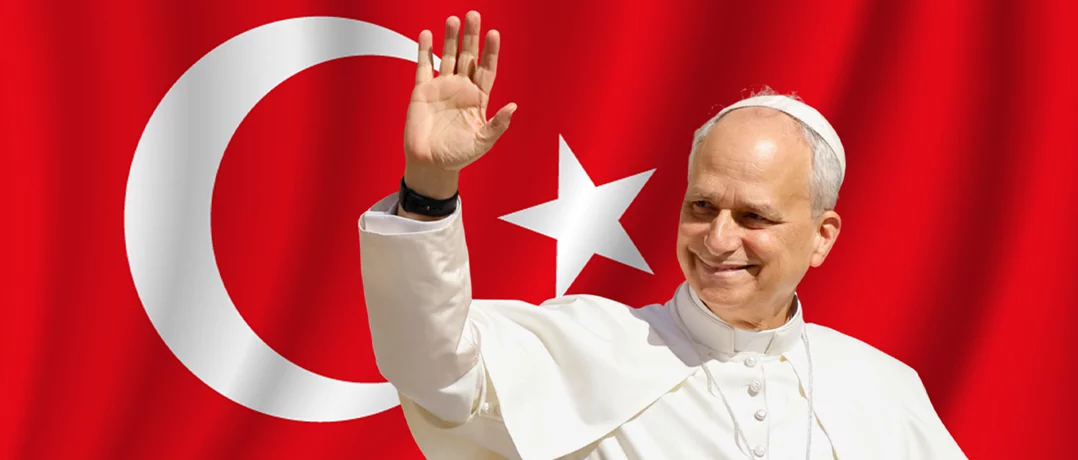
Today, on 27 November 2025, Pope Leo XIV landed at Esenboga International Airport in Ankara, Turkey, marking the beginning of his first foreign trip.
The visit carries immense political and religious weight not only for the Turks, but for the world as a whole. From here, one must seek to understand the visit’s importance to Turkey, which is what drove The Beiruter to conduct an exclusive interview with Turkish journalist, political scientist and publicist Musa Özuğurlu.
The visit’s importance for Christianity
Pope Leo will celebrate the 1,700th anniversary of the Council of Nicaea, which was held in the present-day city of Iznik, northwest Turkey. The council convened in 325 AD by Emperor Constantine I in the city of Nicaea and approved a formulation of the Christian creed known as the “Nicene Creed,” which continues to be followed in Catholic, Eastern Orthodox, Anglican, and other churches to this day.
Özuğurlu said that “the Pope explained his first foreign visit to Turkey, by saying that the Council of Nicaea, one of the cornerstones of Christianity, is a symbol of unity. We want to send a message of peace to these lands. This is important, not only for Christians, but for Muslims and everyone all over the world.” Indeed, the Pope’s visit for the 1,700th anniversary of the First Council of Nicaea holds a profound and meaningful significance. Ahead of his upcoming Apostolic Journey, the pontiff issued on 23 November 2025 the Solemnity of Christ the King, the Apostolic Letter “In unitate fidei,” which has the hope of “encouraging the whole Church to renew her enthusiasm for the profession of faith.” Therefore, Özuğurlu believed, “It is very important for Christian history.”
The second importance of this visit that Özuğurlu stressed are the potential outcomes. He claimed that “it will be highlighted that Turkey, especially Istanbul, is one of the important sanctuaries of Christianity, historically as well as for the future, since we have the Orthodox Ecumenical Patriarchate of Constantinople here.” He believed that “the visit could be a step towards recognition of the Ecumenical Patriarchate of Constantinople. This is not a strong possibility, but I think this will be a step for the future.” The issue of recognizing the latter, which represents the spiritual leader of Eastern Orthodox Christians, has long been a controversial issue in Turkey, which reveals the importance of this visit and the possible Turkish acceptance of the Ecumenical Patriarchate.
Furthermore, as the last dialogue between the Orthodox and Catholic churches was held in Jerusalem, Özuğurlu said that “the anticipated dialogue between the two, which will take place in Istanbul, carries immense weight. So, it is important that it will start again here in Turkey.” Interestingly, another matter related to Christianity (the Orthodox Church especially) is the issue of Hagia Sophia. The latter was a Christian church, before becoming a mosque (following the Ottoman conquest of Constantinople in 1453). However, it was later turned into a museum, only to be returned as a mosque during Turkish President Recep Tayyip Erdoğan’s term. Given the delicacy and controversy engulfing this matter, Özuğurlu believed the Pope “might be sending a symbolic message regarding Hagia Sophia, given its historical significance.”
The visit’s importance for Turkey, Erdoğan and the Islamic world
Özuğurlu asserted that “the Pope will also be visiting Anıtkabir (Atatürk Mausoleum), the founder of the country, signaling its significance as it highlights the pontiff’s respect for the founder of Turkey and the country’s Constitution.” His visit to the Sultanahmet Mosque, he added, “serves as a message to the Islamic world at the same time.” It will also be an important visit since the United States under President Trump wants reconciliation not just in Christianity, but with Muslims and the other religions as well.
On the other hand, Turkish President Recep Tayyip Erdoğan, who “for a long time struggled to initiate dialogue in the Islamic world and assert himself for its leadership,” seeks to “send a message that he is the leader, or that he wants to be a leader.” Simultaneously, the president hopes to send another message “to the Western world, as a representative of Islamic world, through a picture with the Pope. He previously described the European community as a Christian club. Thus, I believe that Erdoğan, through this visit, will signal an attempt for rapprochement with the Western world once again.”
In addition, as the country faces economic difficulties and challenges, Erdoğan’s aim is also for “economic integration with the wider world.” However, Özuğurlu believed that “it is not enough to integrate with the European Union or the Western world by economic means, but rather Erdoğan needs to be accepted again in this mentioned world. From here, this visit may be a step forward for the president.”
Despite the anticipation and enthusiasm, Özuğurlu revealed that “in Turkey, there are controversies concerning the Pope’s visit. Turkey is not a country that Christians live comfortably, as you know. They have some difficulties because of the religious thinking, and some view this [meaning the Pope’s visit] as Turkish surrender to global rulers or to Christians.” “But some hope that it may provide a breathing space during the bloody conflicts in this world: such as in Ukraine and Palestine.”
What about Lebanon and Palestine?
Following his visit to Turkey, Pope Leo will also be heading for a 3-day visit to Lebanon. On this occasion, Özuğurlu claimed that “the Pope’s visit symbolizes a crucial step for dialogue between religions and societies. From here, one can understand the importance of Lebanon, one of the most important Christian centers in the regions where there exists diversity such as what is found in Turkey.”
“From Ankara to Istanbul and then to Beirut,” Özuğurlu affirmed that “it will an important route for the Pope to start with where Christianity was born; referring to Tarsus with St. Paul, then Nicaea (the most important meeting in the Christian history), and finally to Lebanon, one of the most important places for Christians in the world.”
Özuğurlu also tackled the issue of Palestine. He said, “What is also important is to draw attention to the sufferings of the Palestinian people. The issue is not related to Islam, Christianity, or Judaism, but rather humanity. I believe the Pope will give a message to the whole world in this regard.”
Finally, Özuğurlu stressed that this visit was planned prior to the election of the current Pope. However, Pope Francis’ death halted it temporarily. Hence, he believed it to be “a strategic visit, not a coincidence as it was planned before.”
-
-

-
The Beiruter
-
