A new friendship pact between Saint-Paul de Vence and Deir El Qamar celebrates a shared Mediterranean heritage shaped by history, art, and cultural coexistence.




A new friendship pact between Saint-Paul de Vence and Deir El Qamar celebrates a shared Mediterranean heritage shaped by history, art, and cultural coexistence.

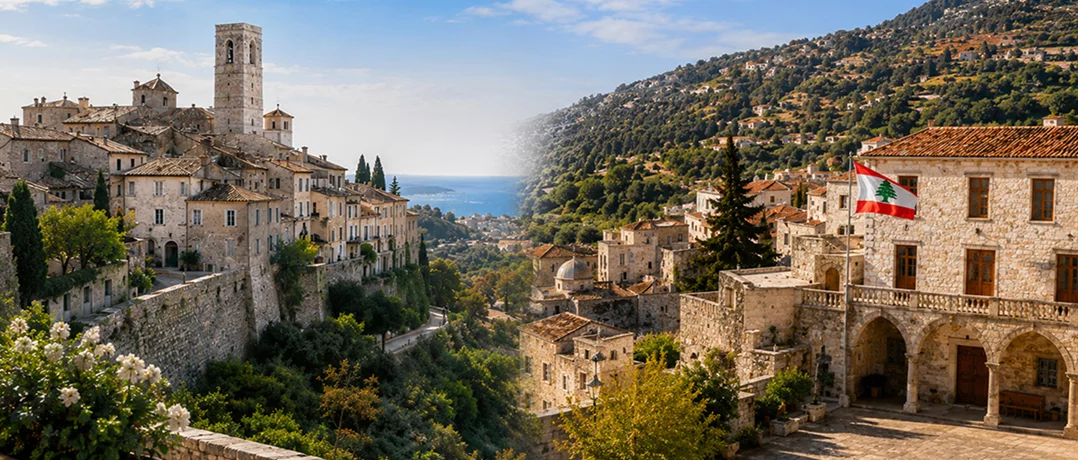
At the initiative of Mon Liban d'Azur, two of the Mediterranean's most storied villages have formalized a bond that geography, history, and culture had long been quietly forging. Perched above the glittering Côte d'Azur, the medieval village of Saint-Paul de Vence has for centuries drawn painters, poets, and pilgrims to its rampart-lined streets. Nearly three thousand kilometers to the east, nestled at 850 meters in the green folds of the Chouf mountains, Deir El Qamar, "the Convent of the Moon", watches over Lebanon with equal timelessness.
These two villages have now sealed what many felt was an inevitable kinship: a formal friendship pact brokered by Mon Liban d'Azur, the Franco-Lebanese cultural collective that has made cross-Mediterranean bridge-building its life's work.
The parallels between Saint-Paul de Vence and Deir El Qamar are striking enough to seem almost scripted. Both are compact, stone-built villages of extraordinary historical density. Saint-Paul de Vence is one of the oldest medieval towns on the French Riviera, celebrated for its Fondation Maeght, its Colombe d'Or hotel, where Picasso and Sartre once traded ideas over dinner, and the cobblestoned Grande Rue that has inspired generations of artists from Chagall to James Baldwin.
Deir El Qamar, for its part, was the capital of the Emirate of Mount Lebanon in the early 17th century under the visionary Emir Fakhreddine II, and was classified as a Lebanese national historical monument in 1945. Its main square, the Midane, is considered one of the most beautiful in the entire Middle East, flanked by palaces, a 15th-century mosque, and Maronite churches that together testify to centuries of coexistence between faiths. The village is also nominated, alongside the Beiteddine Palace and the Cedars of Barouk, for inscription on the UNESCO World Heritage List.
Both villages have long served as magnets for artists and intellectuals; both are defined by their stone architecture and their elevation, physical and cultural, above the everyday world.
The friendship pact would not have happened without Mon Liban d'Azur, a Nice-based intercultural collective whose stated mission is to weave bonds between the two shores of the Mediterranean. Founded by a Franco-Lebanese woman driven by a determination to amplify synergies between France's south and Lebanon, the association has over the years organized cultural dinners, charity events, cedar-planting ceremonies, and delegations of French elected officials to Lebanon. It has collaborated with the Metropole Nice Côte d'Azur, the Association of Lebanese Cities, and cultural institutions on both sides of the sea, raising roughly €150,000 for heritage, health, education, and social causes in Lebanon.
The relationship between Mon Liban d'Azur and Saint-Paul de Vence is not new. The municipality of Saint-Paul de Vence previously partnered with the association to organize the "Journées Libanaises", Lebanese Days, a two-day cultural celebration on the Place de Gaulle featuring Lebanese cuisine, crafts, art exhibitions, show cooking, and official speeches. A cedar of friendship was ceremonially planted during the event, with the mayor of Saint-Paul de Vence present, in a gesture that foreshadowed the deeper commitment now formalized in the friendship pact.
For Deir El Qamar, a village that has survived conquests, massacres, and civil war while preserving its architectural soul, the recognition from a prestigious Riviera commune carries genuine emotional significance.
For Saint-Paul de Vence, the pact is equally meaningful. A village long associated with creative cosmopolitanism and intercultural dialogue, it reinforces its identity as a place where borders dissolve in the presence of beauty and shared humanity.
The friendship between these two villages is, in the end, a Mediterranean story: two places shaped by the same light, the same sea of civilizations, and the same conviction that culture is what truly connects people across water and time.

