



As the ceasefire has done little to alter conditions in Lebanon’s south, Tyre functions as both a site of past strikes and a point of arrival for those still displaced.
Tyre: A target and a refuge

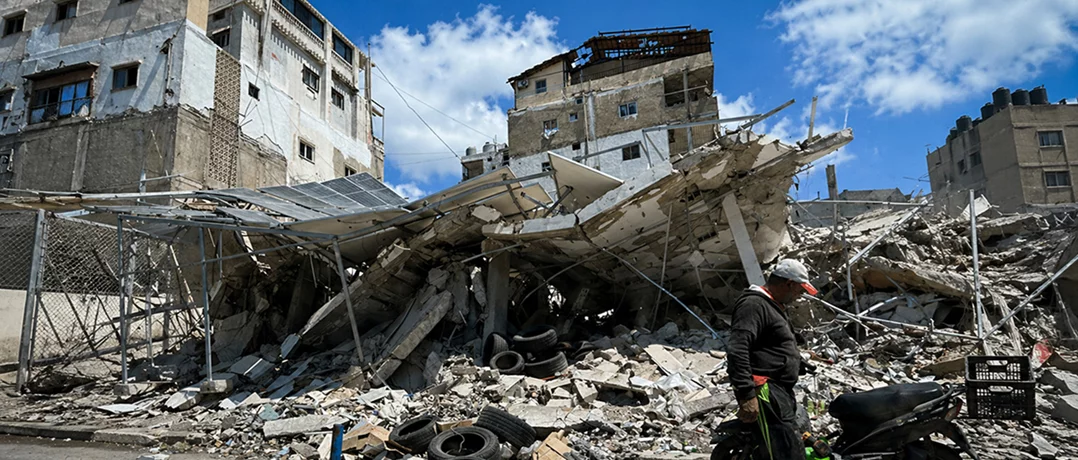
The road to Tyre is dotted with broken bridges.
Leaving the port city of Saida and continuing south along the coastal route, the road crosses the Litani River, where a destroyed bridge lies mangled beside the riverbank. To its right, a makeshift mound of sand and gravel functions as an improvised passage across the river. It is a bumpy crossing to be sure but suffices nonetheless.
The alternative route more inland yields no better results. There, when the road reaches the Litani, a gaping void marks where the Qasmieh bridge once stood, the last bridge destroyed just hours before the ceasefire took effect at midnight on April 16, cuts the road in two. A similar temporary workaround for passing cars runs beside the gap.
After crossing said detour, a checkpoint arrives, where a member of the Lebanese Armed Forces hands out flyers. “Unexploded ordnance remains extremely dangerous under the rubble,” the first page reads. “Do not approach. Do not touch. Report immediately.” The following three pages outline precautions related to white phosphorus contamination and other hazardous munitions.
Ten minutes later, the road reaches Tyre. Driving along the main street, there are clusters of destroyed buildings, with debris scattered along the roadside. The surrounding area, however, is fairly busy. It is just after 10am, and foot traffic is high.
This is Tyre, two months after the war broke out between Israel and Hezbollah and two weeks into the ceasefire. The fighting may have paused, but in Tyre, the war has not receded.

The south’s point of arrival
In the latest round of escalation, Tyre has become both a target and a refuge. Only 25 km north of the Israeli border, Tyre lies within range of some of the country’s most intense fighting and has itself been struck repeatedly.
Yet beyond its proximity and involvement in the conflict, the city also acts as the first point of arrival for those who live in areas that fall within Israel’s new security “buffer zone” that extends 5 to 10 kilometers into Lebanese territory and includes approximately 55 villages and towns.
Lebanese citizens have been prohibited from entering this zone, and many of the internally displaced people (IDPs from these areas have ended up in Tyre’s shelters. For some, Tyre’s closeness to their villages makes it a practical option. For others, there was simply no room in the shelters further north
The Disaster Risk Management unit for the Tyre District oversees much of the displacement response. Working with the Ministries of Education and Social Affairs, as well as NGOs such as the Red Cross, it tracks the movement and number of IDPs and coordinates relief efforts across 65 municipalities, including Tyre, Marjayoun, and Bint Jbeil.
Wissam, Vice-President of the unit, has watched the numbers climb. According to his dashboard monitoring displacement patterns and aid flows, nearly 18,000 people were displaced in the district as of late April, with around 3,500 in shelters and more than 14,000 outside them. Tyre city alone hosts over 7,400.
The level of detail captured in the tracking system is extensive. Beyond the typical demographics (age, sex, household size), Wissam can monitor the # of IDPs with disabilities, how many women are pregnant or breastfeeding (74 and 49 respectively), and which municipalities have sent the most IDPs (Burj el-Shamali, Beit Lif, then Aabbasiyyeh).
Compared to the war in 2024, Wissam explains, the scale has shifted significantly. With considerably more municipalities destroyed, the number of IDPs has skyrocketed. In 2024, the city operated six or seven shelters. Now there are sixteen, with new ones opening as demand grows. One had opened in Burj Shmeel the day before, and by the next morning, 22 families had already registered.
“There are so many IDPs and so few shelters,” Wissam said.
The past month, in particular, has marked a sharp escalation. In late March, Defence Minister Israel Katz announced an expansion of the “demolition of Lebanese houses in the border villages” to safeguard northern Israeli communities, after which military activity in southern Lebanon intensified.
While the Israeli military claims to be targeting warehouses, command headquarters, and additional infrastructure belonging to Hezbollah, legal analysts have warned that the deliberate destruction of homes is an illegal weapon of war and a form of collective punishment. In a statement released one day before the ceasefire, a collection of UN legal experts described the demolitions as similar to the “pattern of domicide that was initiated during the genocide in Gaza.”
The impact of Israel’s intensified operations is evident in Tyre’s displacement figures. And the ceasefire has done little to ease pressure on shelters or reverse the trend. Around 780 additional IDPs registered in the first two weeks following the ceasefire’s announcement, while many who initially returned home have since come back to Tyre’s shelters.
In several municipalities, such as Srifa, zero residents remain.
As Wissam turned back to the displacement dashboard on his computer, a new man stepped forward to register as displaced. Wissam asked a series of questions, filling in the form by hand: full name, number of family members, ID number, phone number, date, and signature.
Once registered, the man was directed to the next desk to receive further instructions concerning where and how to proceed.
On Wissam’s screen, the number rises by one.
Feeding Tyre’s displaced
To meet the needs of a growing displaced population, food provision operations have expanded. Minutes away from the DRR unit, one community kitchen now produces around 3,600 meals a day, prepared by a group of ten displaced women and distributed across shelters.
The kitchen remained active between the periods of fighting in 2024 and 2026, but its capacity has shifted considerably.
“In 2024, we were cooking 1000 meals a day with far more donations,” said head chef, Mounifia Aidibi. “Now…” she said, trailing off as she glanced around the kitchen.
Cooking, for Aidibi, is second-nature. She once ran her own kitchen before it was destroyed in 2024. Some of the equipment now in use at the community kitchen, including three massive vats of rice and vegetables, was salvaged from her former restaurant.
“The needs here are high,” she said. “And many who left are returning.”
Life inside the shelter
At a shelter in Tyre, the scale of displacement becomes immediate. With 497 IDPs across 118 households, the shelter operates at near full capacity.
Almost two months into the war, a semblance of routine has emerged. In one first-floor room, a cheesecake making class is in session. The idea came from four of the shelter’s children whose mother used to make cheesecake at home.
The children’s home has since been destroyed.
Next to the table where the cheesecake is being prepared, a group of younger children are playing a clapping game with a representative from Sheild, a Lebanese NGO that delivers psychosocial support, community-based activities, and livelihood assistance to displaced and conflict-affected communities across southern Lebanon.
“What do you like to eat?” she calls out. “Cake!” “Shawarma!” “Almonds!” “Watermelon!” the children respond.

Many of the children have been out of school since the start of the war. The implications are likely to be long-lasting. Research from UNICEF and the World Bank indicates that conflict-driven displacement can severely disrupt education, with even short periods out of school leading to long-term learning losses. With no immediate pathway to resume school sessions, the disruption is set to extend further.
The war has taken an emotional strain on the shelter’s older residents as well.
Consider the flowers placed on two tables at the edge of the room. Their presence traces back to an earlier session, Eva Homsi, Sheild’s executive director, said, when participants were asked to recall sensory details from before the war. “Around 80 percent said they smelled flowers from home.” This time, Sheild brought them.
According to the World Health Organization, one in five people in conflict-affected settings experience mental health conditions. Interventions that focus on emotional stability and familiarity are increasingly central to the response.
“We try to mainstream all activities and target the same population through different approaches,” Homsi said.
One of the shelter’s women, Zeinab, has turned to poetry as an outlet. In a recent piece, translated by Homsi, Zeinab describes speaking to a cup of coffee, telling it of her sorrow and challenges as she drinks.
“My sadness is hugging the cup with my lips,” she recites.
Her favorite poets are the Rahbani brothers, Mansour and Assi, best known for writing lyrics and poetic texts for the iconic Lebanese singer Fairuz. She keeps a collection of their work at her home in Beit Lif, now out of reach.
“I love poetry,” she says. “So I write often here.”
For Zeinab, poetry offers a way to contain what has been lost. After two months of war in Lebanon, much has been lost. Although the ceasefire remains fragile, parts of the country have returned to a degree of normal activity, reassured by the absence of strikes and evacuation orders.
But in much of the south, this shift has not taken hold. Shelters remain full, returns remain limited, and systemic destruction of infrastructure continues.
The road to Tyre still runs over broken bridges.
-
-
-
Katharine SorensenReporterSpecializing in global affairs, technology and economics, with a focus on on-the-ground investigative reporting.
-
