



Britain’s renewed push for emergency preparedness reflects growing fears of cyberattacks, climate disasters and conflict, alongside a rising prepper movement and declining trust in state protection.
UK government warns: prepare for the end times
UK government warns: prepare for the end times
By Tony McMahon | October 10, 2026

Reading time: 5 min
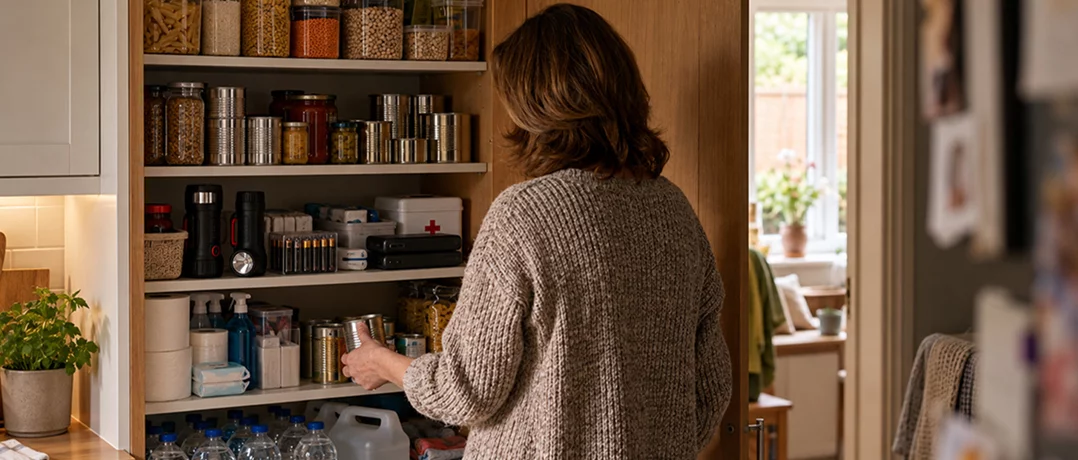
The UK government is warning the British public of a future catastrophe where government services, shops, hospitals, and schools will break down. It’s the kind of advice that caused shockwaves in the 1970s as fears of nuclear war grew. Today, it’s cyber-attacks, climate change, or hostile state action that is spurring the government into action.
A new mood of gloom is undoubtedly gripping the nation. Channel Four recently began airing a new reality survival series, Apocalypse, in which rival teams – Eastside and Westside – must scavenge in an abandoned town with no electricity, water, food supply, or communication.
Meanwhile Sky One has aired a reality show featuring real-life UK politicians that imitates the Cabinet Office Briefing Room (COBRA) meetings convened during national emergencies. The Wargame casts real-life politicians as Britain’s political leaders during a nuclear strike by Russia. Michael Gove, a former Conservative cabinet minister, is now the Prime Minister, while the ex-First Minister of Scotland, Nicola Sturgeon, is his deputy. Ominously, it’s set only nine months in the future.
But these two works of TV fiction are simply mirroring what is unfurling on the ground in Britain. Already a movement of “preppers” is emerging across the UK as trust in state institutions weakens. Covid lockdown kicked off this trend, but subsequent world events have accelerated it.
Dr Kezia Barker, Associate Professor in Environment Futures at Liverpool John Moores University has studied this phenomenon.
“Prepping in the UK is not defined by anti-government libertarian anxiety, but more by a lack of trust that the state is willing or able to protect you from crisis. So not so much worrying that the government will come for you but believing that it won’t.”
The new government advice will come from the Cabinet Office, which operates directly under the Prime Minister. Recommendations will include stockpiling tinned food and keeping the most basic supplies in case of national shortages. The story broke in the Financial Times revealing that politicians were anxious to boost “domestic resilience”.
Cabinet Office minister Louise Haigh, a close ally of Prime Minister Andy Burnham, is co-ordinating the campaign. The threats to British society have been identified as weather-related emergencies, cyber-attacks, and military attacks, most likely from Russian given London’s support for Ukraine in the current war.
Whitehall is preparing a “war book” – a manual for defending the nation against external dangers. A social media campaign would reinforce key messages. Meanwhile, preppers appear to be one step ahead, mirroring a similar trend in the United States, though with key differences.
Dr Luke Kemp is a research associate at the Centre for the Study of Existential Risk at the University of Cambridge. He believes that whereas in the Cold War period from the 1950s to the 1980s, government led survival strategies, now it’s more decentralised and privatised.
“In my book 'Goliath's Curse: The History and Future of Societal Collapse' I use a database of over 300 past societies to show how increasing wealth and power concentration made societies more vulnerable to collapse. This does not bode well for the future. We also face far more severe threats today. While a nuclear war didn't occur in the 1980's, we've had at least a dozen near-misses and today there are still enough nuclear weapons to kill billions.”
Parker has found that whereas many American preppers fixate on access to guns, and a violent societal rupture, British preppers are far less concerned about amassing an armoury or turning a residential home into a fortress. Their approach echoes the “dig for victory” ethos of the Second World War when cities across the UK, bombed repeatedly by the Germans during the Blitz of 1940-41, where stocking up foodstuffs and having good repair skills was crucial.
There’s also been a recent shift in UK prepper activity from being a predominantly male, working-class activity to women with young families. Also disabled people who are very pessimistic about the support they would receive in a major crisis. However, Parker also notes a new and growing force within British prepping: the ultra-nationalist extreme Right.
She believes that a future catastrophe in Britain leading to enforced self-sufficiency will not be a sudden jolt, but a “slow apocalypse” as depicted in the BBC/HBO drama Years and Years, broadcast in 2019. The plot involved a populist politician, Vivienne Rook, who plans concentration camps for opponents and pushes the country into civil war. It also wove in concerns about the abuse of technology.
The UK government has issued emergency guidelines to the public, most famously pausing before mailing an alarming pamphlet titled Protect and Survive to every home at the height of fears over nuclear war in 1980. The front cover informed the recipient: “This booklet tells you how to make your home and your family as safe as possible under nuclear attack.”
It’s still a chilling read today. The public were instructed on how to understand the different sirens that would be used, especially the one warning about nuclear fall-out. With an explanatory image, Protect and Survive told anybody caught outdoors after a nuclear bomb had exploded to throw themselves into a ditch and cover exposed skin with anything to hand, like a jacket.
Every house would have a designated “fall-out room” within which an “inner refuge” would be constructed using bin-liners full of sand and earth surrounding a door leant against the wall.
“You may have casualties from an attack, which you will have to care for, perhaps for some days, without medical help. Be sure you have your first aid requirements in your survival kit.”
Today, online prepper shops targeting UK customers are selling camping equipment, emergency food rations, and crossbows. It mixes the promise of an adventurous lifestyle, returning to nature, with an ominous message that something terrible is about to happen.
Many in the UK are preparing for societal collapse, hoping they will emerge to inherit whatever is left. Their behaviour, once dismissed as weird, is increasingly looking like good planning to many Britons.
-
-

-
Tony McMahonJournalistInvestigative historian, published author.
-
