



Ukraine’s use of unmanned systems to seize Russian positions marks a notable shift toward robotic warfare, redefining combat through risk reduction, asymmetric advantage, and accelerating human-machine integration in military operations.
Ukraine replaces soldiers with robots

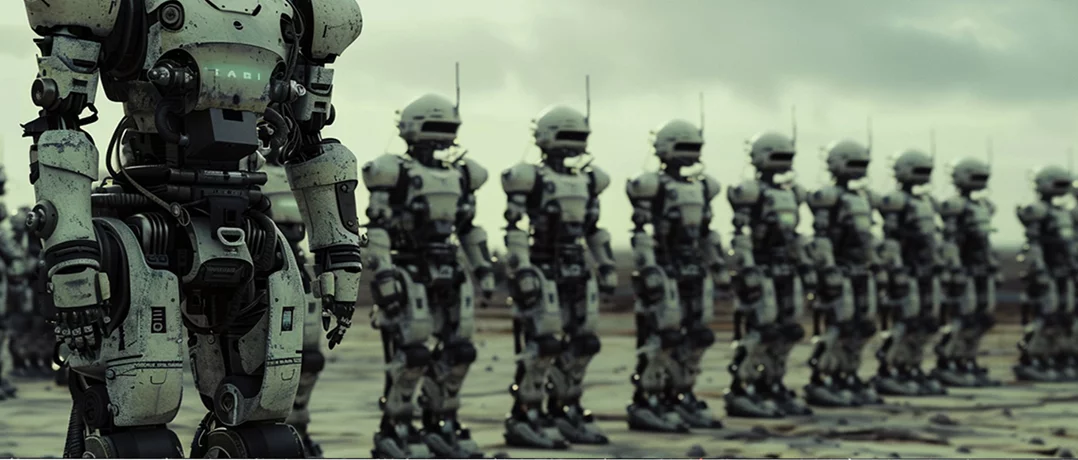
The war in Ukraine has increasingly become a laboratory for modern warfare, where technological innovation is reshaping how battles are fought and won. In a development that signals a potential turning point in military history, Ukrainian President Volodymyr Zelenskyy announced that Ukrainian forces have, for the first time, captured a Russian military position using only unmanned systems (ground robotic platforms and drones) without any direct infantry involvement. According to Zelenskyy, the operation was conducted without casualties on the Ukrainian side, marking what he described as a historic moment in warfare.
This reflects a rapidly accelerating transformation on the battlefield, where robots are no longer merely supporting soldiers but increasingly replacing them in high-risk operations.
A historic battlefield operation without soldiers
Zelenskyy stated that “for the first time in the history of this war, an enemy position was taken exclusively by unmanned platforms,” highlighting that Russian forces ultimately surrendered to machines rather than human soldiers. The operation reportedly involved coordinated use of ground robotic systems and aerial drones, controlled remotely from safe positions far from the front line.
Military commanders involved in similar missions describe a scenario that once belonged to science fiction. In one case cited by Ukrainian forces, Russian soldiers surrendered to robotic systems after being surrounded and pressured by unmanned platforms operating with precision and coordination. The absence of human infantry in the assault underscores a new tactical reality: combat objectives can now be achieved through remote-controlled systems designed to minimize human exposure.
The rise of ground robotic systems in combat
Ukraine’s increased reliance on unmanned ground vehicles (UGVs), often referred to as land robots, has evolved out of necessity. The battlefield has become saturated with surveillance drones and long-range precision weapons, making traditional troop movement extremely dangerous. As a result, Ukrainian forces have adapted by deploying robotic systems for logistics, evacuation, reconnaissance, and increasingly, direct combat roles.
These systems, while currently piloted remotely by human operators, are capable of performing a wide range of tasks. They transport ammunition and supplies, evacuate wounded soldiers from “kill zones,” and even engage enemy positions. Their ability to operate in harsh weather conditions, carry heavy loads, and withstand prolonged missions gives them a significant advantage over aerial drones in certain scenarios.
According to battlefield reports, some units have already demonstrated remarkable endurance. In one documented case, a single armed ground robot reportedly held off a Russian advance for more than a month with minimal maintenance. Such examples illustrate how unmanned systems are beginning to influence not only tactical operations but also broader strategic outcomes.
Scale and impact: Thousands of robotic missions
Ukrainian President Zelenskyy revealed that in just the first 3 months of 2026, ground robotic systems conducted more than 22,000 missions along the front line. These operations range from logistical support to combat engagement, but their collective impact is consistent: reducing human exposure to lethal threats.
Military officials stress that each robotic mission potentially represents a life saved. Instead of sending soldiers into areas heavily monitored by enemy drones and artillery, Ukraine increasingly deploys unmanned systems to carry out the most dangerous tasks. This shift reflects a broader strategic doctrine centered on preserving manpower while maximizing technological superiority.
A shift in military doctrine and strategy
Ukraine’s approach to warfare has evolved into a technology-driven model that integrates drones, robotics, and data systems into a unified operational framework. Defense planners are reportedly working toward a system where unmanned platforms handle a significant portion of frontline logistics and even combat support functions.
This transformation is driven by necessity as much as innovation. Ukraine faces a numerically larger adversary, making traditional force-on-force parity impossible. Instead, military leaders aim to achieve asymmetric advantage through technology. As one commander explained, the key challenge is not invention but scale; ensuring that robotic systems can be deployed widely and consistently across the battlefield.
Analysts from defense think tanks have noted that this shift is already influencing battlefield dynamics. The increased use of drones and ground systems has contributed to slowing enemy advances and enabling targeted counteroffensives. However, experts also caution that while robots are highly effective in support roles, they are not yet capable of fully holding territory without human troops.
Strategic implications beyond Ukraine
Ukraine’s battlefield innovations are attracting global attention. Militaries worldwide are observing how relatively low-cost unmanned systems can counter expensive conventional weaponry. In some conflicts, drones worth tens of thousands of dollars have forced the use of multimillion-dollar missile systems for interception, raising questions about cost-efficiency in modern warfare.
As a result, Ukraine has begun sharing its battlefield experience with international partners. Through diplomatic engagements and defense cooperation agreements, it is offering expertise in drone warfare in exchange for military assistance. Countries in the Middle East and Europe have shown growing interest in these systems as they reassess their own defense strategies.
The Future of Warfare: Human Control Remains Central
Despite rapid technological advancement, Ukrainian commanders remain cautious about fully autonomous combat systems. While artificial intelligence is increasingly integrated into targeting and navigation functions, human oversight is still considered essential. Concerns over misidentification, system failures, and ethical accountability continue to limit the role of fully autonomous weapons.
Military leaders stress that even in an era of advanced robotics, human decision-making remains central to warfare. Robots may execute missions, but strategic judgment and final authorization remain firmly in human hands.
While it is unlikely that robots will fully replace soldiers in the near future, their expanding role signals a profound shift in how wars are fought. Ukraine’s experience demonstrates that unmanned systems are already saving lives, altering battlefield dynamics, and redefining military doctrine. As one commander put it, robots do not bleed, but their impact on the future of war is already undeniable.
-
-

-
The Beiruter
-
