



Discover the story of Our Lady of Lebanon in Harissa, from her arrival from France to her place as a symbol of faith and belonging, featuring an exclusive interview with Father Fadi El Mir on the sanctuary’s history, mission and meaning for generations of Lebanese.
Under the Morning Star: The story of Our Lady of Lebanon
Under the Morning Star: The story of Our Lady of Lebanon
By Michella Rizk | August 14, 2026

Reading time: 7 min
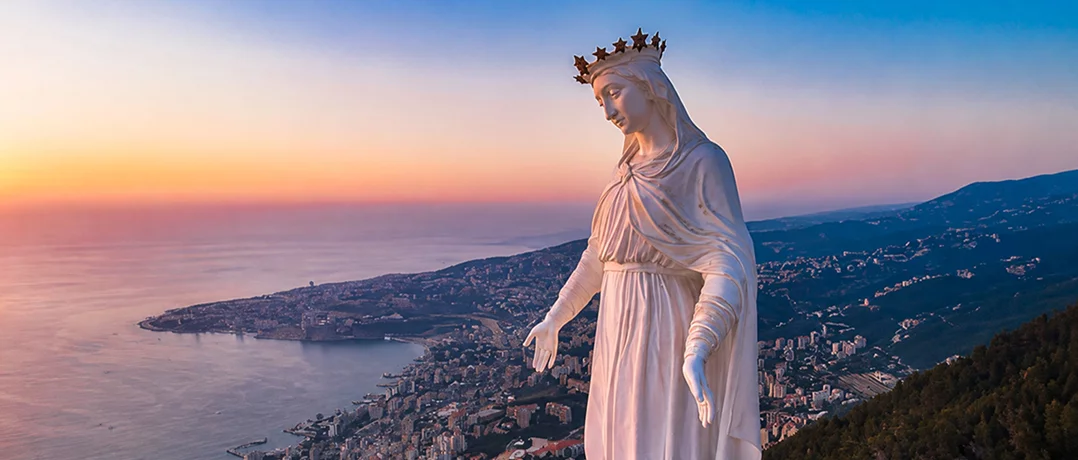
From the coast, she is unmistakable. High above Jounieh, a white figure stands against the green mountain, her arms open toward the Mediterranean and the country below. For generations, her silhouette has become inseparable from Harissa.
But placing the Virgin Mary atop that mountain was no simple undertaking.
Cast thousands of kilometers away, the statue crossed the Mediterranean in pieces before beginning the difficult journey from the coast to the summit of Harissa at the dawn of the 20th century.
More than a century later, Our Lady of Lebanon remains one of the country’s most recognizable religious symbols, while Harissa has become a place of pilgrimage, prayer and memory for Lebanese and visitors from different religious communities.
How Mary reached the mountain
The story began in 1904, when Catholics marked 50 years since Pope Pius IX proclaimed the Immaculate Conception in 1854. In Lebanon, Maronite Patriarch Elias Hoayek and Apostolic Nuncio Carlos Duval wanted the occasion to leave something permanent behind.
The idea became a monumental statue of the Virgin, visible from afar and symbolizing the Lebanese people's devotion to Mary.
Harissa offered the setting. Rising around 650 meters above sea level, the summit overlooks Jounieh Bay, Beirut and the Mediterranean. It also stands near Bkerke, the seat of the Maronite Patriarchate, and the Apostolic Nunciature.
A site known as “the Rock” was selected. The land was purchased from Francis Yaacoub for 50 Ottoman pounds, and the foundation stone was laid in October 1904.
Lebanon was still under Ottoman rule, so the project required official authorization. According to the sanctuary’s historical records, an imperial firman was requested from Istanbul before construction began.
The statue was cast in bronze in Lyon, France, and divided into seven sections for transport. It arrived at Beirut port in 1906.
Moving a 15-ton bronze statue up the mountain was a major undertaking. Historical accounts describe carts, animals, rails and manpower being used to transport and raise the sections into position.
Once assembled, the Virgin stood 8.5 meters high. Painted white, she was placed on a roughly 20-meter stone pedestal, with 104 spiral steps inside leading upward.
On May 3, 1908, the sanctuary was formally inaugurated and given a name that would come to mean far more than its location: Our Lady of Lebanon.
The mother of all
For Father Fadi El Mir, administrator of the Sanctuary of Our Lady of Lebanon, the name reflects what Harissa gradually became. She was not named for Harissa, Keserwan or a particular Christian community, but for the country itself.
The Congregation of Lebanese Maronite Missionaries has served the sanctuary since its early years, he told The Beiruter. Yet those climbing the mountain have never belonged to one community.
“It became a shrine visited by everyone,” El Mir said, pointing to Christians, Druze, Shiite and Sunni Muslims among its visitors.
Some come for Mass, others with a vow or prayer, while some simply stand before the Virgin. For El Mir, this is where Harissa takes on its national character.
It brings all Lebanese together under the protection of our mother, the Virgin Mary, who is the mother of all.
Christian and Muslim understandings of Mary differ, but at Harissa, those relationships can share the same space. According to El Mir, the sanctuary welcomes around 1.5 million visitors a year.
Over time, the name given to the shrine in 1908 travelled far beyond the mountain. As Lebanese communities settled abroad, they carried Our Lady of Lebanon with them. Churches and Marian communities bearing her name appeared in France, South Africa, Australia, the United States, Canada, Argentina and Brazil.
El Mir knows that story personally. He spent 13 years serving at Our Lady of Lebanon in Paris before working with the Lebanese community in South Africa.
“Wherever you go,” he said, Lebanese communities have carried her name with them.
For emigrants, these churches became a way to maintain a connection to Lebanon. Lebanese returning home also brought friends and families from their countries of residence to Harissa, expanding the shrine’s international reach.
Today, pilgrims arrive from the Arab world, Europe, Africa and the Americas, while Harissa participates in international gatherings of Marian sanctuaries.
A shrine that had to grow
As the number of pilgrims grew, the original sanctuary could no longer accommodate everyone coming to Harissa. A much larger basilica was planned beside it, with its foundation stone laid around 1970 and construction beginning in the early 1970s.
Its architecture was designed to reflect Lebanon, drawing on two national symbols: the “cedar and the Phoenician ship”. The basilica accommodates around 3,500 seated worshippers, measuring roughly 115 meters long and 67 meters wide, with a dome rising 62 meters.
Yet its most striking feature may be its connection to the original sanctuary. From inside the basilica, worshippers can look behind the main altar and see the original statue of Our Lady of Lebanon outside. Built for larger crowds, the new sanctuary never turned its back on the old one.
Harissa also hosted major moments in Lebanon’s Catholic history. In May 1997, Pope John Paul II visited during his historic trip and signed “A New Hope for Lebanon” there.
But Harissa’s meaning is perhaps clearest on ordinary days: families climbing the steps, worshippers attending Mass or confession, and visitors standing quietly before the Virgin with prayers they may never say aloud.
For El Mir, this is where the meaning of Mary begins.
What pilgrims come looking for
He describes Mary as "example, intercessor and protector". She represents “humility, purity, silence and great love for her son Jesus and for every one of us.”
For El Mir, Catholics do not worship Mary but ask for her intercession, believing she ultimately points to Christ.
She is the Morning Star who guides everyone to Christ.
The sanctuary has recorded testimonies of healings and answered prayers attributed to her intercession, including from Muslims and non-Christians.
As "Protector", Mary’s image above the coast, arms extended toward Lebanon, has embodied protection for generations. This devotion is especially visible in May, when pilgrims gather for Mass, confession, prayers and the rosary. Celebrations include processions, Marian prayers in several languages and symbolic traditions bringing together young people from across Lebanon.
On August 15, the Feast of the Assumption, worshippers process with the Virgin’s statue, while boiled wheat is blessed and shared.
Yet beyond the crowds, El Mir sees Harissa as a place of quiet faith.
“This shrine welcomes everyone,” he said. “It is a place for silence and prayer.”
The whole world needs prayer, whether in Lebanon or outside Lebanon.
The Harissa few visitors see
Once a week, a different group makes its way to Harissa.
Elderly and vulnerable residents from surrounding communities are picked up and brought to the sanctuary. They attend Mass, share lunch and spend time together before being driven home.
It is part of a side of Harissa that is easy to miss if the visit ends after the 104 steps and the view.
Masses are celebrated throughout the day, alongside confession and spiritual guidance. A listening center opened in 2022 offers a place for people who need to talk, while priests and specialists provide psychological and social support.
The sanctuary's work also extends to more practical needs. Medical services include general medicine, pediatrics, gynecology and dentistry, alongside a pharmacy and assistance with equipment for people with disabilities.
Young volunteers from the Knights of the Cedars and its children's branch help sustain religious celebrations, cultural programs and social initiatives.
For the visitor looking up from Jounieh, none of this is visible.
The statue is the landmark.
But around it, Harissa remains a living sanctuary: a place people come to for prayer, but also one that tries to care for them when they arrive.
Looking beyond the mountain
More than a century has passed since seven pieces of a bronze Virgin arrived at Beirut port. Since then, Lebanon has endured wars, political upheaval and waves of emigration, while generations have climbed Harissa to stand beneath Our Lady of Lebanon. Others have encountered her far from home, in churches built by Lebanese communities abroad.
Yet every August 15, the story returns to the Feast of the Assumption, when Catholics celebrate Mary being assumed, body and soul, into heaven. For El Mir, the feast carries a broader message. Human beings, he said, are not on earth simply to die and be buried here. Mary’s Assumption points Christians toward another destination, a passage “from this perishable earth to the Kingdom.”
Following Christ’s Resurrection and Ascension, he sees the Assumption as a sign that earthly life is not the end.
It shows us that our faith in eternal life is firm and true, and that our hope is strong.
-
-
-
Michella RizkContent Manager/WriterFocusing on social affairs.
-
