



Albania’s “Flamingo Revolution” marks a growing grassroots movement sparked by Jared Kushner’s proposed luxury resort dispute, expanding into wider demands for environmental protection and political reform.
Unpacking Albania’s “Flamingo Revolution”

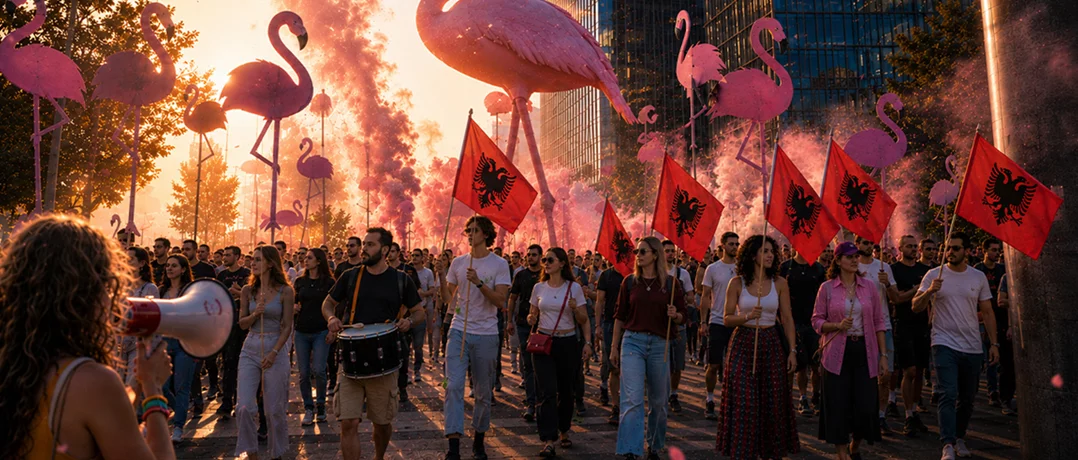
What began as a controversial tourism development on Albania’s southern coast has evolved into one of the most significant political movements in the country’s post-communist history. A proposed €1.4 billion luxury resort associated with American investor Jared Kushner, the son-in-law of United States (U.S.) President Donald Trump, has become the focal point of widespread public frustration over environmental protection, governance, corruption, economic inequality, and Albania’s future direction.
Although the project itself remains under review and Albanian authorities insist that environmental standards will be respected, the controversy surrounding the development has ignited a grassroots movement known as the “Flamingo Revolution.” The protests have rapidly expanded beyond opposition to a single investment project and transformed into a broader challenge to Albania’s political establishment.
The resort that sparked a national debate
The controversy centers on plans for a luxury tourism complex near the Pishë Poro-Narta protected area and the Vjosa River delta in southern Albania. The region is widely regarded as one of the country’s most ecologically valuable landscapes, providing habitat for flamingos, sea turtles, Mediterranean monk seals, and hundreds of migratory bird species.
The proposed development would create a large tourism destination capable of accommodating approximately 10,000 guests. Supporters argue that the project could generate jobs, attract foreign investment, and further strengthen Albania’s growing tourism industry. Critics, however, fear that large-scale construction could permanently damage a fragile ecosystem and undermine one of the country’s most important natural assets.
Environmental concerns intensified after reports emerged that infrastructure work had begun before a comprehensive environmental impact assessment had been completed. Activists documented the construction of access roads and alleged damage to protected habitats, while confrontations between protesters, private security personnel, and authorities further increased public attention.
From environmental protests to political movement
Initially, opposition to the project was driven primarily by environmental organizations, conservationists, and local residents. However, the movement quickly expanded as many Albanians began viewing the development as a symbol of broader structural problems within the country, describing the protests as an expression of long-standing dissatisfaction with Albania’s political and economic trajectory since the fall of communism in 1991.
As protests grew, demands shifted from simply halting the resort to calling for political accountability and institutional reform. Demonstrators argue that the project reflects a political system that prioritizes powerful investors and political connections over public consultation and environmental protection.
Additionally, for decades, Albanian politics has been dominated by 2 major figures: PM Edi Rama and former PM Sali Berisha. Protesters increasingly argue that political competition between the 2 leaders has failed to address persistent concerns about corruption, low wages, emigration, and economic inequality. As a result, the protests have become largely independent of established political parties, attracting citizens from diverse ideological backgrounds united by dissatisfaction with the status quo.
The movement attracted thousands of participants across Albania, including demonstrations in Tirana, Shkodra, Durrës, Lezhë, Gjirokastër, and other cities. Albanian communities abroad also organized solidarity protests in several European and North American cities.
The flamingo, whose habitat is at the center of the dispute, emerged as the movement’s symbol. Protesters carried flamingo-themed signs and banners, transforming the bird into a representation of resistance against what many perceived as unsustainable development and political favoritism.
Tourism development versus environmental protection
The dispute highlights a broader challenge facing Albania as it experiences rapid growth in international tourism. Over the past decade, visitor numbers have increased dramatically, transforming the country into one of Europe’s fastest-growing travel destinations.
PM Rama has championed tourism as a key driver of economic development, arguing that foreign investment is essential for improving living standards and integrating Albania more deeply into the global economy. Supporters of this strategy believe that large-scale tourism projects can generate employment, modernize infrastructure, and increase government revenues.
Opponents, however, argue that uncontrolled development risks repeating mistakes made elsewhere in the Mediterranean, where excessive construction has damaged coastlines and reduced environmental sustainability. Critics maintain that Albania’s competitive advantage lies precisely in its relatively untouched landscapes, pristine beaches, and unique ecosystems.
The controversy therefore reflects a fundamental debate over what kind of tourism model Albania should pursue: large-scale luxury developments aimed at international investors or a more sustainable approach focused on environmental preservation and local communities.
Implications for European Union membership
The dispute has also attracted attention from the European Union (EU), which closely monitors environmental governance as part of Albania’s accession process.
Albania remains one of the leading candidates for future EU membership, alongside neighboring Montenegro. However, environmental protection forms an important component of EU accession requirements. European officials have expressed concern about legal changes that allow exemptions for major investment projects and have emphasized the need for rigorous environmental assessments.
In response, Albanian authorities have assured Brussels that the project will comply with European environmental standards and that a full environmental impact assessment will be conducted. EU representatives have welcomed those assurances while continuing to monitor developments closely.
The outcome of the controversy could therefore influence not only domestic politics but also Albania’s broader European integration ambitions.
Hence, whether Jared Kushner’s proposed resort ultimately proceeds or not, the “Flamingo Revolution” has already demonstrated that questions surrounding development, environmental protection, and political accountability have become central to Albania’s future. The protests may ultimately be remembered not simply as opposition to a luxury resort, but as a defining moment in the country’s ongoing effort to determine what kind of nation it wants to become.
-
-

-
The Beiruter
-
