Long before modern debates about sexuality, poets, rulers, and intellectuals across the Islamic Golden Age left behind a rich record of same-sex relationships, gender diversity, and homoerotic literature.




Long before modern debates about sexuality, poets, rulers, and intellectuals across the Islamic Golden Age left behind a rich record of same-sex relationships, gender diversity, and homoerotic literature.

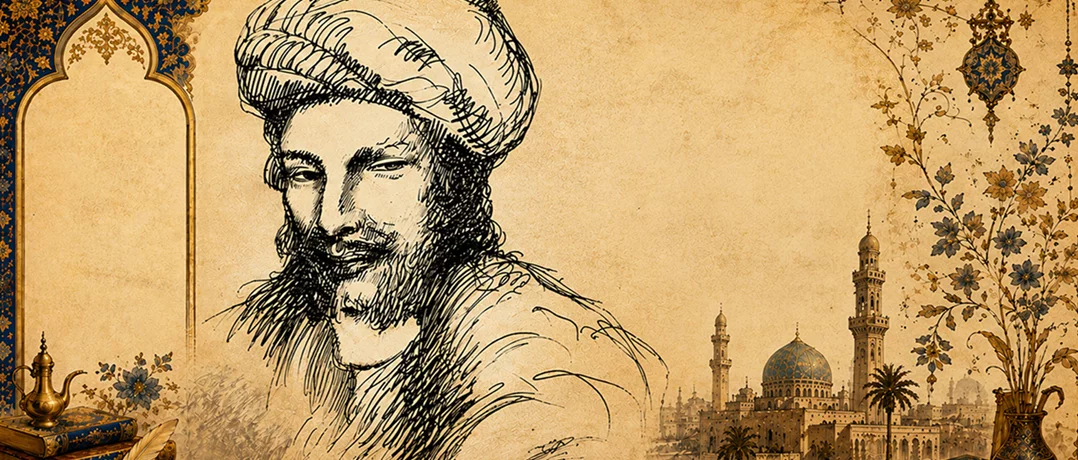
When Islamic civilisation was the envy of the world and its greatest city, Baghdad, dripped with gold and wealth, there was also a surprising level of tolerance for same sex love.
It’s Pride Month across the world when LGBT people celebrate their community and the ongoing fight for equality and legal rights. It may come as a surprise but there is a rich Muslim LGBT history stretching back over 1,000 years. Poets, sultans, and warriors expressed their love for other men, especially in the medieval Islamic Golden Age.
Abu Nuwas (c.756-814) lived in Baghdad at the height of the Abbasid caliphate. His poems made witty observations about urban life, including his love of handsome young men. On one occasion, he entered a bathhouse and was very pleased by what he saw:
In the bathhouse, the mysteries hidden by trousers
Are revealed to you.
All becomes radiantly manifest.
Feast your eyes without restraint! ....
Ah, what a palace of pleasure is the bathhouse!
Even when the towel-bearers come in
And spoil the fun a bit.
There was a whole genre of medieval Arabic poetry called ‘Mujun’ – meaning, shameless. And the caliphate’s elite could not get enough of it.
Poets like Ibn Sara as-Santarini (1043-1123) and Ahmad al-Tifashi (1184-1253) provoked scandalised giggles from their readers. For example, Al-Tifashi described a man called Abu Ahmad who “wriggles when he walks, like a swimming fish”.
In Al-Andalus (Muslim ruled Spain and Portugal), the poet Muhammad ibn Ammar (1031-1086) had a stormy love affair with the ruler of Seville, Al-Mu’tamid ibn Abbad (c.1069-1091) describing their “night of union” where “there was wafted to me, in his caresses, the perfume of its dawns”. Al-Mu’tamid also put pen to paper:
“I made him captive - his charming eyes in turn
Made me his captive: now we both are masters, both slaves!
Oh Sword, be kind toward a captive of love,
Who asks not, as a favour, to be freed by you!”
Al Mu’tamid installed Ibn Ammar as his vizier, but the ungrateful lover rebelled and was not only imprisoned but killed in person by the man with whom he had shared that night of passion.
The sixth Abbasid caliph was Abu Musa Muhammad ibn Harun al-Rashid – better known as Al-Amin (787-813). He was open about his same-sex relationships, especially with a slave named Kawthar. The caliph wrote: “Kawthar is my soul, my religion, my illness, and my therapeutic”.
Al-Amin never consummated his marriage and ignored the female concubines. His mother, Zubayudah, began worrying that he would not produce an heir. So, she ordered the female slaves in the palace to dress as men, even cutting their hair short and wearing fake moustaches. The tactic did not work, and Al-Amin was overthrown by his own brother.
There was a wide spectrum of sexuality in the Islamic Golden Age, which included eunuchs, homosexuals, and ‘ghumaliyyat’. The latter were enslaved women who cross-dressed to look more masculine and appeal to gay men like Al-Amin. In Al-Andalus, Iberian Christians were often horrified at the gender fluidity in elite Muslim households, and it was a point of cultural friction.
From the late 15th to the early 20th century, the Ottoman Empire dominated the Muslim world including the Levant. Theodore Spandounes was a Greek historian in the early 16th century who fled Constantinople when it fell to the Ottomans but then went back to try and understand the enemy of his family.
Spandounes was confused by the bisexuality of the empire’s rulers, especially as this seemed to clash with Muslim scripture:
“They are the most self-indulgent men in the world. They keep many women because their law encourages the propagation of children. But they also cohabit with quantities of men.”
An intriguing story told by the Byzantine chronicler Laonikos Chalkokondyles (1423–1470) claims that the Ottoman sultan Mehmed II (1432-1481), famous for conquering Constantinople, had an affair with a Romanian prince, Radu the Handsome (c.1438-1475). Radu’s older brother, Vlad III, was the ruler of Wallachia and the inspiration for the horror novel Dracula. He was notorious for impaling Ottoman enemies on wooden stakes so Mehmed and Radu invaded Wallachia, ending his bloody rule.
Lesbian love was recognised during the Islamic Golden Age with both physicians and poets recording same sex relations between women. One scholar speculated that it was due to excessive heat in the labia. However, the fourth Abbasid caliph, Musa al-Hadi (764-786) was furious when he received reports from a court eunuch that two women in his harem were having an affair.
The historian Muhammad ibn Jarir al-Tabari (839-923) wrote that Al-Hadi personally beheaded the two women himself. Their heads were then brought on a platter into a banquet he held later. However, the reason for the double execution was less to do with morals than property rights. Al-Hadi was furious that these women, owned by him, were pleasuring each other instead of reserving themselves solely for him.
Attitudes have certainly changed since the Islamic Golden Age. In 2001, the Egyptian Ministry of Culture ordered the burning of 6,000 copies of the works of Abu Nuwas, especially targeting his homoerotic works. One member of parliament condemned the 9th century verses as “explicitly indecent material amounting to pornography”. Publishers were dismissed from their jobs for corrupting public morals.
One must wonder what the long dead sultans and poets of the caliphate a millennium ago would say as their works went up in flames. Maybe they would enjoy the shock value it still provokes.