A new participatory initiative by BeyArt and BeMA is transforming Lebanon’s public spaces through student-led murals, beginning in the historic coastal city of Batroun.




A new participatory initiative by BeyArt and BeMA is transforming Lebanon’s public spaces through student-led murals, beginning in the historic coastal city of Batroun.

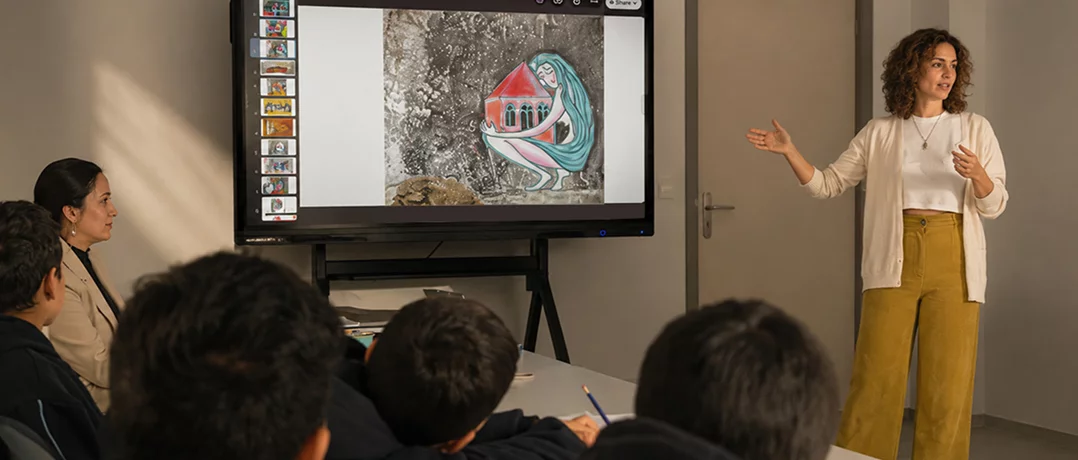
BeyArt and BeMA have launched a landmark participatory initiative, beginning in the ancient city of Batroun. On May 7, 2026, students from Batroun Elementary Public School are painting a mural on the walls of their city as part of “Urban Blooms”. The project combines arts education with public intervention, embedding student participation directly into the production of a permanent mural in their city.
This is the promise behind “Urban Blooms,” the inaugural participatory cultural initiative launched by BeyArt in collaboration with the Beirut Museum of Art (BeMA). Blending arts education, community engagement, and public intervention, the project redefines the role of public art in Lebanon today, transforming it into a living, collective expression of identity, memory, and civic connection.
At its core, “Urban Blooms” is conceived as a long-term, scalable platform that moves art beyond traditional gallery settings and embeds it directly into the rhythms of daily life. The initiative unfolds across Lebanon's cultural and geographic landscapes, with each chapter engaging a specific site through artistic practices rooted in its history, its communities, and its living heritage.
BeyArt has framed the Batroun chapter as the first in a series of interventions across Lebanon's varied cultural and geographic landscapes. Each edition will engage a different community, a different site, a different set of histories, contributing, collectively, to a broader narrative about what Lebanese public space can hold and carry.
Batroun, one of the oldest cities in the world, hugging the Mediterranean coast north of Beirut, provides the setting for this opening edition. At its heart are the students of Batroun Elementary Public School, who have undergone a structured program combining art history, technique, and collective practice. Through BeMA's Learning Department, they were introduced to mural and street art before stepping outside the classroom to take part in creating it.
The centerpiece mural, titled Mare Nostrum and realized at the landmark venue Chez Maguy by artist Marie Joe Ayoub, draws from Batroun's deep historical relationship with the sea. The artwork depicts a large mermaid surrounded by vibrant fish and sea sponges, a nod to the city's historical sponge-diving legacy, translating this memory into a contemporary visual language of movement and marine forms.
The students’ involvement extends from classroom workshops to direct contribution to the city mural, leaving a lasting imprint on the public spaces they inhabit every day.
For those behind Urban Blooms, the project is as much about what it represents as what it produces. "I believe art is powerful and has an important role in today's world, especially in Lebanon," says Ranine El Homsi, founder of BeyArt. "The sense of community we build is crucial in our work, Urban Blooms is community-centered and wishes to preserve the beautiful stories and heritage of Batroun through the talent of selected Lebanese mural artists."
That community dimension is felt just as strongly on BeMA's side. For Rayane Raidi, Programs Manager at BeMA, the most significant moment is the shift from classroom to city: "Seeing students move from the classroom into the city, working together, expressing themselves through art, and leaving their own mark on a public wall, for children in public schools today, this is more than an artistic activity. It is an opportunity to build confidence, connection, and belonging through a shared creative experience."
Co-Director Taline Boladian frames the collaboration itself as a statement. "We are so proud to be partnering with BeyArt to bring to life a beautiful work of art," she says, "but more importantly, a message of positivity despite the country's current circumstances." She hopes the project doesn't stop here, that it acts as a springboard for future collaborations and inspires more artist and student-led initiatives across Lebanon.
Future editions will feature a curated sequence of artworks by emerging and established artists, each responding to a different community's identity and heritage. Each mural will also include a QR code connecting visitors to the story behind the artwork, the artist's process, and partner contributions, bridging physical and digital cultural experiences.
The initiative ensures that access to creative expression remains a reality for younger generations, not a luxury deferred. BeMA, which holds the Lebanese Ministry of Culture's Collection in its care, brings institutional depth to the project. Through programs like Creative Pathways, it bridges classrooms with exhibitions and community spaces, using hands-on practices to foster expression, critical thinking, and meaningful cultural engagement.
In “Urban Blooms”, that philosophy finds its most public expression yet: learning becomes creation.

