



The United States and Iran prepare for a second round of nuclear talks in Geneva as diplomatic engagement unfolds alongside heightened military pressure and deep disagreements over enrichment, sanctions, and regional security.
US and Iran set for second round of nuclear talks
US and Iran set for second round of nuclear talks
By The Beiruter | February 16, 2026

Reading time: 3 min
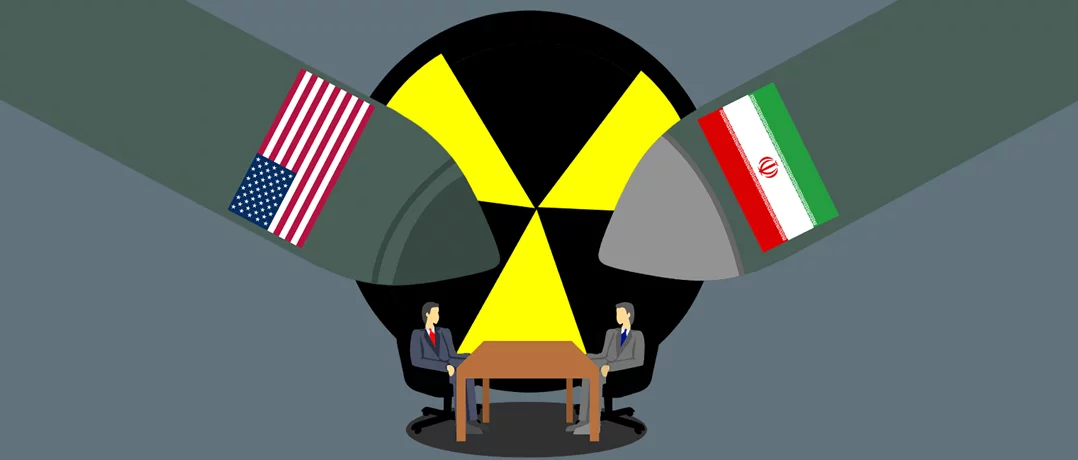
Illustration by Karim Dagher
The United States (US) and Iran are preparing to hold a second round of nuclear negotiations in Geneva, signaling a renewed diplomatic effort to prevent further military escalation in the Middle East.
The upcoming talks take place amid mounting tensions, marked by Washington’s intensified military presence in the Gulf and increasingly firm rhetoric from both sides. While diplomatic channels remain open, deep disagreements over uranium enrichment, sanctions relief, and regional security issues continue to challenge the prospects of reaching a comprehensive agreement.
Diplomatic engagement amid escalating pressure
The Geneva meeting follows earlier indirect discussions facilitated by Oman, which has emerged as a key mediator between Washington and Tehran. The American delegation is expected to include senior adviser Jared Kushner and White House envoy Steve Witkoff, while Iran’s team will reportedly be led by Foreign Minister Abbas Araghchi. Omani Foreign Minister Badr al-Busaidi is anticipated to play a central role in bridging the gap between the two delegations.
Recent diplomatic activity indicates that both sides are cautiously testing possibilities for compromise. US officials confirmed that messages outlining Washington’s position were transmitted to Iranian leadership through Omani intermediaries. Iranian authorities acknowledged receiving these communications, suggesting that backchannel diplomacy remains active despite public tensions.
Nevertheless, the negotiations face fundamental obstacles. President Donald Trump has reiterated that any future agreement must include a complete halt to uranium enrichment inside Iran, a demand Tehran has consistently rejected. Iranian officials argue that maintaining limited enrichment capabilities is a sovereign right under international nuclear agreements, positioning the issue as a primary barrier to progress.
Military posturing and strategic signaling
The diplomatic outreach has been accompanied by a substantial US military buildup in the Middle East, which act as both a deterrence strategy and a bargaining tool. The Pentagon recently ordered the deployment of a second aircraft carrier strike group to the region. The USS Gerald R. Ford is set to join the USS Abraham Lincoln and accompanying naval assets already stationed in the Gulf.
The Ford, the largest aircraft carrier in the US fleet, is capable of carrying more than 75 aircraft and is supported by advanced radar systems and guided missile destroyers. American officials have described the deployment as a precautionary measure designed to ensure military readiness should negotiations fail. President Trump explicitly linked the deployment to the diplomatic track, stating that additional military strength would be necessary if an agreement proves unattainable.
However, prolonged naval deployments have raised operational concerns within the US military. Senior naval officials have warned that extended missions place significant strain on personnel and equipment, potentially affecting long-term readiness and morale. Despite these concerns, Washington appears committed to maintaining a visible military presence to reinforce its negotiating position.
Diverging negotiation agendas
The scope of the talks represents another major point of contention. The United States seeks to expand negotiations beyond Iran’s nuclear activities to include ballistic missile development, regional proxy networks, and domestic human rights concerns. Iran, by contrast, insists that discussions should focus exclusively on its nuclear program and the lifting of economic sanctions.
Iranian officials have signaled willingness to consider technical compromises, including the potential dilution of highly enriched uranium stockpiles, provided that sanctions relief is included in any agreement. Tehran has stressed that sanctions have severely damaged its economy and views their removal as a prerequisite for meaningful concessions.
Adding further complexity, regional actors have attempted to influence the negotiations. Israel has advocated for a broader agreement addressing missile capabilities and Iran’s support for armed groups across the Middle East. Meanwhile, Gulf states have expressed concern that any military confrontation could trigger a wider regional conflict, particularly as tensions remain high following recent wars and internal unrest within Iran.
From here, the second round of nuclear negotiations in Geneva represents a critical juncture in US-Iran relations. Both sides have expressed interest in pursuing diplomacy, yet their strategic objectives remain significantly misaligned. Washington seeks comprehensive limitations on Iran’s military and nuclear capabilities, while Tehran demands sanctions relief and recognition of its nuclear rights.
The simultaneous use of diplomatic engagement and military pressure underscores the fragile nature of the negotiations. While the talks offer a potential pathway to de-escalation, failure to reach an agreement could heighten the risk of confrontation with far-reaching regional consequences.
-
-

-
The Beiruter
-
