

By linking tariffs to Greenland, Washington has turned trade into a tool of territorial pressure, straining NATO unity.
US-EU tariff war over Greenland

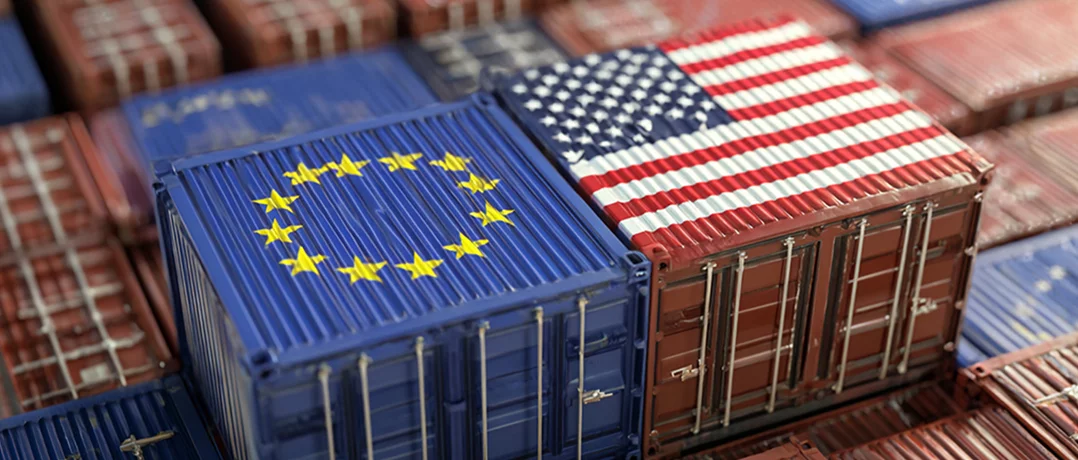
United States (US) President Donald Trump’s renewed push to secure control over Greenland has taken an unprecedented turn, extending beyond diplomacy into the realm of economic coercion.
In January 2026, Trump announced new tariffs on 8 European countries, all close North Atlantic Treaty Organization (NATO) allies, tying their removal explicitly to negotiations over the “complete and total purchase of Greenland.” The move has triggered political backlash on both sides of the Atlantic, unsettled markets and raised fundamental questions about alliances, sovereignty and the use of trade policy as leverage.
The tariff threat explained
Under Trump’s announcement, imports from Denmark, Norway, Sweden, France, Germany, the United Kingdom (UK), the Netherlands and Finland will face a 10% tariff starting 1 February 2026. If no agreement is reached by 1 June 2026, the rate will rise to 25%. The president framed the move as a national security necessity, arguing that Greenland is vital to US and global security and warning that Russia and China could otherwise expand their influence in the Arctic (a critical region rising to prominence due to its natural resources and sea routes caused by global warming).
What makes the threat exceptional is its explicit linkage to a territorial demand. Tariffs are traditionally justified by trade imbalances, unfair competition or industrial protection. In this case, they are being used to pressure allies into acquiescing to a geopolitical objective; an approach that many European leaders have labeled economic “blackmail.”
How existing trade arrangements complicate matters
The practical implementation of the tariffs is far from straightforward. 6 of the 8 targeted countries are members of the European Union (EU), which operates as a single customs and trade bloc. Individual EU states cannot negotiate separate trade deals with the US, nor can they be selectively sanctioned without raising legal and logistical challenges. Whether the new tariffs would stack on top of existing EU-US tariff arrangements, or override them, remains unclear.
The situation differs for the UK and Norway. London, no longer an EU member (on 31 January 2020 due to “Brexit”), negotiated its own trade deal with Washington in 2025, securing relatively favorable terms compared with the EU. Norway, while outside the EU, aligns closely with the bloc through the European Economic Area and negotiates trade via the European Free Trade Association (EFTA). Both now face uncertainty over whether Trump’s proposed tariffs would supersede existing agreements.
Reaction inside the United States
Domestically, the tariffs have sparked sharp criticism. Democratic leaders argue they will raise prices for American consumers and harm US exporters by provoking retaliation. Some Republicans have also expressed unease, warning that targeting NATO allies undermines collective security and risks fracturing long-standing partnerships. For this purpose, senators in the have introduced a bipartisan bill, called the “NATO Unity Protection Act,” aimed at preventing President Trump from seizing NATO territory, including the self-governing Danish island of Greenland. It includes barring the Department of Defense and Department of State from using funds to “blockade, occupy, annex or otherwise assert control” over the territory of any other NATO member state.
Questions have also been raised about presidential authority. Legal experts and lawmakers have noted that using tariffs to force another country to sell territory may exceed the scope of emergency economic powers, which are already facing scrutiny in US courts.
Europe’s unified pushback
European reaction has been swift and unusually unified. Leaders across the political spectrum have condemned the tariff threat, emphasizing that Greenland’s status is a matter of sovereignty and self-determination. A joint statement by the 8 targeted countries reaffirmed solidarity with Denmark and the people of Greenland, warning that tariff threats risk a “dangerous downward spiral” in transatlantic relations.
Aside from sending troops to Greenland (which was done some EU member states in a voluntary manner), the EU has convened emergency meetings to consider its response, including the possible use of its Anti-Coercion Instrument (a powerful legal mechanism that allows the bloc to impose wide-ranging retaliatory measures against economic pressure). While some EU officials stress a preference for dialogue, others argue that failing to respond decisively would set a dangerous precedent.
Strategic and economic stakes
Beyond the immediate impact of trade, the dispute carries broader strategic consequences.
Greenland occupies a crucial position in the Arctic, offering control over key air and sea routes and hosting US military installations. As climate change accelerates Arctic accessibility, competition among major powers is intensifying (especially between Washington, Moscow and Beijing).
Economically, the tariffs risk damaging growth on both sides of the Atlantic. Analysts warn that if the higher rates take effect, they could shave measurable growth off export-dependent European economies while fueling inflationary pressures in the United States. Financial markets have already shown signs of unease, reflecting concerns over renewed trade instability.
In conclusion, Trump’s Greenland tariffs represent a sharp escalation in the use of economic tools to pursue geopolitical goals. By targeting close allies and tying trade penalties to a territorial demand, the administration has tested the resilience of NATO unity and the rules-based international order it once contributed to its establishment. Whether the standoff ends in negotiation, retaliation or quiet de-escalation remains uncertain. What is clear, however, is that the episode has exposed deep fault lines in transatlantic relations, and raised lasting questions about how far economic power can, or should, be pushed in the pursuit of strategic ambition.
-
-

-
The Beiruter
-
