



Rising rhetoric from Washington and Tehran, combined with US military deployments and unresolved nuclear concerns, has pushed US–Iran relations back into a tense standoff with heightened risks of regional escalation.
US-Iran exchange warnings as confrontation still looms
US-Iran exchange warnings as confrontation still looms
By The Beiruter | January 23, 2026

Reading time: 4 min
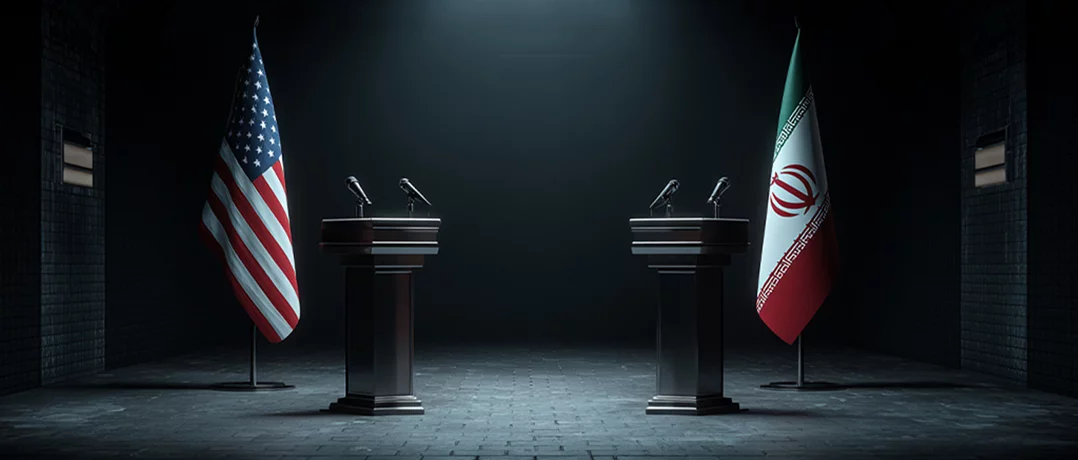
Tensions between the United States (US) and Iran have once again intensified, driven by sharp rhetoric from President Donald Trump, reciprocal warnings from Iranian military leaders, and visible military movements across the Middle East.
While Washington insists it hopes to avoid further confrontation, recent statements and deployments underline how fragile the current calm remains and how quickly the situation could escalate.
Trump’s renewed warnings to Tehran
President Trump has issued a renewed and explicit warning to Iran, stating that the United States would strike again if Tehran were to acquire a nuclear weapon. Speaking in a televised interview, Trump stressed that Iran “cannot have a nuclear weapon,” adding that any attempt to cross that threshold would prompt a decisive response. Although he expressed hope that no additional military action would be necessary, his remarks left little ambiguity about Washington’s red lines.
Trump linked some of his earlier threats to Iran’s handling of recent domestic protests, particularly reports of planned mass executions. He claimed that the cancellation of hundreds of executions influenced his decision to halt a previously considered military strike, describing this as a temporary de-escalation rather than a change in policy. At the same time, he warned that Iran would face catastrophic consequences if it attempted to assassinate him or resumed prohibited nuclear activities.
US military movements signal preparedness
Alongside the rhetoric, Washington has significantly increased its military presence in the region. Trump confirmed that a “very large military force” is moving toward the Middle East, including a US aircraft carrier strike group, naval vessels, and combat aircraft. Additional air defense systems are also reportedly under consideration for deployment.
US officials have emphasized that such force buildups are often defensive in nature and intended to deter escalation. However, the scale and timing of the movements have drawn comparisons to past military operations, including the US strikes on Iranian nuclear facilities in June 2025. Those strikes, which Washington described as precise and covertly planned, continue to shape Iranian and regional threat perceptions.
Israel’s parallel messaging
Israel, a central actor in the regional balance, has also signaled readiness. Israeli Air Force commander Major General Tomer Bar stated that Israel’s air forces are on constant alert and capable of operating deep inside enemy territory if required. He noted that lessons learned from the brief but intense 12-day armed conflict with Iran in June 2025 have strengthened Israel’s preparedness for future scenarios.
Israeli officials continue to stress that while defensive systems aim to protect its citizens, offensive capabilities remain central to deterrence, particularly in the face of perceived existential threats.
Iran’s hardline response
Iranian officials have responded with an equally forceful language. Mohammad Pakpour, commander of Iran’s Islamic Revolutionary Guard Corps (IRGC), warned the United States and Israel against what he described as “miscalculations” that could trigger a confrontation more severe than the previous conflict. He asserted that Iranian forces are at a higher level of readiness than ever before and prepared to act on orders from the country’s leadership.
Tehran has consistently framed US threats as part of a broader pressure campaign and has accused Washington of fueling internal unrest. Iranian leaders have also sought to project deterrence, signaling that any attack would be met with a significant response, potentially widening the conflict beyond bilateral confrontation.
Nuclear weapons concerns
At the core of the renewed tensions lies Iran’s nuclear program. Trump reiterated that Iran continues to conduct nuclear activities that the US considers unacceptable. Compounding concerns is the lack of recent verification by the International Atomic Energy Agency (IAEA), which has not been able to conduct regular inspections for several months.
International estimates suggest that Iran possesses a substantial stockpile of highly enriched uranium, which, if further enriched, could be sufficient to produce multiple nuclear weapons. Tehran has yet to provide a full accounting of nuclear materials at sites previously targeted by US strikes, adding to uncertainty and suspicion among Western governments.
In conclusion, the convergence of forceful rhetoric, military deployments, and unresolved nuclear questions has placed US-Iran relations on a precarious footing. While both sides claim to prefer restraint, their actions suggest a readiness for confrontation if red lines are crossed. With regional stability already strained, the coming period will test whether deterrence can hold or whether miscalculation will once again push the Middle East toward a wider and more dangerous conflict.
-
-

-
The Beiruter
-
