

U.S.-Iran tensions at the NPT Review Conference in New York exposes deep divisions over nuclear compliance, legitimacy, and the future of global non-proliferation governance.
U.S.-Iran tensions erupt at the NPT Review Conference
U.S.-Iran tensions erupt at the NPT Review Conference
By The Beiruter | April 29, 2026

Reading time: 4 min
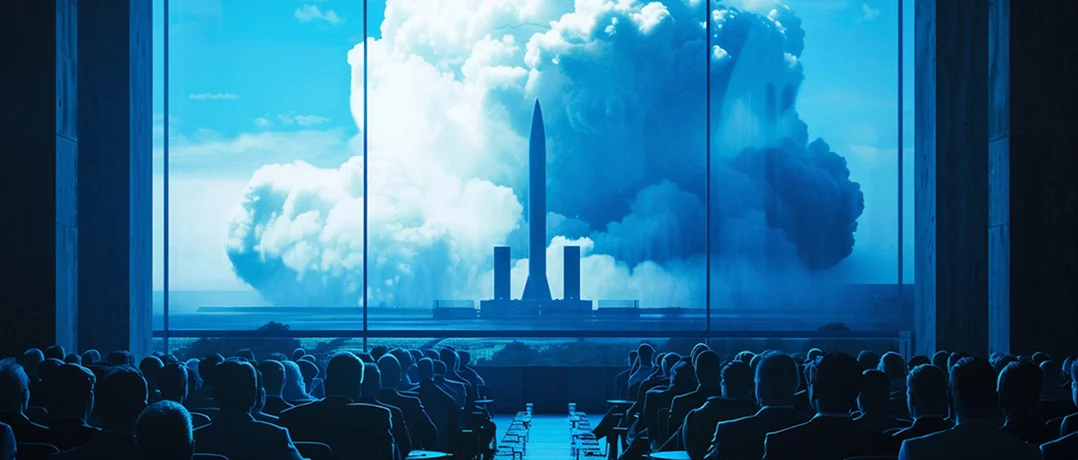
The opening of the Eleventh Review Conference of the Treaty on the Non-Proliferation of Nuclear Weapons (NPT) at the United Nations (UN) headquarters in New York was meant to reaffirm global commitment to prevent nuclear catastrophe. Instead, it quickly became a stage for renewed geopolitical tensions, most notably between the United States (U.S.) and Iran.
Their diplomatic clash, triggered by Tehran’s appointment as a vice president of the conference, underscored deeper disagreements about compliance, legitimacy, and the future of nuclear governance and concept of non-proliferation.
Diplomatic confrontation over Iran’s role in the NPT Review Conference
Tensions erupted when Washington openly criticized Iran’s selection to a leadership role at the conference. Christopher Yeaw, representing the U.S. Bureau of Arms Control and Non-proliferation, described the appointment as an “affront” to the treaty. He argued that Iran’s history of limited cooperation with the International Atomic Energy Agency (IAEA) and unresolved concerns about its nuclear activities undermined the credibility of the conference itself.
Tehran swiftly rejected these accusations. Reza Najafi, Iran’s ambassador to the IAEA, dismissed the U.S. remarks as politically motivated. He highlighted what Iran perceives as a contradiction in American policy: the U.S., the only country to have used nuclear weapons in war, positioning itself as a judge of compliance. This rhetorical exchange reflects a long-standing pattern in U.S.-Iran relations, where accusations of double standards and selective enforcement dominate diplomatic discourse.
The dispute is inseparable from the ongoing geopolitical conflict. The nuclear issue remains central to broader confrontations involving the U.S., Iran, and regional actors. Washington continues to insist that Iran must never acquire nuclear weapons, while Tehran maintains that its nuclear program is strictly for peaceful purposes and that it retains the right to uranium enrichment under international law (particularly under the provisions of NPT’s Article IV). This has complicated efforts to revive diplomatic agreements and has heightened the stakes of multilateral forums such as the NPT Review Conference.
What is the NPT?
The Treaty on the Non-Proliferation of Nuclear Weapons, which entered into force in 1970, is widely regarded as the cornerstone of the global nuclear order. Its primary objective is to prevent the spread of nuclear weapons, promote the peaceful use of nuclear energy, and advance the goal of eventual disarmament.
The treaty rests on 3 interrelated pillars:
Non-proliferation: non-nuclear-weapon states agree not to develop or acquire nuclear weapons (Article II), while nuclear-weapon states commit not to assist them in doing so (Article I).
Disarmament: the 5 recognized nuclear-weapon states (those that tested nuclear devices before 1967; meaning the U.S., Russia, the United Kingdom, France, and China) pledge to pursue negotiations aimed at reducing and ultimately eliminating their arsenals (Article VI).
Peaceful Use: all parties retain the right to develop nuclear energy for civilian purposes (Article IV) under international safeguards (Article III).
With more than 190 member states, the NPT is one of the most widely adhered-to international agreements. The IAEA plays a critical verification role, ensuring that civilian nuclear programs are not diverted toward military ends.
Despite its near-universal membership, however, the treaty has faced persistent challenges, including non-compliance disputes (such as the case of Iran), the existence of nuclear-armed states outside the framework (such as Israel, India, Pakistan, and North Korea), and disagreements over the pace of disarmament.
Review conferences, held every 5 years, are designed to assess progress and reinforce commitments. Yet recent meetings have struggled to produce consensus outcomes, reflecting deep divisions among member states. The current conference, therefore, carries significant weight: another failure could further erode confidence in the treaty’s effectiveness.
Between nuclear proliferation pressures and disarmament commitments
The confrontation between the U.S. and Iran is symptomatic of a broader problem facing the global non-proliferation regime. As UN Secretary-General António Guterres warned in his address to the conference, regarding the dangers of nuclear weapons,
Today, a state of collective amnesia has taken hold.
The Cold War’s lessons, once engrained into public consciousness, appear to be fading, even as nuclear risks intensify.
Several trends point toward a renewed arms race. Major powers (namely the U.S. and Russia, which hold about 90% of global stockpiles, as well as China) are modernizing their nuclear arsenals, and in some cases expanding them; upgrading existing warheads and deploying new-generation nuclear weapons. Arms control agreements (such as the 2010 New START Treaty) that once imposed limits and fostered transparency have weakened or collapsed (especially after the 2022 Russia-Ukraine War erupted). The absence of binding constraints between leading nuclear states raises concerns about unchecked competition and strategic instability.
At the same time, regional tensions continue to drive proliferation pressures. In the Middle East, unresolved disputes over Iran’s nuclear program contribute to fears of a cascading effect, where neighboring states might seek similar capabilities. Elsewhere, security dilemmas and shifting alliances reinforce reliance on nuclear deterrence rather than disarmament.
Yet the picture is not entirely bleak. The NPT still provides a framework for dialogue and cooperation, and many states remain committed to its principles. Non-nuclear countries, in particular, have increasingly demanded accountability from nuclear-armed states, highlighting the “disarmament deficit” between commitments and action. Civil society movements and survivor testimonies, such as those of the Hiroshima and Nagasaki bombings, continue to remind policymakers of the human cost of nuclear war.
Ultimately, the future trajectory, whether toward proliferation or disarmament, will depend largely on political will. Rebuilding trust, strengthening verification mechanisms, and reviving arms control negotiations are essential steps. Without them, the risk is not merely the erosion of the NPT, but the normalization of nuclear competition.
-
-

-
The Beiruter
-
