



Amid escalating war fears, Bkerké and the Vatican intensify diplomatic and humanitarian efforts to protect Lebanon’s Christian border villages and support displaced residents.
Vatican- Bkerké movement to protect the villages of the South
Vatican- Bkerké movement to protect the villages of the South
By Gabriel Mrad | March 18, 2026

Reading time: 3 min
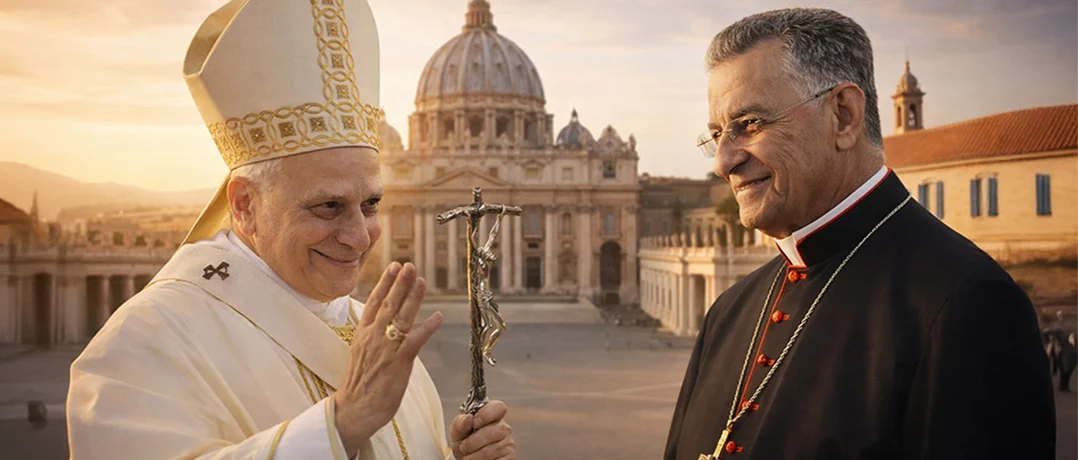
Amid the ongoing war and the dangers it poses to Lebanon in general, and to the border villages in the south in particular, questions arise regarding the actions of Bkerké and the role of the Maronite Patriarchate, especially amid fears that “history might repeat itself,” causing Christians on the frontlines to pay the price for attacks, invasion, and displacement. They could lose their land and livelihoods, becoming travelers in search of shelter either within the national territory or in diaspora countries.
However, the facts from ongoing communications and the movement led by Patriarch Mar Bechara Boutros al-Rahi show that the Church’s and diplomatic efforts are active in protecting these villages and supporting their residents. According to information obtained by Nidaa Al Watan, communication lines are open around the clock between Maronite Patriarch Cardinal Bechara Boutros al-Rahi and the Holy See, with coordination taking place on both positions and initiatives on the ground.
Church sources confirm that this extensive movement is directed by Patriarch al-Rahi with direct support from the Holy See, while the Papal Nuncio in Lebanon, Monsignor Borgia, plays a central role in organizing and following up on communications. Vatican interest in Lebanon is also evident through the Pope’s repeated statements in his speeches and daily publications, where he consistently allocates space to talk about Lebanon and its Christian border villages, a clear indication of the Holy See’s meticulous monitoring of developments.
Information indicates that the Vatican’s Foreign Minister (FM) is also conducting communications with the United Nations (UN) and several countries as part of diplomatic efforts aimed at ending the war, protecting Lebanon, and supporting the president through direct engagement.
In the same context, American sources have recently confirmed that the administration of US President Donald Trump is monitoring developments in the southern villages, noting that US-Israeli communications aim to prevent any harm to the Christian villages.
Church sources confirm that Patriarch al-Rahi follows daily the political and humanitarian developments concerning the border villages, aiming to shield them from the flames of war and to secure support for residents in moral, nutritional, and health-related terms. The visit by the Apostolic Nuncio in Lebanon is a practical expression of this ecclesiastical umbrella. He does not act alone, but in coordination with the local Maronite diocese and the presence of monks and nuns.
Previously, Patriarch al-Rahi had sent two bishops to meet with the army commander, reflecting Bkerké’s keenness to maintain communication with the military institution and monitor security conditions in the border areas, especially since the residents of these towns see the state as their safe haven and the army as their protective shield.
Field efforts
Within the framework of full coordination between the Vatican and the Maronite Patriarchate, recent days also witnessed a meeting including a delegation of bishops and the Papal Nuncio in Lebanon. According to information, all Maronite dioceses are engaged in the developments, providing financial and in-kind assistance to the residents of the border villages, in addition to offering shelter for those forced to evacuate.
Thus, the Church’s movement is not limited to political communications but is accompanied by extensive field efforts to provide aid. These communications have led to contributions from companies and institutions to support the residents of these villages, while the Maronite Patriarchate mobilized various Maronite institutions for this purpose.
In this context, the Maronite General Council in Beirut has made its headquarters available to residents of the border villages to serve as an operational coordination center for displaced persons in the capital. The Executive Council of the Maronite League, chaired by Maroun Helou, has also established a crisis cell that holds open meetings to follow up on the issue. The League’s Regional Committee is expected to meet on Wednesday (today), inviting civil associations and donors to coordinate efforts to provide humanitarian support to the border villages.
The Maronite Diaspora Foundation has also contributed assistance on various levels, while the “Maronites for Lebanon” gathering has participated in support efforts, as part of a broad movement directed by Bkerké and its Patriarch.
In parallel with these efforts, Maronite League Secretary-General, lawyer Paul Youssef Kanaan, sent a message to the UN Secretary-General requesting international guarantees to protect the border villages and their residents.
Additionally, the Bishop of the Batroun Diocese held a meeting at the Catholic Media Center, calling for support and solidarity with the border villages.
It is clear that the movement is not confined to Lebanon; Maronite dioceses abroad have instructed their communities to contribute to supporting these villages, while dioceses and parishes in Lebanon are collecting material and financial aid to deliver to those in need. In Beirut, a special team in the Beirut Diocese, under the guidance of Bishop Paul Abd al-Sater, organizes support and relief efforts.
Thus, the border villages today are at the heart of a wide ecclesiastical, diplomatic, and humanitarian movement led by Bkerké in coordination with the Vatican, aiming to shield them from the war and provide support to their residents in the most difficult circumstances. The continuation of military confrontations threatens serious developments, and there is hope that local and international efforts will succeed in halting the machinery of gunpowder and fire, preserving what remains and preventing what is worse.
