



A glimpse into the diverse reasons thousands gathered for Pope Leo XIV’s visit, capturing a nation seeking comfort, connection, and a brief pause from its enduring hardships.
Voices from a Nation in Prayer

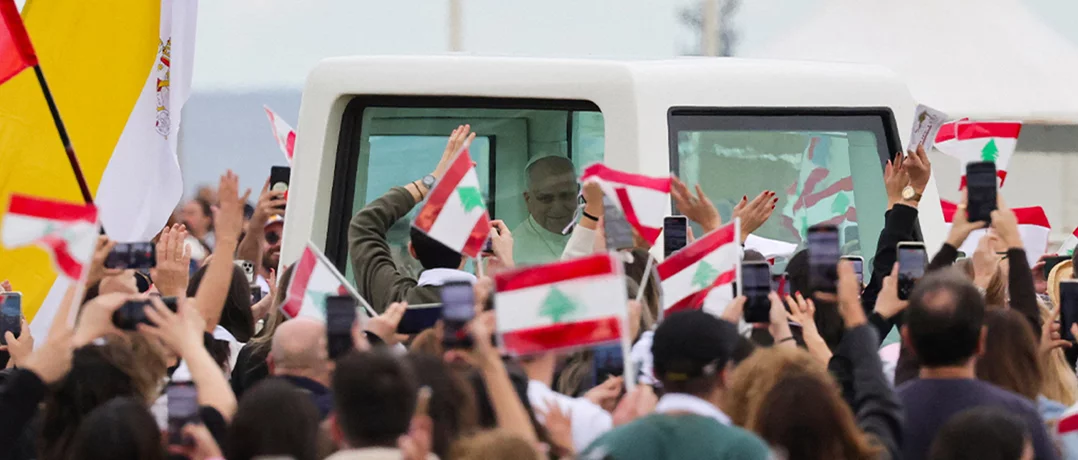
Thousands of people: families, teenagers, the elderly, migrants, fathers holding their children on their shoulders, walked toward the same place with different pleas. Before the sun rose on the waterfront, they were already there. Some clutched rosaries, others photos of loved ones, and many simply carried the weight of years that have not been kind. All came for one reason: to hear Pope Leo speak, to stand together in a moment that felt larger than the country’s wounds.
For days, the conversation across Lebanon had been the same: “Are you going to the pope’s mass?” The question was not merely about religion. It was about longing for reassurance, for presence, for a sign that God, or hope, or someone still saw them. And so, they came.
Leila, 21 “I just wanted to feel close to God today.”
“I came to pray,” she said plainly. “Not for anything specific. I just wanted to say thank you.” Her voice was soft but steady. “This year was heavy for everyone. Friends leaving, people getting sick, the constant worry about what’s next… I think I forgot how to feel grateful. So I told myself: if the Pope is coming to Lebanon, I want to be there. Just to reconnect with something bigger than all of this.”
She smiled almost embarrassed by her own honesty. “I’m young, but I feel like I grew up too fast in this country. Today I wanted to feel… childlike faith again. Simple faith. The kind that doesn’t ask for anything.” For a moment she watched the crowd, then added: “When everyone prays together, it feels like the whole country takes the same breath. Even if it’s just one moment, it’s enough for me.”
Elias & Nadine, Married 42 years
They walked slowly, Nadine leaning on Elias’s arm. She had the soft tone older Lebanese women use when talking about difficult things. “I had cancer ten years ago,” she said. “God was kind. I’m still here. So, I came to say thank you. That’s all.”
“And also… I like seeing people,” she added. “Everyone is tired. It’s good to see faces again.” Elias nodded but added something more grounded: “We’re not here for politics,” he said. “We’ve seen enough of that for a lifetime. We’re here because… when you reach our age, you pray for peace, not for solutions. “He squeezed her hand as he said it.
Georges, 32 “I didn’t want to stay home today.”
Georges held a small photo of his sister, just between his fingers, like a habit. “I don’t talk much about what happened,” he said. “People get uncomfortable.” He was not angry. He was not crying. His tone was flat, honest.
“When they said the Pope was coming, I thought… okay. Maybe I’ll go. Maybe it will feel like someone is talking to all of us, not just to one group.” He paused for a long moment. “And honestly? I didn’t want to be alone this morning.”
Rana, 41 “our leaders don’t speak to us anymore.”
Rana stood with her arms crossed, watching the crowd with the alertness of someone who follows the news too closely for her own peace of mind. She did not come for emotional reasons, she came with an argument. “I’m here because I’m tired of politicians treating us like we’re furniture,” she said. “Years of crisis and no one has the courage to say a full sentence of truth.”
She wasn’t angry, just blunt. “When the Pope speaks, the whole country stops and listens. Imagine that someone from outside has more moral authority here than the people we elect.” She shook her head lightly. “I don’t expect him to fix anything. But I came to hear a voice that doesn’t lie to me. A voice that isn’t protecting a party, a za‘im, or a seat.”
And I came because I want my daughter to see that public life isn’t only for men yelling on TV. It can be people gathering for the right reasons.
Salma, 63 “I came for a simple prayer.”
An elderly woman with a tiny cross around her neck, “I’m not here to ask for anything big,” she said. “I just want God to protect my children, that’s all.” Her children are grown, living in three different countries. “My house is quiet,” she added with a small laugh. “Too quiet. So when I heard the Pope was coming, I thought: yalla, let me go sit with people. Let me pray in a crowd instead of praying alone.” She tightened her scarf. “People think we come for miracles. We come for reassurance.”
The Psychology of a Nation
Taken together, the voices scattered across the field draw a map of a country suspended between private exhaustion and public silence. The reasons these people came, some simple, some hesitant, some openly political, form a kind of collective testimony that says more about Lebanon than any official statement in the past decade.
Across the interviews, one emotional pattern appears repeatedly: people are regulating themselves constantly. They soften their expectations, shrink their demands, narrow their vocabulary of hope. No one asks for prosperity. No one talks about stability as something realistic. The wishes are minimal: reassurance, company, a break from the noise, a sense of not being alone inside their own country.
This is the psychology of long-term crisis: hope becomes modest because disappointment has grown expensive. What the morning revealed is that Lebanese people have not lost their capacity for collective feeling. They have simply lost the infrastructure that normally contains it. When something finally gives them permission to stand side by side, they show up without hesitation. This is not naivety. It is muscle memory. Despite years of fragmentation, the people instinctively lean toward each other when given the chance.
A Country Wounded but Standing
They came for different reasons: grief, gratitude, exhaustion, longing, faith, but they stood on the same ground. For a moment, Lebanon felt less divided. The crowd stretched across the field like a living testament to resilience: a mosaic of stories, each heavier than the last, yet all carried forward by hope. It was not a miracle or a political solution. It was the feeling that Lebanon had paused its suffering long enough for people to remember who they are when they stand together.
And when the mass ended, they walked away, some smiling, some crying, some silent, but all leaving with something they did not have when they came. A reason. A reminder. A moment of faith. This is why they came.
-
-

-
The Beiruter
-
