

At a USJ-hosted discussion centered on his memoir Un destin au Levant, Walid Joumblatt reflected on Lebanon's pluralism, Syria's transition after Assad, Hezbollah's future, and the enduring lessons of the civil war.
Walid Joumblatt on Lebanon and the politics of coexistence
Walid Joumblatt on Lebanon and the politics of coexistence
By The Beiruter | June 05, 2026

Reading time: 5 min
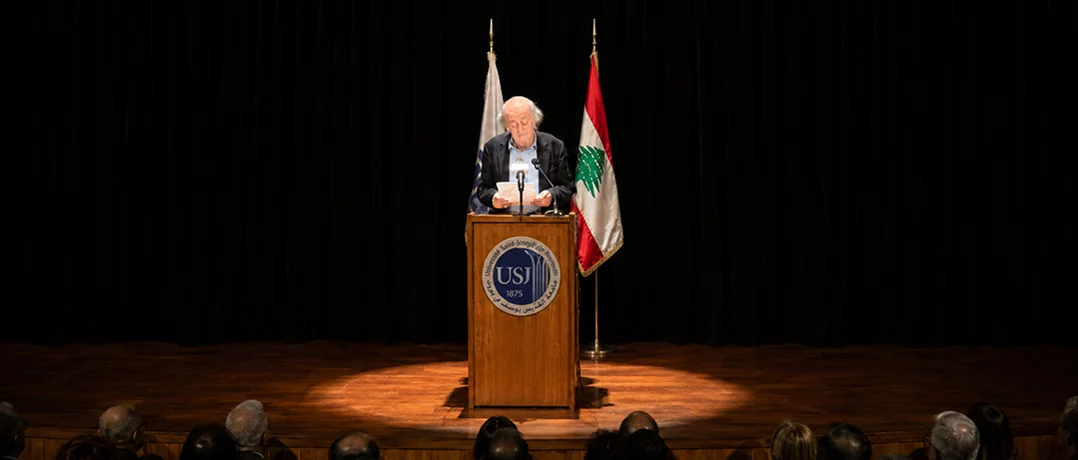
Speaking before a packed audience at Université Saint-Joseph de Beyrouth, former Progressive Socialist Party leader Walid Joumblatt used a discussion centered on his recently published memoir, Un destin au Levant ("A Destiny in the Levant"), to revisit many of the questions that have defined Lebanon and the wider region over the past half century, from war and coexistence to statehood, identity, and political change.
Hosted by Librairie Stephan and moderated by journalist Albert Kostanian, the discussion frequently moved beyond the memoir itself. Rather than revisiting episodes from his political career alone, Joumblatt reflected on Lebanon's identity, the collapse of the Assad regime in Syria, Hezbollah's future, the Palestinian cause, and the enduring legacy of the Lebanese Civil War. At 76, and no longer occupying the commanding political position he once held, his remarks revealed both lingering frustrations with regional developments and a pragmatic approach to the region's political challenges.
Defending Lebanon's pluralism
Kostanian began by noting a theme that runs throughout the memoir: a deep attachment to Lebanon itself.
Given Joumblatt's lifelong association with Arab nationalism and the Palestinian cause, the moderator suggested that readers might be surprised by the prominence Lebanon occupies in the book. Yet throughout the discussion, Joumblatt repeatedly returned to the idea that Lebanon's greatest strength lies in precisely that pluralism, and defended the concept of Greater Lebanon, the multi-confessional state created in 1920 that forms the basis of modern Lebanon.
“I am part of Greater Lebanon," Joumblatt said. “Despite our attachment to Arab nationalism and the grand dreams of the time of Nasser, this Lebanon is worth preserving from any totalitarian drift that could prevent this pluralism.”
The reference to Egyptian President Gamal Abdel Nasser was telling. Like many Arab politicians of his generation, Joumblatt came of age during the height of pan-Arab nationalism, when Nasser's vision of Arab unity inspired movements across the region. Yet he argued that many of the nationalist projects that emerged from that era ultimately evolved into centralized and authoritarian systems.
That experience, he suggested, reinforced rather than diminished the value of Lebanon's political model. Arab identity, in his view, was rooted not in ideological uniformity but in the historical and cultural diversity of the Levant itself.
"Arab identity is Palestine, Lebanon, Syria, Iraq and Egypt," he said, rejecting the notion that the center of gravity of the Arab world had shifted decisively toward the Gulf monarchies.
Joumblatt was particularly skeptical of the growing political influence of the Gulf states. While acknowledging their economic and technological advances, he argued that they remain strategically vulnerable because of their dependence on external security guarantees. Referring to rising tensions between Iran and the United States, he warned that Gulf countries could ultimately find themselves paying the price for a confrontation they do not control.
Syria After Assad
Syria occupied much of the evening's discussion and revealed both Joumblatt's lingering frustrations and cautious hopes for the future.
The former PSP leader spoke forcefully against any attempt to partition or fragment the country, describing such proposals as a threat not only to Syria but to the wider region.
"The dismantling of Syria would be catastrophic," he said.
Joumblatt also revisited his longstanding criticism of the Assad era, describing the former regime as one built around an “alliance of minorities” that excluded large segments of Syrian society. The fall of Bashar al-Assad, he suggested, had created an opportunity to move beyond that model, even if the outcome remains uncertain.
Asked about Syria's new president, Ahmed al-Sharaa, Joumblatt adopted a cautious and pragmatic tone. While expressing unease at the speed with which international leaders have embraced Syria's new ruler, he argued that the country's new authorities should be given an opportunity to govern.
"It is necessary to trust him," he said.
Joumblatt also underscored the importance of relations between Beirut and Damascus. Describing constructive ties with Syria's new authorities as "inevitable," he argued that many in Lebanon remain conditioned by decades of engagement with the Assad regime and have yet to fully adjust to the political realities that followed its collapse.
His remarks on Syria furthermore carried a distinctly personal dimension. Speaking about the Druze community in Sweida, Joumblatt expressed evident frustration with developments since Assad's fall, lamenting what he views as growing divisions and competing loyalties.
Hezbollah and the state
At a moment when Lebanon is once again grappling with questions of sovereignty, security, and the distribution of armed power, the issue of Hezbollah's future inevitably surfaced during the discussion.
"It cannot be disarmed by force," he said. "We are acting as though Hezbollah is a foreign body."
The argument was rooted less in sympathy for Hezbollah than in his assessment of Lebanon's social and political realities. Joumblatt maintained that the group cannot simply be treated as an external actor because it remains deeply embedded within Lebanese society. Any attempt to resolve the issue militarily, he suggested, risks reopening sectarian fault lines and producing consequences far more dangerous than the problem it seeks to solve.
Looking back on the years following the Cedar Revolution, Joumblatt recalled his fear that escalating political confrontation could trigger a wider sectarian conflict involving the PSP, Amal Movement, and Hezbollah. Those concerns, he suggested, have not entirely disappeared.
Yet he was equally clear that the current arrangement cannot serve as a permanent solution.
"The resistance, the people and the army together that does not work," Joumblatt said. "We need the state."
The challenge, in his view, lies in finding a political path toward that objective without plunging the country into another cycle of internal conflict.
Palestine and the limits of peace
The Palestinian issue remained a constant thread throughout the evening, surfacing repeatedly in discussions about regional politics, Syria, and Lebanon itself.
When asked whether peace with Israel remained possible, Joumblatt's skepticism was immediate.
"What peace?" he asked.
He went on to reiterate his support for a two-state solution, noting that Kamal Joumblatt had accepted the principle decades ago. Yet he expressed little optimism about its prospects under current conditions, arguing that meaningful recognition of Palestinian national rights remains absent from the region's political reality.
At the same time, Joumblatt stopped short of declaring the Palestinian cause defeated. National aspirations, he argued, often outlive the circumstances that appear to extinguish them. Drawing comparisons with Armenians and Kurds, Joumblatt reflected on the capacity of collective identities to endure across generations, surviving displacement, political setbacks, and changing regional orders. Causes that appear dormant or impossible at one moment, he suggested, can reemerge decades later under entirely different circumstances.
Looking back on war
Kostanian also pressed Joumblatt on the civil war and his own role within it.
Unlike some Lebanese political figures who frame the conflict primarily through the actions of outside powers, when reflecting on the violence of the civil war years, Joumblatt acknowledged the responsibility born by Lebanese actors themselves.
“We had become wolves,” he said.
The discussion was therefore notable for its refusal to place responsibility solely beyond Lebanon's borders. While acknowledging the influence of regional and international actors, Joumblatt repeatedly returned to the role Lebanese factions themselves played in shaping the country's trajectory.
Such reflections touched on questions that continue to confront Lebanon today: how to preserve pluralism in a fractured society, balance principle with pragmatism, and move forward without forgetting the past.
For a politician whose career has spanned more than half a century of conflict, upheaval, and transformation, those questions appeared as urgent as ever.
-
-

-
The Beiruter
-
