



U.S. naval blockade on Iran’s ports near the Strait of Hormuz is considered as a coercive bargaining tool, however with serious questions on feasibility, legality, Iranian response, and global implications.
Washington’s siege on Iran: Bargaining chip or escalation?
Washington’s siege on Iran: Bargaining chip or escalation?
By The Beiruter | April 14, 2026

Reading time: 4 min
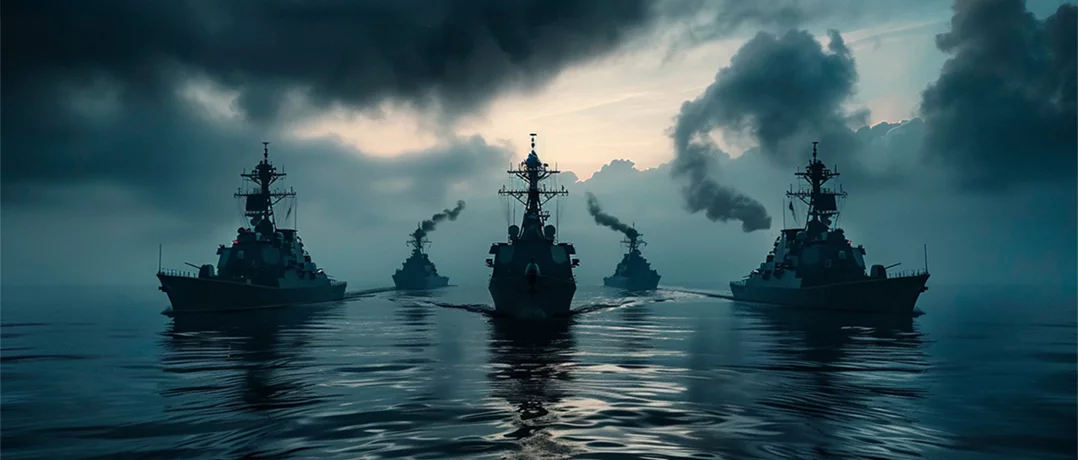
The prospect of a United States (U.S.) naval blockade targeting Iranian ports near the Strait of Hormuz represents a significant escalation in an already fragile geopolitical environment. Announced in the aftermath of failed negotiations, such a move is intended to pressure Tehran into reopening one of the world’s most critical maritime chokepoints.
Yet, while the U.S. possesses the military capability to implement such a blockade, its feasibility, legality, and broader economic consequences remain deeply contested.
The strategic logic behind a blockade
At its core, a naval blockade is designed to restrict an adversary’s access to maritime trade, thereby weakening its economy and coercing political concessions. In this case, Washington’s objective is twofold: to deprive Iran of vital oil revenues and to compel it to lift restrictions it has imposed on shipping through the Strait of Hormuz.
This narrow waterway is one of the most strategically important energy corridors in the world, handling roughly one-fifth of global oil trade under normal conditions. By targeting Iranian ports rather than the entire strait, the U.S. appears to be attempting a calibrated approach: applying pressure on Tehran while avoiding a complete shutdown of global maritime traffic.
Operational requirements and constraints
Enforcing a blockade in such a high-traffic and politically sensitive region is a complex undertaking. It would require a sustained deployment of U.S. naval assets, including warships, surveillance systems, and possibly special operations forces. American forces would likely operate from relatively safer waters, such as the Gulf of Oman, tracking vessels leaving Iranian ports and intercepting them in international waters.
Despite the technological and logistical advantages of the U.S. Navy, several operational challenges persist. The massive scale of commercial shipping passing through the Strait of Hormuz complicates monitoring and enforcement. Even a limited blockade would require identifying, tracking, and potentially boarding a large number of vessels; an effort that is both resource-intensive and legally sensitive.
Moreover, the success of the blockade would depend heavily on early enforcement actions. If the U.S. can convincingly demonstrate its willingness to seize or redirect vessels, it may deter shipping companies from attempting to bypass restrictions. Conversely, inconsistent enforcement could undermine the blockade’s credibility.
Legal and normative considerations
The legality of a naval blockade hinges on adherence to international law, particularly the principles governing armed conflict at sea. A blockade must be declared, effectively enforced, and applied impartially to vessels of all nations. It must also ensure that the passage of humanitarian aid is not hindered.
Failure to meet these criteria could expose the U.S. to accusations of illegality, especially if civilian populations are adversely affected. The question of humanitarian exemptions is particularly sensitive. Denying essential goods such as food and medicine could violate international norms and erode diplomatic support for the operation.
Additionally, the interception of neutral vessels, especially those linked to major powers such as China or India, could escalate tensions beyond the immediate U.S.-Iran context. Thus, legal compliance is not merely a procedural matter but a strategic necessity.
Iran’s potential response
A critical variable in the blockade’s effectiveness is Iran’s likely response. Tehran retains a range of asymmetric capabilities, including naval mines, fast-attack boats, drones, and anti-ship missiles. These tools could be deployed to disrupt shipping lanes, target U.S. assets, or threaten regional infrastructure.
Such actions would not only complicate the blockade but could also trigger further escalation at a time where negotiations seem to be ongoing. Even limited disruptions, such as the mining of key maritime routes, could have disproportionate effects on global trade by increasing insurance costs and deterring commercial shipping.
Impact on global energy markets and supply chains
The most immediate and visible consequence of a blockade would be its impact on energy markets. With the Strait of Hormuz already partially constrained, further disruptions could push oil prices significantly higher. Even the perception of risk is enough to drive volatility, as traders react to uncertainty. Higher oil prices would translate into increased fuel costs for consumers and businesses worldwide. Energy-importing regions, particularly in Asia, would be especially vulnerable. However, the interconnected nature of global markets means that the economic impact would be widely felt, including in the U.S. and Europe.
Beyond energy, the blockade could severely disrupt global supply chains. The Strait of Hormuz is a critical route not only for oil but also for fertilizers, food products, and industrial raw materials. Approximately 30% of global fertilizer shipments pass through the region, making agricultural production particularly vulnerable. Any disruption to fertilizer supply could reduce crop yields, exacerbating food insecurity in already fragile regions. Similarly, interruptions in the flow of chemicals and metals could impact manufacturing sectors worldwide, from construction to consumer goods.
A tool of pressure, not a decisive solution
Historically, naval blockades have rarely achieved decisive outcomes on their own; which esteemed academics asserted, such as Pr. John Mearsheimer in “The Tragedy of Great Power Politics.” While they can impose significant economic hardship, targeted states often adapt by finding alternative trade routes, relying on domestic production, or seeking support from allies.
In Iran’s case, continued economic ties with countries such as China and Russia may mitigate the blockade’s impact. Moreover, the existence of land-based trade routes and access to alternative maritime corridors limits the extent to which Iran can be economically isolated. The country’s deeply entrenched ideological approach further complicates the disruption of national unity; thus, hindering a possible uprise against the ruling regime.
As such, the blockade should be understood as one instrument within a broader strategic framework rather than a standalone solution. Ultimately, the central question is not whether the U.S. can enforce such a blockade, but whether the costs will outweigh the benefits.
-
-

-
The Beiruter
-
