



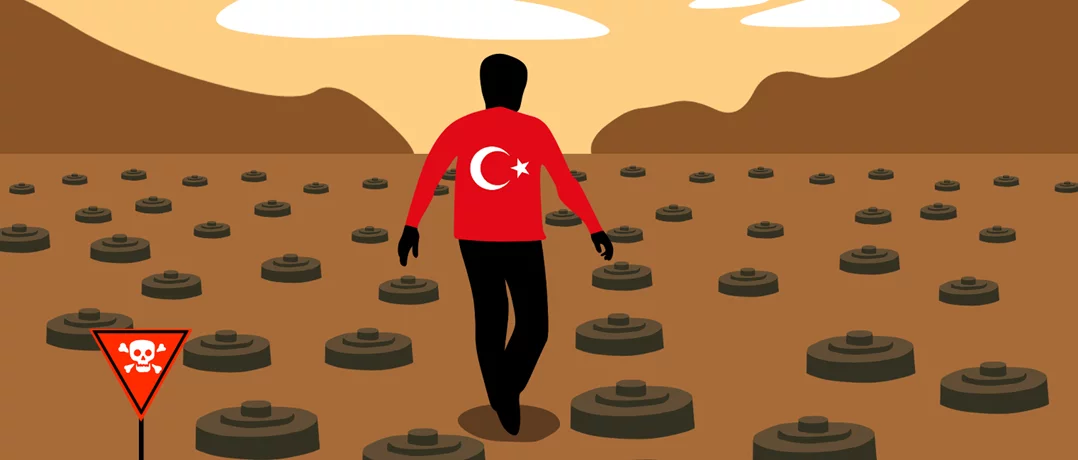
Since the outbreak of the conflict, Turkey has remained unable to shape the course of events, yet is increasingly apprehensive about their consequences.
What about Türkiye?

On March 4, NATO air and missile defense systems intercepted an Iranian ballistic missile reportedly heading toward the Incirlik Air Base in southern Türkiye. According to the Turkish Ministry of Defense, the missile originated from Iran and traveled across Iraqi and Syrian airspace before being detected en route to Turkish territory. It was ultimately neutralized by NATO assets positioned in the Eastern Mediterranean.
Five days later, another Iranian missile entered Turkish airspace and was similarly intercepted by NATO defenses. In response, Turkish Foreign Minister Hakan Fidan formally protested, warning that any future violations would prompt reciprocal action. Tehran, however, rejected the accusations, maintaining that it had not targeted Türkiye and reaffirming its respect for Turkish sovereignty.
Together, these incidents underscore the growing risk of spillover from the Iran conflict, raising urgent questions about how Türkiye will navigate an increasingly volatile regional security environment.
The Kurdish dimension and Turkish anxiety
İbrahim Karataş from the Middle East Council on Global Affairs asserts that one of Türkiye’s foremost security concerns relates to the potential mobilization of Kurdish groups in Iran’s northern and northwestern regions. This fear is rooted in a long-standing strategic doctrine in Ankara, which treats any emergence of Kurdish political or military autonomy along its borders as a direct national security threat. The presence of the Kurdistan Free Life Party (PJAK) in Iran intensifies these concerns. In the context of a broader regional conflict or a weakening of Iranian state authority, Ankara anticipates that PJAK or similar actors could expand their operations, reactivating the Kurdish question along Türkiye’s eastern frontier.
One of Ankara’s most alarming scenarios is the fragmentation of Iran along ethnic or sectarian lines. A breakdown of central authority could trigger a multi-sided civil war involving diverse groups such as Persians, Azerbaijanis, Kurds, Baluchis, Arabs, and others. Therefore, the PJAK, what Ankara considers the Iranian extension of the PKK, would likely attempt to capitalize on instability, a development Turkish officials already suspect may be supported externally by actors such as the United States and Israel.
Despite recent announcements by the PKK regarding its potential dissolution, the process remains incomplete. Although Türkiye has successfully constrained the PKK’s Syrian affiliate, the YPG, through its backing of the Syrian central government, instability in Iran could open a new front for Kurdish opposition.
Karataş emphasizes that historical precedents reinforce these anxieties. The aftermath of both the Gulf War and the Iraq War saw large refugee inflows into Türkiye and enabled the PKK to entrench itself in northern Iraq’s Qandil Mountains, which remain a strategic stronghold. Similarly, the Syrian Civil War generated both humanitarian and security pressures. Millions of refugees entered Türkiye, while the YPG consolidated control over significant Syrian territory. Although Türkiye has since contained many of these immediate threats through military interventions, the long-term presence of refugees continues to shape domestic political tensions.
Expanding security risks and strategic calculations
Salim Çevik of the Arab Center Washington DC highlights that the prospect of external powers supporting Kurdish insurgency inside Iran has heightened Turkish concerns. Early reports suggesting that Donald Trump considered arming Iranian Kurdish groups alarmed Ankara, even though such proposals were later publicly dismissed. Given Washington’s inconsistent policy signals, Turkish policymakers remain skeptical. From Ankara’s perspective, any effort to militarize Kurdish groups in Iran would risk severe regional destabilization and could push Türkiye into an unintended alignment with Tehran, drawing it into a conflict it has sought to avoid.
Çevik also highlights the direct risks the conflict poses to Turkish territory. Iranian strikes across the region raise the possibility that strategic sites in Türkiye, such as Incirlik Air Base, Kürecik Radar Station, and the Baku-Tbilisi-Ceyhan pipeline, could become targets. Since the outbreak of hostilities, several Iranian missiles have entered Turkish airspace, though all were intercepted by NATO defense systems. While it remains unclear whether these missiles were aimed directly at Türkiye or not, Ankara has deliberately avoided escalation. The deployment of U.S. Patriot systems on Turkish soil reflects recognition of the threat, even as Türkiye maintains a policy of restraint.
Importantly, Türkiye’s NATO membership serves as a deterrent. Any direct attack on Turkish territory could trigger collective defense mechanisms under Article 5, significantly raising the stakes for Iran. At the same time, the absence of fully independent U.S. operational bases in Türkiye ensures that Ankara retains control over how its territory is used, limiting the likelihood of unilateral escalation.
From a broader geopolitical perspective, Çevik argues that a weakened, but intact, Iran may actually serve Turkish interests. Iran has long been a regional competitor, and the erosion of its influence creates opportunities for Türkiye to expand its own role. This dynamic has already been evident in Syria, where the decline of Iran’s regional network contributed to the fall of Bashar al-Assad’s regime, allowing Turkish-backed actors to gain influence. Similar opportunities could emerge in Iraq and the South Caucasus if Iran’s regional position continues to erode without complete state collapse.
Nevertheless, the total collapse of the Iranian state would represent a severe crisis for Türkiye. Such an outcome would likely generate mass displacement, widespread instability, and security threats beyond Ankara’s capacity to manage. Despite these risks, Türkiye has limited means to shape the trajectory of the conflict. Its strategy has therefore centered on cautious neutrality, maintaining open communication with Tehran while avoiding direct involvement. As a NATO member that has preserved relations with multiple actors, Ankara may position itself diplomatically in any future negotiations, though its actual influence over outcomes remains uncertain.
-
-

-
Peter ChouayfatiPolitical Analyst and Researcher
-
