



What to Expect from the United Nations General Assembly’s 81st Session?
What awaits this year’s UNGA session?

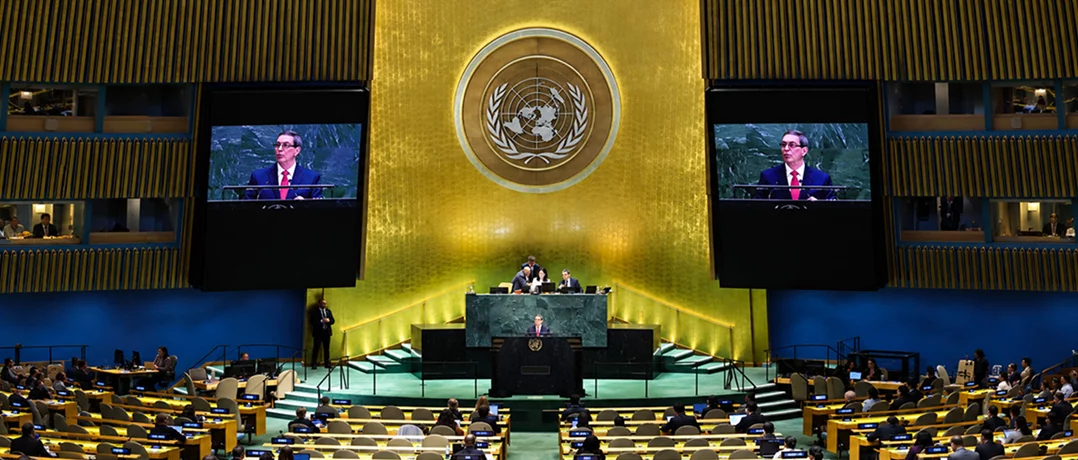
Each September, world leaders converge on United Nations (UN) Headquarters in New York for one of the most important events in international diplomacy. The annual high-level week of the United Nations General Assembly (UNGA) brings together presidents, prime ministers, foreign ministers and senior officials from all 193 UN Member States to address global challenges, exchange national priorities and engage in intensive diplomatic negotiations.
The 81st session of the United Nations General Assembly officially opened on 8 September 2026 and will continue until 7 September 2027. Presided over by Bangladesh’s Khalilur Rahman, the session is taking place under the theme “Restoring Trust, Managing Transformation: A United Nations That Delivers for All,” with an agenda reflecting many of the defining issues shaping international affairs.
High-level week: Global diplomacy at its busiest
The centerpiece of the session is the annual High-level Week, during which heads of state and government gather in New York for the General Debate and a series of thematic high-level meetings.
The General Debate begins on 22 September and continues through 26 September before concluding on 28 September. Following long-standing tradition, Brazil will deliver the first national statement, followed by the United States (U.S.) as host country, with the remaining speakers appearing according to an agreed schedule.
While speeches delivered from the General Assembly’s iconic podium often receive worldwide attention, much of the week’s diplomatic activity occurs behind closed doors. Hundreds of bilateral and multilateral meetings allow leaders to discuss regional conflicts, trade, security, development and other strategic priorities away from the public spotlight.
Global politics expected to dominate the sidelines
This year’s session also carries institutional significance. It marks the final High-level Week under Secretary-General (SG) António Guterres, whose second and final term concludes on 31 December 2026. Discussions over the selection of the next UN Secretary-General are continuing as Member States seek a successor to Guterres, who scheduled to assume office on 1 January 2027.
In opening the session, Guterres is expected to renew calls for de-escalation in the Middle East, the protection of international maritime navigation through the Strait of Hormuz and the Bab el-Mandeb, and continued efforts to secure a ceasefire in Ukraine. While these issues are expected to feature prominently in bilateral discussions, diplomats are not anticipating major diplomatic breakthroughs during the week.
Iran will remain one of the most closely watched issues. Iranian President Masoud Pezeshkian is scheduled to address the General Assembly shortly after U.S. President Donald Trump delivers his speech. Their appearances come months after the conflict involving the U.S., Israel and Iran, with uncertainty continuing over prospects for renewed diplomacy. The Iranian delegation will also attend under strict travel restrictions imposed by Washington as the host country.
Russia’s war against Ukraine is likewise expected to dominate discussions. Ukrainian President Volodymyr Zelenskyy is scheduled to address the Assembly as Kyiv continues to seek international political and military support. Russia will be represented by Foreign Minister (FM) Sergey Lavrov rather than President Vladimir Putin, who has not attended the General Assembly for several years. The conflict is also expected to feature prominently in bilateral meetings among European, North American and allied delegations.
The Israeli-Palestinian conflict will remain another central issue. Palestinian Authority (PA) President Mahmoud Abbas is expected to address the Assembly remotely after the U.S. again declined to issue visas for his delegation. Israeli Prime Minister (PM) Benjamin Netanyahu is scheduled to speak later the same day, with his address expected to focus on Israel’s security policy, the conflict in Gaza and regional developments involving Iran.
Beyond these crises, several diplomatic developments are likely to attract attention throughout the week. Venezuelan interim leader Delcy Rodríguez is expected to participate amid continuing political developments following the removal of former president Nicolás Maduro earlier this year.
While approximately 120 heads of state and government or senior representatives are expected to participate, several major powers, including China, India, Germany and South Africa, will be represented by senior officials rather than their heads of government.
Sustainable development approaches the 2030 deadline
One of the first major events is the Sustainable Development Goals (SDG) Moment.
With fewer than five years remaining until the 2030 deadline established under the 2030 Agenda for Sustainable Development, governments will review progress across the 17 Sustainable Development Goals (SDGs), including poverty reduction, quality education, public health, clean energy, climate action and access to clean water.
The meeting is expected to focus not only on measuring implementation but also on identifying successful policies and practical solutions that can be replicated across different countries and regions.
Climate, health, and global resilience
Climate change remains one of the central themes of the 81st session.
On 23 September, world leaders will participate in a High-level Meeting on Climate Action and the Just Transition convened by Secretary-General (SG) António Guterres. Discussions will focus on accelerating renewable energy deployment, expanding climate finance for developing countries and supporting communities already experiencing severe climate impacts.
The following day, another high-level meeting will examine the growing threat posed by sea level rise, particularly for small island developing states and low-lying coastal regions facing increasing risks to infrastructure, freshwater resources and human settlements.
Global health security will also return to the international agenda on 25 September through a High-level Meeting on Pandemic Prevention, Preparedness and Response. Building on lessons learned from the COVID-19 pandemic, Member States are expected to discuss stronger health systems, improved international coordination and more equitable access to vaccines, medicines and emergency medical resources.
Human rights, equality, and nuclear disarmament
Several meetings during High-level Week will commemorate major international milestones.
On 23 September, the General Assembly will mark the 40th anniversary of the Declaration on the Right to Development, reaffirming that development encompasses not only economic growth but also participation, equality and human dignity.
Five days later, Member States will commemorate the 25th anniversary of the Durban Declaration and Programme of Action, one of the UN’s principal international frameworks for combating racism, racial discrimination, xenophobia and related intolerance.
The final major meeting, held on 29 September to mark the International Day for the Total Elimination of Nuclear Weapons, will revisit one of the UN’s oldest priorities. Although nuclear disarmament has remained on the UN agenda since its founding, nearly 80 years later nuclear weapons continue to shape international security and strategic competition.
The United Nations’ principal deliberative body
The General Assembly is the UN’s main policy-making and representative organ. Unlike the Security Council, where only 15 members participate in decision-making, every one of the UN’s 193 Member States has an equal vote in the General Assembly, regardless of size or political influence.
Although General Assembly resolutions are generally non-binding, they carry considerable political and diplomatic weight. They establish international norms, guide the work of the UN system, authorize budgets, elect members to major UN bodies (including the non-permanent members of the Security Council) and provide a global platform for addressing virtually every issue covered by the UN Charter.
Much of the UNGA’s work is conducted through six main committees covering international security, economic development, humanitarian affairs, decolonization, administrative matters and legal issues before recommendations are adopted in plenary meetings.
The 81st session of the UNGA therefore represents far more than a series of speeches. It serves as the world’s largest annual diplomatic gathering, bringing together governments to negotiate, coordinate and address issues that transcend national borders.
-
-

-
The Beiruter
-
