



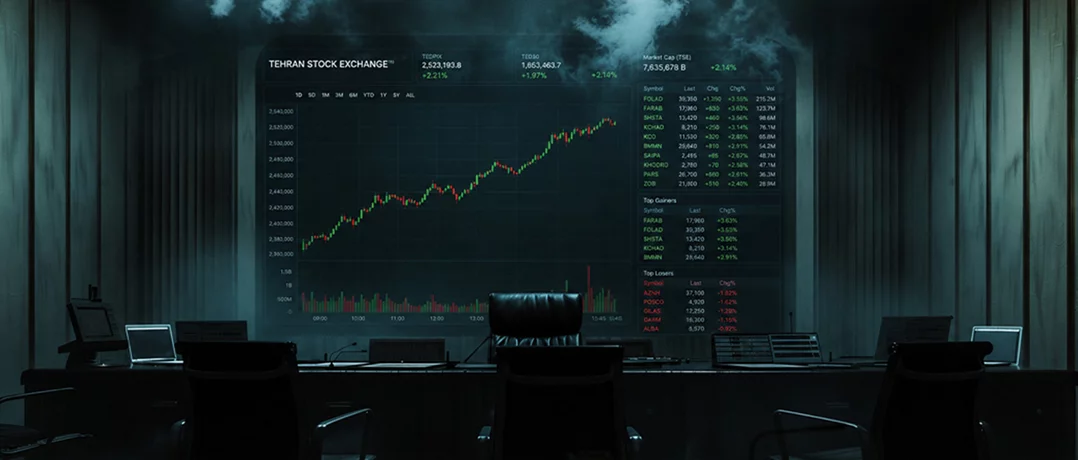
While most analysts dismiss Iran's stock market as too manipulated by the state to matter, even authoritarian financial markets can serve as a window into otherwise opaque elite interests. In recent decades, the Tehran Stock Exchange has foretold which sanctions worked, and which didn’t.
What Iran’s stock market reveals

Sanctions have become the quintessential Goldilocks course of action in foreign policy, offering governments a tool that falls between diplomacy and military force. Governments deploy financial penalties to constrain military activities, deter nuclear proliferation, or even encourage democratization. The allure is apparent: sanctions promise meaningful economic pressure without the carnage of war. The tool has especially seized the imaginations of American politicians, resulting in the United States instituting three times more sanctions than any other country.
Sanction policy rests on the premise that its economic consequences actually harm decision-making elites, when instead, poorly designed sanctions risk being absorbed, dodged, or even channeled into profits by the very regimes they intend to undermine. The case of Iran illustrates this clearly: since the 1979 Islamic Revolution, Iran has become a chief target of sanctions, second only to Russia with over 5,000 sanctions against it. Over decades of sanctions, the regime’s power has hardly dwindled: by February 2026, the government was still resilient enough to survive the assassination of its supreme leader, Ayatollah Ali Khamenei, and has continued to hold power through a war, a fraying ceasefire, and renewed strikes.
At best, sanctions have been inconsistent in urging Iranian officials to cooperate; at worst, they have further entrenched the power of the Islamic Revolutionary Guard Corps (IRGC) while causing mass financial strife among everyday Iranians. This dynamic is especially clear in the decades-long attempt to deploy sanctions against Iran's nuclear program, with deals collapsing and reigniting amid the tightening and easing of financial restrictions.
How can policymakers determine in real time if proposed sanctions will effectively target decision-making elites, so that the government in question will actually change course? The answer may lie with the often-overlooked Tehran Stock Exchange.
Iran’s stock market: Opaque, but revealing
Financial markets are increasingly used alongside traditional indicators to gauge how political events impact economic expectations. Their utility is rooted in their continuous and rapid aggregation of market participants' expectations, reflecting people’s sentiment in response to current events more quickly than official data. In his book, Turnaround: Third World Lessons for First World Growth, former Dean of NYU Stern Dr. Peter Blair Henry explains, “the stock market provides a powerful, non-ideological indicator of likely policy effectiveness” in that it’s representative of “the impact market participants expect the policy change to have in both the short run and the long run.”
Economists have used this logic to evaluate economic policies in reputable, developed stock exchanges. It hasn't been extensively applied to understanding the incentives of capital-holding elites in authoritarian states – the group that can apply the most pressure on a regime – making them the ideal target for sanctions aiming to change government behavior.
The hesitation to look at authoritarian equity markets is not unfounded: they are often subject to extensive government manipulation that seems to disqualify them as faithful indicators. This assumption holds true of the Tehran Stock Exchange (TSE), Iran's equity market with 12 million registered investors. According to the Middle East Institute, most of the roughly 1,000 firms listed on the TSE are government-owned, and even ostensibly "private" companies are often controlled by the Ayatollah or the IRGC. The government uses the TSE to generate revenue for its runaway budget, both by selling state assets on the exchange and by allegedly manipulating the currency exchange rate.
However, the Tehran Stock Exchange doesn't have to be a fair equity market to serve as a meaningful indicator of elite discontent. In fact, the very factors that deter foreign investors might make it ideal for evaluating the efficacy of sanctions. By comparing TSE returns during key political events, and separately assessing the reactions of known IRGC-affiliated firms versus independent ones, it becomes possible to see what sanctions actually unnerve Iran's decision-making elite.
Markets foretold that a nuclear deal was coming
In the 2000s, the Tehran Stock Exchange displayed increasingly muted responses to the repeated institution of new sanctions, even as domestic and regional political shocks – the 2005 presidential election, the outbreak of war in neighboring Afghanistan – resulted in statistically significant abnormal returns. These findings were documented in a 2011 academic study, "Efficiency, Risk, and Events in the Tehran Stock Exchange," which tracked TSE reactions to both domestic and foreign political events.
One troubling explanation for the market's unfazed reaction to sanctions is that they weren't just ineffective, but backfired, pushing the Iranian economy underground and further into the IRGC's control. One event tracked by the 2011 paper is the 2007 sanctions imposed under UN Resolution 1747, which targeted individuals and entities linked to Iran's nuclear program. The lack of any abnormal TSE returns in response to this announcement suggests Iranian elites had built revenue streams they expected to remain unaffected by the pressure the UN was trying to impose. As sanctions fail to reach businesses, capital moves out of legitimate markets that can be monitored by the West and instead into black markets the IRGC increasingly dominates with its international connections.
To fortify this theory, the market reactions of firms closely linked to the IRGC and the vast conglomerate controlled by the Ayatollah should be analyzed separately from the rest of the market, as this isolates the impact on elites most directly influencing the nuclear policy decisions sanctions are aiming to change. A 2022 study published in The Economic Journal, "On Target? Sanctions and the Economic Interests of Elite Policymakers in Iran," does exactly this, focusing on the period following a shift in the international community's approach to sanctions around 2010. Rather than sanctioning individuals and businesses as in the 2000s, which TSE returns indicate Iranian elites had adjusted to, sanctioners increasingly targeted Iran's fundamental access to global finance, including removing Iranian business deals from the SWIFT system.
In November 2013, a diplomatic breakthrough was announced in Geneva that resulted in a partial freeze of Iran's nuclear program with limited relief from sanctions, paving the way for the comprehensive 2015 JCPOA agreement. As the Tehran Stock Exchange reopened following the news of an imminent deal, the 2022 study reports that the stock returns of elite-owned firms rose a dramatic 3.8 percentage points over two days. The researchers found that firms with clear ties to the IRGC or the Ayatollah reacted significantly more positively than other TSE-listed firms, suggesting that sanctions relief successfully carried more weight for the elites they were designed to pressure.
These findings don't definitively prove that the 2010s shift toward targeting Iran's financial system caused the JCPOA's success. They do indicate, however, that the promise of sanctions relief in 2013 mattered to elites, and that the incentives for continued negotiation existed. The TSE returns data from 2013 made this incentive visible in real time, while hinting at the inefficacy of earlier sanctions: this demonstrates how the market signals when Iran’s convoluted system of elites is under pressure.
Future of sanctions as a tool in nuclear negotiations
A lot has changed since the 2015 signing of the JCPOA. Trump withdrew in 2018, and the 2026 US-Iran war is still unresolved with sanctions taking center-stage in ongoing negotiations. Meanwhile, mechanisms for regimes to evade sanctions keep evolving: cryptocurrency now provides Iranian elites with a new avenue for moving capital that is much more difficult to monitor, and sanctions themselves have grown blunter and more indefinite, often imposed reflexively without specific demands.
Still, the evidence is clear that pinpointing the desires of key financial stakeholders matters, and that monitoring even authoritarian equity markets can be pivotal in doing so. The danger of badly tailored sanctions must be fully realized: they not only miss their intended target, but push economies further into the hands of the very regimes they seek to undermine. By incorporating information from authoritarian equity markets into sanctions design, diplomats become better equipped in negotiations with Iran and other adversarial states. Sanctions will then move closer to their original ideal: pressure aimed at regimes, not innocents, and peace achieved through negotiation, not war.
-
-

-
Soraya JohnsonJunior research/writer
Focusing on political analysis, economic trends, and investigative reporting.
-
