



As NATO leaders gather in Ankara, growing strains in transatlantic relations, compounded by disputes over Ukraine, Iran, and U.S. commitments, reveal both the fragility and enduring relevance of the alliance in a changing global security landscape.
What to look out for ahead of the NATO summit in Ankara
What to look out for ahead of the NATO summit in Ankara
By Peter Chouayfati | July 06, 2026

Reading time: 4 min
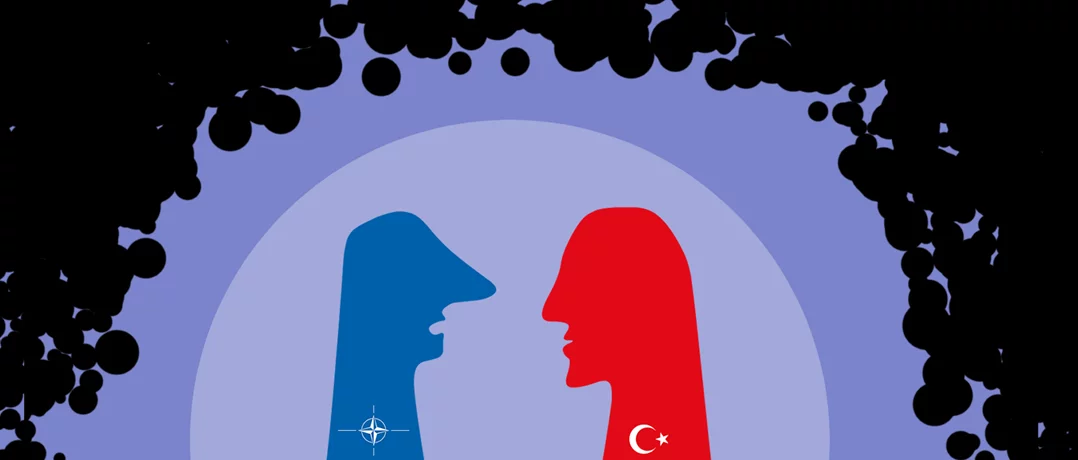
Illustration by Karim Dagher
When NATO leaders convene in Ankara on July 7 and 8, they will do so against a backdrop of an unresolved Ukraine-Russia war, a shaky Iran-US deal, and persistent doubts over how committed the United States still is to the alliance. European security is once again set to dominate the summit agenda, where numerous underlying tensions could resurface.
A promise under strain
According to Axios reporters Dave Lawler and Zachary Basu, NATO's foundational bargain, that an attack on one member obligates a response from all, has effectively been made conditional by President Trump, who has signaled that allies unwilling to back him in his own conflicts may not be able to count on American support in theirs. Trump and members of his administration have expressed open frustration with European allies who declined to grant the U.S. military access or airspace to strike Iran, going so far as to label the reluctant allies "cowards" for not helping reopen the Strait of Hormuz.
NATO's mutual-defense clause technically doesn't extend to a conflict like the one with Iran, which sits outside the alliance's territory. However, that doesn't make the moment any less consequential. If anything, it could mark a turning point for an alliance that has anchored Western security for nearly eighty years.
This isn't the first jolt to transatlantic relations under Trump. Earlier threat to annex Greenland, a Danish (and therefore NATO) territory, along with tariffs levied against allies who resisted, is one of several flare-ups that have periodically tested the alliance's cohesion over his two terms. Taken together with the fallout from the Iran war, these episodes have pushed European leaders to seriously consider what a security architecture without reliance on Washington might look like.
Former U.S. ambassador to NATO Ivo Daalder is cited in the piece estimating that even with increased defense spending commitments, Europe would need years to credibly deter Russia on its own, and roughly a decade to fully replace the American security umbrella. Daalder's deeper concern is whether Trump would actually authorize military support if a NATO ally were attacked.
The Iran conflict has proven strategically useful for Moscow, both by lifting oil revenues and by pulling Western attention elsewhere, and that Russian officials have publicly framed the NATO infighting as proof of European weakness. While Trump has again floated withdrawing from NATO, a 2023 law bars a president from doing so without congressional approval.
A deeper structural crisis
Writing for Chatham House, Glyn Morgan argues that NATO as an institution is likely to endure, pointing to its long history, entrenched institutional interests, and the absence of any credible alternative, but he draws a sharp distinction between NATO's survival and its reliability as a functioning security guarantee. In his view, the disputes over Ukraine and Iran have exposed deep structural weaknesses.
Morgan situates the current strain within a long-recognized feature of asymmetric alliances: the weaker partner's exposure to two classic risks, abandonment and entanglement. He argues that Ukraine illustrates abandonment, with the administration's messaging pointing toward a willingness to concede Ukrainian territory, a precedent he suggests could embolden Russia toward the Baltic states next. Iran, meanwhile, exemplifies entanglement in his analysis: after initially floating regime change, the U.S. found European allies hesitant to back the American-Israeli campaign, partly out of fear that a collapsed Iranian state would send refugees toward Europe.
But Morgan contends that Europe now also faces two newer and more troubling dynamics beyond the traditional pair: what he calls appropriation, referring to the American ambition to absorb Greenland, and extortion, the use of the U.S. security guarantee as leverage in trade disputes. He observes that even committed Atlanticist leaders, naming Germany's Friedrich Merz and Poland's Donald Tusk, have begun to question the wisdom of Europe's continued dependence on U.S. security guarantees.
Skepticism remains as to whether a Democratic administration in 2029 would simply restore the old order. He lays out four reasons this optimism falls short. First, it leaves European security hostage to the unpredictability of American elections. Second, the value gap between the U.S. and Europe has widened, a point he traces back to JD Vance's 2025 Munich speech. Third, higher European defense spending alone won't resolve the deeper vulnerabilities exposed by recent events. And finally, both American parties, going back to the Obama-era "pivot to Asia," have increasingly treated China as the priority over Europe. He further warns that boosting military budgets within NATO's existing structure only deepens Europe's reliance on a U.S.-led command system, reinforcing what foreign policy scholar Stephen Walt has termed a "predatory hegemon" dynamic.
The present turbulence isn't an aberration to be waited out but the visible symptom of the end of the postwar American-led order that shaped European security, trade, and politics from 1945 onward. His conclusion is that Europe's task isn't simply to satisfy American demands for higher spending, but to begin imagining its own security in a world where the transatlantic order it has relied on for eighty years is coming apart.
-
-

-
Peter ChouayfatiPolitical Analyst and Researcher
-
