



As the United States deployed AI-assisted battlefield systems at unprecedented scale, Iran relied on mass drone attacks, cyber operations, and low-cost saturation tactics to impose heavy costs.
When AI meets asymmetric war

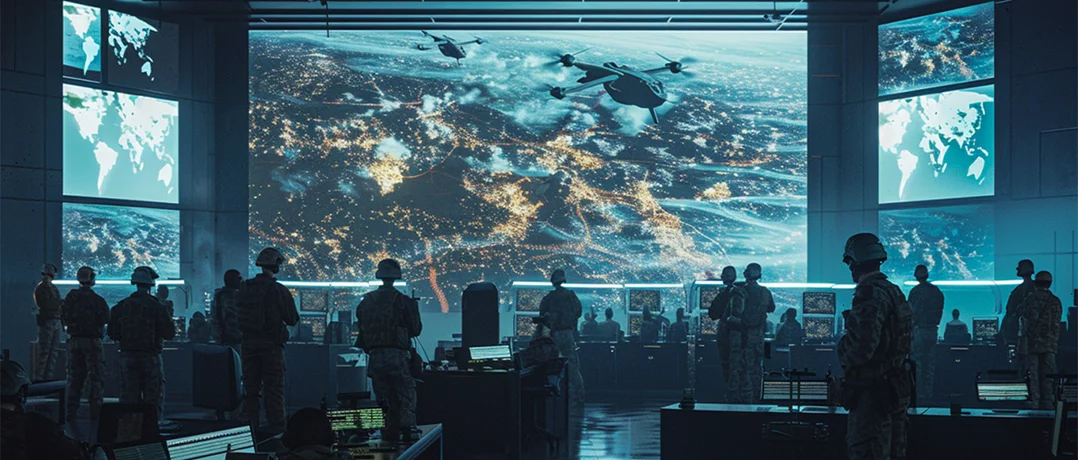
When the United States launched Operation Epic Fury against Iran on February 28, 2026, it deployed the most advanced AI-assisted military targeting system ever used in open warfare. According to an April White House statement, the US military struck more than 13,000 targets in the first 38 days of the campaign. But a new analysis from the Carnegie Endowment for International Peace argues that the war also exposed a central limitation of AI-driven warfare: technological superiority and faster targeting systems do not necessarily break an adversary designed to absorb sustained attacks.
More than three months after the conflict began, the war has become the clearest example yet of this tension now emerging at the center of modern warfare. As the United States and Israel integrated machine-assisted targeting, automated surveillance analysis, and networked battlefield coordination into operations, Iran relied on mass drone deployment, cyber operations, maritime disruption in the Strait of Hormuz, and saturation attacks designed to overwhelm expensive defense systems with sheer volume. Rather than replacing asymmetric warfare, Carnegie’s analysis argues, artificial intelligence is accelerating both sides of it simultaneously.
The AI targeting machine
At the center of the US operation was the Maven Smart System, an AI-powered data platform built by Palantir Technologies and, until March 2026, powered by Anthropic’s Claude AI. According to the Arms Control Association (ACA), a nonpartisan research organization, Maven collected data from radar signals, satellite and drone imagery, and electronic communications and fused them into a single operating picture of the battlefield. The system identified priority targets, suggested attack coordinates, recommended weaponry, and reportedly evaluated proposed strikes against international humanitarian law standards before presenting options to commanders.
The scale of what Maven enabled was significant. ACA reported that more than 2,000 command-and-control targets, 1,500 air defense installations, and 1,450 industrial facilities were struck in the first five weeks of the war. Cameron Stanley, the Pentagon’s chief digital and AI officer, described the system at a March conference as compressing what were previously eight or nine separate decision-support tools into a single interface, allowing commanders to identify a target, assemble an attack plan and execute an order from one screen. Analysts observing the conflict noted that AI systems of this kind can generate hundreds of targets within days, compared with dozens over months for human analysts.
Yet such acceleration has also raised growing concerns about how much meaningful human oversight remains in AI-assisted warfare. Although the US military maintained that human officers reviewed every target before strike approval, when the Shajareh Tayyebeh girls’ elementary school in Minab was struck on February 28, most of the 170 people killed were children. A preliminary Central Command assessment later found that intelligence maps had failed to indicate that the site, once part of a military base, had long since been converted to civilian use and had been added to an AI-generated target list without adequate human supervision.
Iran’s strategy was volume
While the United States and Israel applied AI at the targeting layer, Iran pursued a fundamentally different strategy built around scale and cost imbalance.
According to the Carnegie analysis, by 2026 Tehran had accumulated decades of experience producing low-cost drones and ballistic missiles and distributing them through regional proxy networks. Shahed-136 drones, first deployed against Saudi Aramco facilities in 2019, cost an estimated $20,000 to $50,000 each to produce, while Patriot and THAAD interceptors used against them can cost hundreds of thousands or even millions of dollars per launch. Iran reportedly entered the conflict with between 2,500 and 4,000 ballistic missiles and drone stockpiles that some analysts estimated could reach 80,000.
Its strategy depended less on precision than saturation. The analysis argues that if only 10% to 20% of attacking drones survived interception efforts, large-scale launches could still generate substantial operational and economic damage.
The numbers reflected this logic. In the first week of the war alone, Iran launched more than 2,000 drones and 500 ballistic missiles against regional and U.S. targets. Over time, the accuracy of Iranian strikes reportedly improved, which analysts partly attributed to Russian targeting assistance and operational lessons drawn from the Ukraine war.
Subsequent assessments cited in the analysis found that Iranian attacks damaged or destroyed at least 228 military structures or pieces of equipment across the Middle East. Among the most significant losses was the destruction of an E-3 AWACS airborne surveillance aircraft stationed in Saudi Arabia and valued at roughly $540 million. Iran also reportedly downed two dozen MQ-9 Reaper drones at a cost exceeding $700 million and destroyed a $300 million AN/TPY-2 radar system at Muwaffaq Salti Air Base in Jordan, a core component of THAAD missile defense infrastructure.
The globalization of AI conflict
The costs imposed on Iran have been immense. According to Carnegie’s estimates, the country suffered roughly $270 billion in economic damage, equivalent to approximately 57% of its GDP. At least 1,700 people were killed, while residential buildings, schools, hospitals, bridges, and port infrastructure sustained widespread destruction.
Yet the broader significance of the conflict may lie less in the damage itself than in what other states and armed groups learned from it. The Bloomsbury Intelligence and Security Institute forecasts that Russia and China will accelerate their own AI military programs in response to what was demonstrated in Iran. The spread of drones offers a preview of how quickly such technologies can proliferate. According to the Vision of Humanity analysis of global conflict data, just 10 non-state armed groups had access to weaponized drones in 2010. By 2025, 469 groups were deploying them across 17 countries.
The Iran war suggested that AI-assisted warfare may follow a similar trajectory. Advanced targeting systems can make militaries faster and more connected, but they also exist alongside increasingly cheap and accessible technologies capable of exhausting even the most sophisticated defense infrastructure. The result is not a replacement of asymmetric warfare, but a faster and more expansive version of it.
-
-

-
The Beiruter
-
