



An exclusive interview with former Minister of Social Affairs and prominent political figure in Beirut, Dr. Richard Kouyoumjian, explores the proposed Karantina displacement shelter controversy, highlighting security fears, demographic concerns, and governance challenges amid Lebanon’s fragile balance between humanitarian response and political realities.
When displacement shelters risk demographic shift
When displacement shelters risk demographic shift
By The Beiruter | March 23, 2026

Reading time: 4 min
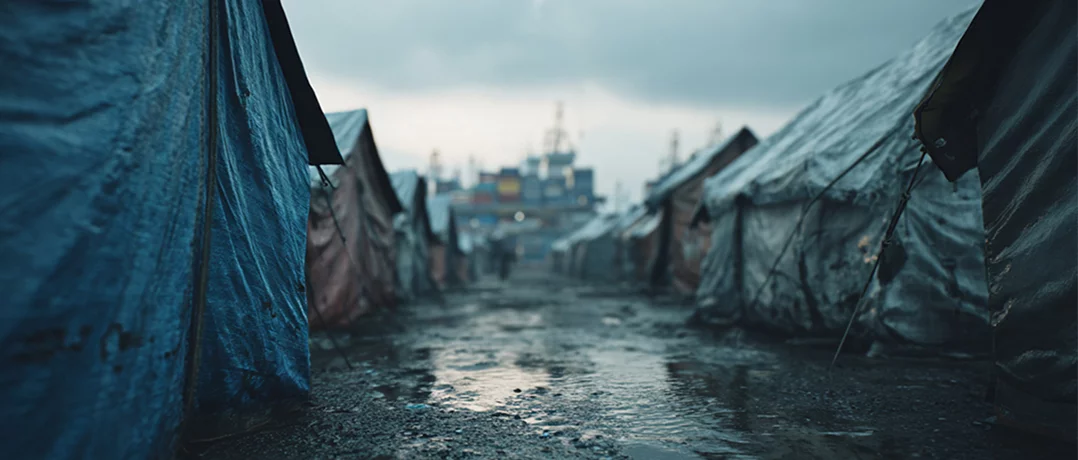
The proposal to establish a large displacement camp in the Karantina district of Beirut has triggered widespread debate, raising questions that go far beyond humanitarian logistics. At the heart of the controversy lies a deeper concern: whether such initiatives are purely relief-driven or part of a broader strategy tied to shifting balances of power within the country. The issue reflects the fragility of the Lebanese state, where security, demography, and politics remain deeply intertwined.
The Beiruter reached out to former Minister of Social Affairs and prominent political figure in Beirut, Dr. Richard Kouyoumijian, in order to gain crucial insights into the matter at hand and understand the gravity of the given issue.
Local opposition rooted in security fears
According to Kouyoumjian, the objection of displacement centers in areas such as Ashrafieh, Rmeil, and Medawar does not primarily stem from political parties, but rather from residents themselves. While acknowledging the state’s responsibility to provide shelter for displaced citizens, he stressed that local communities harbor serious concerns; foremost among them being security.
Kouyoumjian noted that residents fear that some displacement centers could host armed individuals or become associated with politically affiliated groups. In a country where state authority is often contested, such possibilities raise alarms about potential instability. For many, the introduction of a large human gathering under unclear supervision creates a risk of localized tensions that could quickly escalate.
The fear of permanence and demographic change
One of the central fears expressed by Kouyoumijian is that displacement, while undeniably a humanitarian issue, may also be instrumentalized within Lebanon’s internal power struggles, thus highlighting a major source of anxiety: the uncertainty surrounding the duration of these camps. What begins as a temporary humanitarian solution may evolve into a long-term reality. Given the scale of destruction in affected regions, many displaced families may have no viable homes to return to in the foreseeable future. With reconstruction funding uncertain and economic collapse ongoing, temporary shelters risk becoming permanent settlements. This concern is not speculative but grounded in Lebanon’s past experiences.
Kouyoumijian recalled historical precedents in areas such as Karantina and Nabaa, whereby it has been demonstrated how camps can gradually transform into permanent settlements, sometimes accompanied by demographic shifts and socio-political complications. Karantina itself carries heavy symbolic weight, having been associated with violence and conflict during the civil war. Residents worry that such transformations could alter the delicate fabric of their communities, particularly in regions already sensitive to sectarian and political balances.
Kouyoumijian added that
previous experiences with refugee camps in Lebanon, especially Palestinian camps, have often led to the emergence of spaces operating beyond effective state control.
This has reinforced fears of “a state within a state,” a phrase Kouyoumjian invokes to describe the threat of repeating past mistakes.
Karantina site: environmental and strategic concerns
The specific location proposed for the shelter near the Port of Beirut has further amplified opposition. Kouyoumjian points to environmental factors that make the site unsuitable, including poor sanitary conditions, unpleasant odors, and the presence of unmanaged waste and stray animals.
However, the concerns extend well beyond environmental suitability. The site’s proximity to the entrance of the Port of Beirut, a critical economic lifeline for the country, introduces significant security considerations.
The gathering of a large displaced population in such a sensitive area could expose both the residents of the camp and those working in the port to heightened risks, particularly in an already unstable context.
These concerns have been echoed by the syndicate representing truck owners operating within the Port of Beirut has issued strong objections, highlighting the security and operational risks associated with the camp’s proximity to port activities and warning of potential disruptions and security vulnerabilities.
State retreat and the power of local pressure
In light of mounting objections, Kouyoumjian reveals that discussions between parliamentary representatives and Prime Minister Nawaf Salam have led to a reconsideration of the project. Assurances have reportedly been given that the Karantina site will not be used as a displacement center, at least for the time being.
This reversal underscores the influence of local pressure in shaping policy decisions, particularly in a country where public trust in institutions remains fragile. It also highlights a recurring governance challenge: balancing urgent humanitarian needs with the legitimate concerns of host communities.
Kouyoumjian stresses that
the issue is not a rejection of displaced individuals themselves, but rather of the manner in which decisions are made.
He advocates for a more equitable distribution of shelters across less sensitive areas, combined with clear planning and communication.
Looking beyond Karantina, Kouyoumjian warns that similar objections could emerge in other regions if the same approach is maintained. Reports of armed presence or political control within some displacement centers have already fueled skepticism among local citizens.
Hence, while the need to shelter displaced populations is both urgent and legitimate, the manner in which such measures are implemented carries profound consequences. Without careful planning, transparency, and national consensus, temporary solutions risk becoming catalysts for deeper instability.
-
-

-
The Beiruter
-
