



Hosted in the former Green Line landmark Beit Beirut, Freedom Recalled uses art to engage with Lebanon’s ongoing legacy of violence and crisis.
When Lebanese trauma becomes art

“Freedom Recalled”, a new artist-led exhibition hosted at Beit Beirut, brings together the work of 36 artists confronting Lebanon’s unresolved history of violence, loss, and collective trauma. Organised by AD Leb, the exhibition spans nearly five decades of national rupture, from the outbreak of the Lebanese Civil War in 1975 to the aftermath of the Beirut Port explosion and the ongoing crises that shape life today.
Rather than presenting trauma as a closed chapter, “Freedom Recalled” treats it as an ongoing condition, one that continues to surface in bodies, cities, institutions, and memory. The exhibition positions art not as decoration or escapism, but as a tool for documentation, confrontation, and dialogue.
Why Beit Beirut matters
The choice of venue is integral to the exhibition’s framework. Beit Beirut, originally built in 1924, was seized during the civil war and transformed into a sniper outpost overlooking the Green Line that once divided East and West Beirut. Today, the building functions as a museum and cultural space, its bullet-scarred walls left exposed. Hosting Freedom Recalled within this site embeds the artworks directly into a space marked by violence, surveillance, and division.
The exhibition’s scenography responds to this history by reframing the Green Line as a space of transition rather than separation. Natural elements, open pathways, and layered installations guide visitors through a sequence of thematic contrasts, memory and erasure, violence and care, silence and testimony. The exhibition unfolds as a structured journey rather than a chronological archive, encouraging visitors to move between personal and collective perspectives.
The body as a site of memory
Several artists address trauma through the body, focusing on how emotional injury is stored and reactivated. Multidisciplinary artist Christine Safatly presents works from her “X-Ray Scanner” series, including drawings that merge anatomical forms with jagged abstract marks. Executed in black-and-white pencil and pastel, the works focus on the spine as a structural and psychological axis.
The scratching and mark-making in Safatly’s drawings evoke the physical sensation of memory, suggesting trauma as something internal, layered, and difficult to define. The works explore how the body registers experiences that remain unresolved.
Collective rupture after the Beirut Port explosion
The Beirut Port explosion features prominently through works that document its social and emotional aftermath. Cultural and visual anthropologist Sabah Haider presents “Three Stages of Grief”, a multimodal installation examining collective response in moments of rupture.
One component, “Another Wall That Shouldn’t Exist”, displays 108 handwritten reproductions of personal text messages Haider received after the blast, each requesting medication amid severe shortages. Stripped of names and digital context, the messages form a wall of anonymous appeals, transforming private communication into a collective archive of crisis.
The installation also includes “The Crying Table”, an interactive work inviting visitors to sit and share experiences, and “Dear Diaspora”, a series of postcards using dark Lebanese humour to comment on recent crises. Visitors are encouraged to take the postcards, extending the work beyond the exhibition space.
Memory, erasure, and public debate
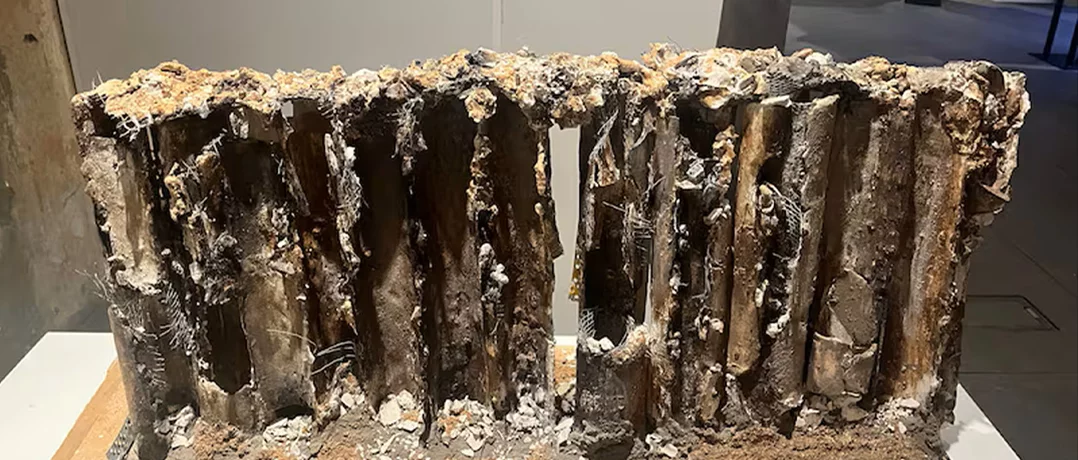
Questions of preservation and forgetting are addressed in “Between Memory & Erasure… a Rightful Debate”, a work by Maya Hmeidan and Assaad Seif of NGO Silat for Culture. The piece centres on the damaged Beirut Port grain silos, which absorbed much of the blast’s impact and later became a focal point of public controversy.
The work combines a photograph taken during a Unesco inspection, where light and shadow across the rubble form a lion-like figure dubbed the “Guardian of the Silos”, with a written dialogue between two opposing voices: Memory and Erasure. One argues for preserving the silos as a memorial, while the other advocates for replacing them with a new structure.
Art and mental health
Throughout “Freedom Recalled”, several works incorporate participation and exchange, shifting visitors from passive viewers to active contributors. Writing, conversation, and shared space recur as artistic strategies, reflecting how trauma in Lebanon is experienced collectively rather than individually.
Mental health, often marginalised in Lebanese public discourse, emerges as a recurring theme. By situating psychological injury within a public and historical space, the exhibition challenges the notion that trauma is private or detached from political failure and systemic violence.
-
-

-
The Beiruter
-
