

Marking 25 years, the 2001 Mountain Reconciliation remains a defining milestone in healing wartime divisions, restoring coexistence, and inspiring Lebanon’s sovereignty movement.
When the Mountain chose peace

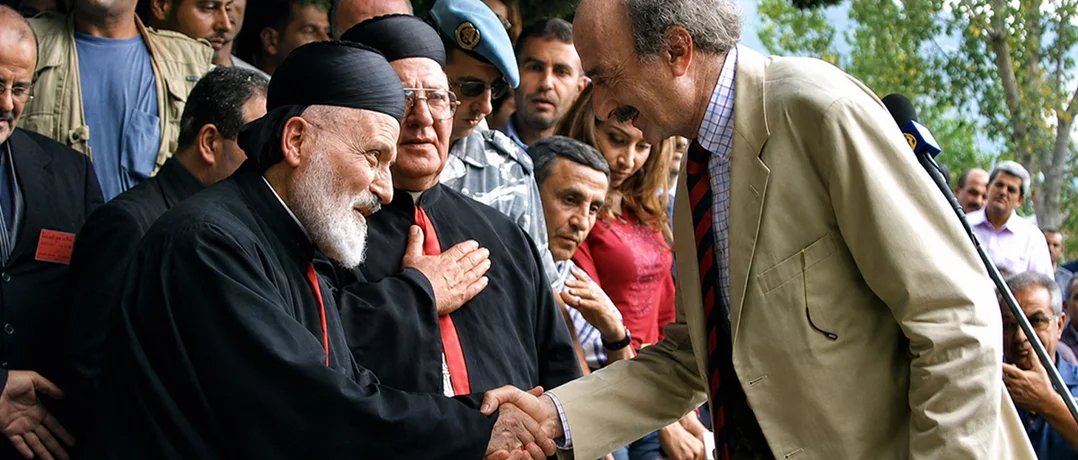
On 3 August 2001, the historic visit of Maronite Patriarch Nasrallah Boutros Sfeir to Mount Lebanon, culminating in his meeting with Druze leader Walid Jumblatt at the Moukhtara Palace, marked far more than a symbolic act of reconciliation between two communities that had endured centuries of conflict. It represented a decisive effort to heal the wounds left by the 1983 Mountain War, restore coexistence between Christians and Druze, and lay the foundation for a broader national movement advocating Lebanese sovereignty and political independence.
Often referred to simply as the “Mountain Reconciliation,” the initiative transformed relations within Mount Lebanon while simultaneously reshaping the country’s political dynamics during the final years of Syrian occupation. 25 years later, it remains one of the defining milestones that helped pave the way for the Cedar Revolution of 2005 and the withdrawal of Syrian forces from Lebanon.
Historical background: From conflict to reconciliation
Relations between the Maronite Christian and Druze communities have experienced periods of both cooperation and confrontation throughout Lebanese history. Violent clashes during the 19th century, particularly between 1840 and 1860 under Ottoman rule, left lasting scars on the collective memory of both communities.
The most painful chapter in contemporary history unfolded during the Lebanese War (1975-1990). In 1983, following the Israeli withdrawal from much of Mount Lebanon, fierce fighting erupted between Druze and Christian forces (namely between the Progressive Socialist Party and both Kataeb and Lebanese Forces) in what became known as the “Mountain War.” Thousands were killed, while tens of thousands of Christian residents fled villages across the Chouf and Aley districts, creating one of the country’s largest episodes of internal displacement.
Although the war formally ended with the 1989 Taif Agreement, the social and psychological consequences of the conflict remained unresolved. Many displaced families had yet to return to their homes, mutual distrust persisted, and genuine reconciliation had not been achieved.
Creating the conditions for a historic initiative
The political environment that enabled the Mountain Reconciliation began to emerge after Israel completed its withdrawal from southern Lebanon in May 2000. This development significantly altered the domestic political landscape by weakening one of the principal justifications for the continued Syrian occupation of Lebanon.
A pivotal moment came on 20 September 2000 when the Council of Maronite Bishops, led by Patriarch Sfeir, issued a landmark statement calling for the implementation of all provisions of the Taif Agreement, including the withdrawal of Syrian forces. The declaration elevated Bkerke beyond its traditional religious role and established it as an influential national voice advocating Lebanese sovereignty.
The statement also attracted growing support from political figures across sectarian lines. Among its most prominent supporters was Walid Jumblatt, who publicly endorsed the Patriarch’s position despite operating within a political environment heavily influenced by Damascus. His endorsement signaled the emergence of an unprecedented partnership between leading Christian and Druze figures around issues extending well beyond sectarian interests.
At the same time, Christian opposition figures increasingly coordinated their efforts through the Qornet Chehwan Gathering, a coalition established under Patriarch Sfeir’s moral patronage. The movement united numerous Christian politicians and parties opposed to Syrian dominance, further expanding the momentum for political change.
The historic visit to Mount Lebanon
Within this context, Patriarch Sfeir embarked on his long-anticipated visit to Mount Lebanon on 3 August 2001. The journey took him through numerous villages that had suffered displacement and violence during the Lebanese War. Throughout the visit, he encouraged displaced Christians to return to their ancestral homes while emphasizing forgiveness, coexistence, and national unity rather than revenge.
The defining moment occurred when Patriarch Sfeir arrived at Moukhtara Palace to meet Walid Jumblatt. The widely publicized handshake between the Maronite Patriarch and the Druze leader became one of the most enduring images in Lebanon’s post-war history. During the meeting, both leaders acknowledged the painful legacy of the past while stressing that no stable future could be built upon historical grievances. Rather than assigning collective blame, they highlighted reconciliation, mutual respect, and the restoration of Mount Lebanon’s unique tradition of coexistence among its diverse communities.
The visit also carried a strong symbolic dimension. By physically traveling through former frontlines and areas from which Christians had been displaced, Patriarch Sfeir demonstrated that reconciliation required tangible engagement with communities rather than symbolic declarations alone.
Political significance beyond sectarian reconciliation
Although primarily presented as a social and communal reconciliation, the initiative quickly assumed broader political significance.
The improved relationship between Christian and Druze communities undermined long-standing arguments that Lebanon remained too fragile to govern itself without extensive external oversight. As opposition figures increasingly coordinated their positions, new political alliances emerged linking Patriarch Sfeir, Walid Jumblatt, Christian opposition groups, and, gradually, former Prime Minister (PM) Rafik Hariri on questions relating to sovereignty, institutional reform, and implementation of the Taif Agreement.
The Syrian-backed authorities viewed these developments with increasing concern. Only 3 days after the reconciliation, Lebanese security forces launched a broad campaign of arrests targeting members of several opposition movements, reflecting official apprehension regarding the growing cooperation among anti-Syrian political actors.
Despite these measures, the momentum generated by the Mountain Reconciliation continued to expand over the following years through broader opposition coordination, including the Bristol Gathering and subsequent political initiatives.
Long-term legacy
The Mountain Reconciliation proved to be much more than a successful local peace initiative. Following the assassination of former PM Hariri in February 2005, many of the political and societal networks that had developed through the reconciliation process became central components of the Cedar Revolution.
The unprecedented cooperation between Christian, Druze, Sunni, political leaders and even Shiite figures helped mobilize massive public demonstrations demanding the end of Syrian military presence in Lebanon. International pressure, combined with widespread domestic mobilization, ultimately resulted in the withdrawal of Syrian forces in April 2005 and the termination of its occupation of the country.
On the social level, the reconciliation facilitated the gradual return of many displaced Christian families to villages across the Chouf and Aley districts. Although demographic, economic, and developmental challenges have limited the scale of permanent resettlement in some areas, relations between Christian and Druze communities have remained largely peaceful, demonstrating the durability of the reconciliation’s core principles.
Perhaps its greatest achievement lies in establishing dialogue and political courage as viable alternatives to inherited divisions. The initiative revealed that reconciliation requires not only political agreements but also symbolic leadership, public trust, and a willingness to confront painful historical memories. It also demonstrated that national healing is possible when political leadership embraces dialogue over division and shared citizenship over sectarian confrontation.
-
-

-
The Beiruter
-
