



Lebanon's craftsmen revive broken instruments, preserving the music, memories, and stories carried within them.
Where broken instruments learn to sing again

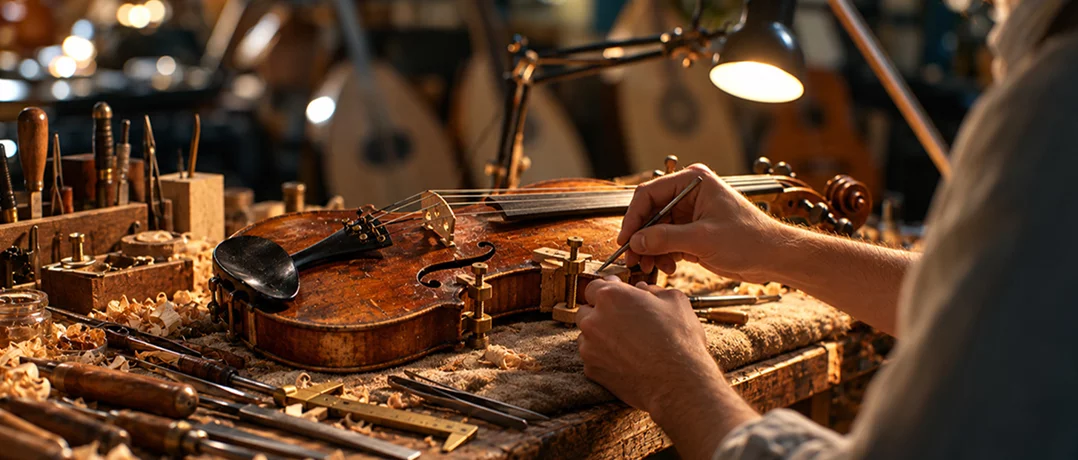
A single crack across a soundboard can silence an oud that has played for a lifetime. A warped piano key can turn a familiar tune into a stumble. In music shops across Lebanon, some hidden behind unmarked doors in Beirut's older quarters, others set along the busier streets of Zouk, a circle of craftsmen spend their days listening for what has gone wrong inside an instrument, and coaxing it back into tune.
Jonathan Sebaaly works from a narrow space tucked down a Beirut alley so easy to miss that most of his clients find him only by referral. In Zouk, Najib Maroun keeps a brighter, more visible storefront, though the work inside follows much the same discipline.
Combined experience reveal a craft of total precision, and a telling divide between the instruments that arrive from Lebanon's own musical heritage and those imported from the West.
Jonathan Sebaaly: Listening to wood
Reparing a Lebanese instrument, such as the oud, begins with understanding what the instrument has lived through before it ever reached his hands. "Every crack tells you something about how the instrument was treated," he told The Beiruter. "Humidity, a fall, years of neglect, the wood takes on everything, and my job is to read that memory before I touch a single tool."
Much of his work on Arabic instruments centers on the delicate spruce soundboard and the intricate rosettes carved into it, both prone to splitting if the wood dries too quickly or absorbs too much moisture. Restoring a crack often means carefully gluing the fracture from the inside, reinforcing it with small wooden cleats invisible to the eye once the repair is complete. "You are not trying to erase what happened to the instrument," he reflected. "You are trying to make sure it never happens again in the same place."
When asked to compare this work with repairing a guitar, Sebaaly explained, “ the guitar is built for stability, steel-reinforced necks, lacquer finishes meant to resist change. An oud is built for sound, which means it's built more fragile. Fixing a guitar is often mechanical. Fixing an oud is more like restoring a painting." In his shop, he estimated, Arabic instruments, ouds, buzuks, the occasional qanun, made up the overwhelming majority of repairs, with guitars and the rare violin trickling in mostly from younger clients.
Najib Maroun: Two worlds under one roof
In Zouk, Maroun's shop tells a different story , shaped by a steadier mix of Eastern and Western instruments passing through his door. Having repaired everything from qanuns to upright pianos, he approaches each instrument as its own puzzle, governed by entirely different logic. "A qanun is mathematics," he remarked, describing adjusting one of the dozens of small tuning levers, known as mandals, that run along its edge. "Seventy-two strings, sometimes more, each one needing exact tension against the others. Move one lever even slightly, and you can hear the imbalance ripple across the whole instrument."
Repairing a piano, by contrast, he described as an exercise in mechanics as much as sound. "Inside a piano, you are dealing with hundreds of moving parts, hammers, felts, pins," Maroun continued. "A guitar or piano repair often has a clear mechanical cause and a clear mechanical fix. A qanun or an oud repair has more guesswork. You rely on your ear far more than your checklist."
Maroun recalled a particular repair that stayed with him, an elderly customer's qanun, inherited from a grandfather and left silent for years after several strings snapped and its wooden frame warped slightly from storage. Restoring its voice, he noted, required replacing the strings in careful stages to avoid shocking the frame with sudden tension.
"When I finally tuned the last string and she heard it again, she was too stunned to speak," he recalled. "That silence told me more than any thank you could have."
Maroun's client base split more evenly between traditions, with guitars and pianos arriving steadily alongside qanuns and ouds, reflecting Zouk's more mixed musical community.
Lebanon’s own instruments still dominate the repair benches of those who specialize in them, even as Western instruments steadily claim more space on Lebanese shelves. Repairing an instrument is never simply mechanical work. It is an act of restoring memory, music, joy, and emotion, until the sound a family once knew finds its way back into the room.
-
-

-
The Beiruter
-
