



Violinist and composer Jad Al Masri fuses Middle Eastern heritage with global soundscapes, performing with his father Rabih Al Masri while reshaping music creation through his platform MuseAI.
Where musical legacy meets the future of AI
Where musical legacy meets the future of AI
By Adella Beaini | February 22, 2026

Reading time: 3 min
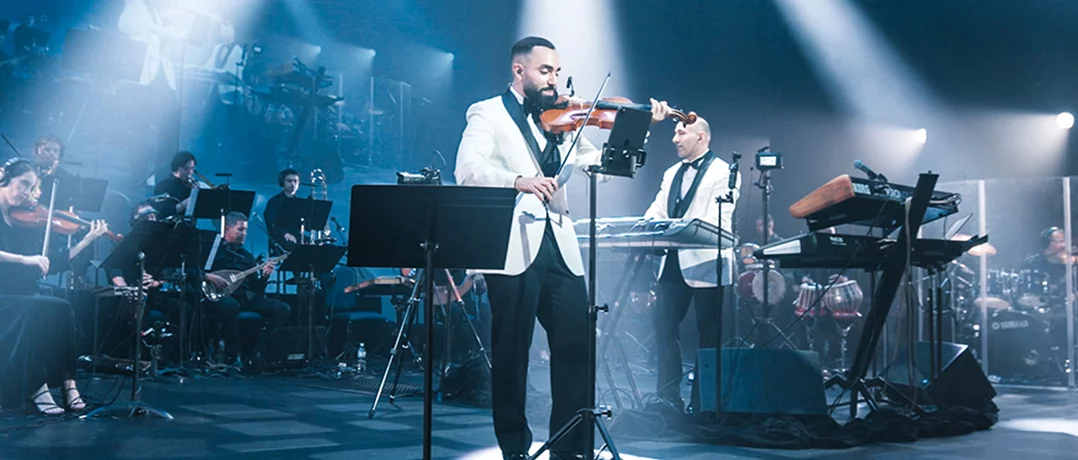
In a rehearsal room filled with strings, scales and stories stretching from Lebanon to Sydney, violinist and composer Jad Al Masri is chasing something bigger than a melody he’s chasing a legacy.
From performing alongside his father, renowned musician Rabih Al Masri, to launching music technology platform MuseAI, the young creative is carving out a space where tradition, innovation and identity collide determined to prove music can unite cultures while evolving with technology.
“Music has always been a serious part of my life. I really haven't lived an existence in which music wasn't a serious part of my life, thanks to my father,” Jad says
“ I'd always had music operating in the background through him playing or through me hearing things that he's playing.”
While music was ever-present growing up, he points to a defining moment.
“Music and the business associated with music really started to catapult itself from 2019 onwards when we released our first song together,” he says.
With the amazing feedback that we received from that, we knew we were onto something huge. And so we pursued it even further.
Today, he describes his sound as borderless.
“I would describe it as a multicultural musical journey. What I mean by that is you journey through the soundscapes from over 12 different cultures and genres in one or slightly more than one listening experience.”
That journey is deeply shaped by performing with his father a partnership grounded in respect, history and shared vision.
“Performing as a duo professionally is a privilege. The dynamic is very flexible in the sense that we express our own creative ideas,” he says.
We have this ability to entertain different perspectives amicably because there's a mutual respect for the work that we're creating, deepened through the personal relationship we have with each other.
He says the influence runs deeper than collaboration.
“ I've been very fortunate to develop a very similar musical style. And I wouldn't want to have any other musical style in the world, period,” he says.
“Because I know that my father's musical style was forged through six-hour-a-day practice sessions for more than five years during the Lebanese war. Living and breathing, practicing, mastering instruments, developing techniques that hadn't been done before on the keyboard.
“This is what took him and catapulted him around the world. So I wouldn't have any other start to music.”
Their recent multicultural orchestral concert bringing together the large ensemble in Australia and audiences from diverse backgrounds was about more than performance.
But Jad’s ambitions stretch well beyond the stage.
After years of juggling voice notes, lyric fragments and recordings scattered across platforms, he set out to solve a problem familiar to many creatives losing ideas in digital clutter.
“The problem stemmed from the fact that over my compositional experience which is about ten years right now, from music production to songwriting to violin performance I had thousands of audio ideas, but also thousands of lyric fragments and scores and harmonic ideas that lived so separately in so many different apps,” he says.
The solution became MuseAI.
“MuseAI is a workspace for musical ideas. You can capture musical ideas (like audio, lyrics, song demos, unreleased music), organise them, share and collaborate on them, and ideate with them to take them further,” he says.
“You can hear them in different ways, hear them in different styles, hear them with different sounds, understand them even more. All in one, elegant, unified workspace instead of 6+ different apps.”
For Jad, the platform is personal.
“MuseAI is absolutely an extension of my creativity. But more than that it's an empowerment of it,” he says.
“It solves problems I face as a creator, problems I've lived with for ten years.”
As artificial intelligence reshapes creative industries, he believes human connection remains at the core.
I don't worry about it replacing human artistry. Here's why: the future of music will always be human.
“The reason why artists have fans is because the artist is presenting their worldview a manner of filtering the world through their unique, flawed set of characteristics and attributes (flawed in a good way, by the way), which relates to the listener emotively and emotionally.”
Looking ahead, he has bold ambitions both musically and technologically.
“We're building core infrastructure that will empower the creative workflows of the expected 200 million music creators globally by 2030,” he says.
Ultimately, his vision comes back to impact.
“The first thing that comes to mind is: innovation, multifaceted, individuality, elegance, timeless, powerful. I mention those words because those are the things I want to be known by.”
I want to be known for leaving a difference.
“We want to leave a legacy that imparts to the next generation that it’s important to embrace what sets you apart. It sounds trite, but our music genuinely reflects that. We fuse hip hop and rap with orchestral sounds grounded in a Middle Eastern context.”
And at the heart of everything he builds from orchestral performances to software is a simple philosophy.
“And ultimately, I want both the music and the technology to point back to the same core message: embrace what sets you apart. Protect it. Refine it. Build with it. Because that is where real innovation comes from.”
