



In the absence of a centralized archival system, a fragmented network of institutions has taken on the work of preserving Lebanon’s vast and contested historical record.
Who keeps Lebanon’s collective memory?

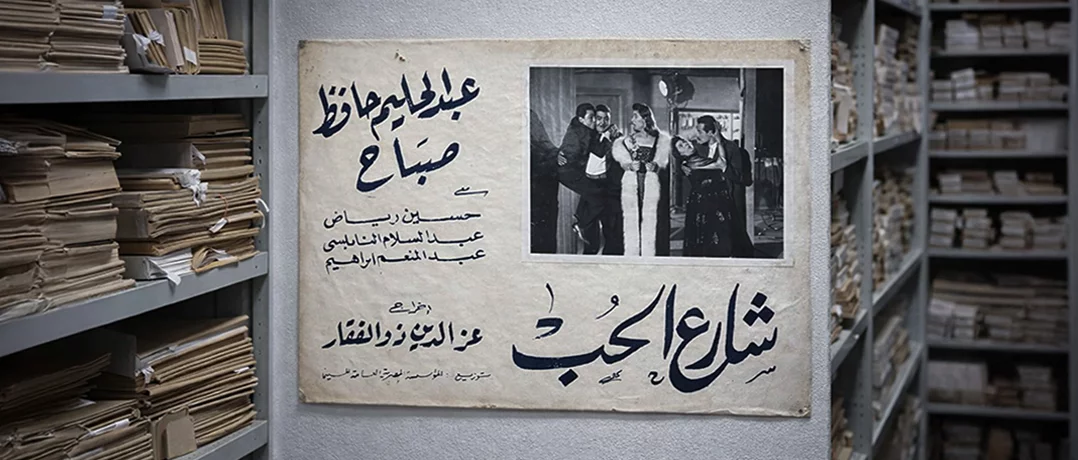
Arab Cinema Lobby Cards Collection - American University of Beirut/Library Archives
The room is colder than expected, but that seems to be the point.
It sits on the third floor of the library at the American University of Beirut (AUB), where manuscripts lie in acid-free boxes under carefully regulated air. A de-humidifier runs constantly. Two air-conditioning units maintain a chilled, stable temperature. The entire environment is calibrated to protect its materials’ integrity. It is, by all accounts, a room designed to temper the passage of time.
“We are fortunate here,” says Samar Mikati, head of Archives and Special Collections at AUB, gesturing toward the collection. “We never get bored.”
AUB’s collection, while impressive in scope, represents just one fragment of Lebanon’s broader archival landscape, marked by extraordinary depth. From centuries-old manuscripts to oral testimonies and religious texts, these materials are as diverse as they are instructive, offering a window into the country’s layered and often contested past.
This landscape, as Mikati put it, is nothing short of a “treasure trove.”
Such breadth, however, raises a central question: who is responsible for preserving Lebanon’s historical inheritance? And what is at stake when no single institution assumes custodial authority?
While many countries rely on strong public archival infrastructures to sustain their collective memory, Lebanon’s archival landscape remains fragmented and decentralized. The result is not an absence of archives, but a system without a center.
A system built on state absence
The archival landscape is shaped, above all, by the limited role of the state. Lebanon does maintain a National Archives in Beirut’s Hamra neighborhood, established in the mid-twentieth century to serve as the central repository for state records. Today, however, its role has diminished. The institution functions largely as a storage site for ministerial documents, holding little beyond government files.
Part of the explanation lies in timing. The archives were formalized during the civil war, when state institutions were already under strain. Many records were never properly cataloged, and the institution’s mandate remained narrow. Over time, as political instability and economic crises compounded, the development of a comprehensive archival system fell further down the list of national priorities.
Archivists across institutions describe a similar set of constraints. Political volatility, limited funding, and a shortage of trained personnel have all hindered efforts to build a unified framework. At USEK, librarians Rana El Ghobry and Carlos Younes point to the absence of a “clear, enforceable national archival policy” as a central obstacle. Without it, institutions remain largely isolated in their practices.
For others, such as co-founder of UMAM D&R Monika Borgmann, the issue is as much political as logistical.
Preserving Lebanon’s modern history, especially the civil war period, requires a level of independence that state institutions may not guarantee. Archives dealing with contested memory must be protected not only from deterioration but also from political pressure.
As Borgmann stressed, “historical preservation is a question of trust.”
 Conservation and Preservation Section - American University of Beirut/Library Archives
Lebanon’s alternative archival landscape
Against this backdrop of state absence, Lebanon’s archives have flourished in unexpected places. Universities, private libraries, and NGOs now collectively house one of the richest archival ecosystems in the region.
At AUB, the Archives and Special Collections Department has grown from a small room into a large-scale repository. Its holdings now include thousands of manuscripts, maps, and audiovisual materials, alongside hundreds of thousands of photographs and periodicals. The expansion accelerated in the early 2000s, as the institution began actively acquiring collections beyond its own history.
A short drive away, the Bibliothèque Orientale at Saint Joseph University reflects a different lineage. Its origins trace back to the nineteenth century, when Jesuit priests traveling through Lebanon and Syria began assembling collections of prayer books, manuscripts, and archaeological documentation. Today, the library holds thousands of manuscripts and an extensive photographic archive, making it one of the most significant research centers in the region.
Further north, at the Holy Spirit University of Kaslik, the archival infrastructure is more explicitly structured. The library is organized into specialized centers dedicated to conservation, digitization, and Lebanese studies. Since the early 2000s, it has undergone what staff describe as a “qualitative transformation,” shifting toward a more ambitious role in preserving national heritage. Its collections now include manuscripts, personal papers, maps, and audiovisual materials, processed at a scale that reaches into the millions of items.
Even institutions that appear public often originate in private initiative. The Baakline National Library, for example, began as the personal collection of Walid Jumblatt before being incorporated into the Ministry of Culture. Its holdings–newspapers, magazines, manuscripts, and audiovisual materials—have grown largely through donations rather than systematic state acquisition.
Speaking from the UMAM Documentation & Research (UMAM D&R) center in Dahiyeh, Borgmann recalled how her early-2000s work with her partner and later husband Lokman Slim on the film Massaker revealed a gap. The project, which focused on six perpetrators of the Sabra and Shatila massacres, required archival material that the Lebanese state simply did not have.
They therefore set out to build what Borgmann describes as a “citizen archive,” focused on memory, violence, and the civil war. What began in 2005 with the Slim family papers and Borgmann’s audiovisual materials has since grown into a wide-ranging, multi-format collection.
Together, these institutions have built a parallel memory infrastructure, stepping into the space the state has long left vacant.
Building an archive
If Lebanon’s archives are decentralized, the process of building them is equally ad hoc.
Collections rarely arrive through formal transfer. More often, they are pursued through long, personal negotiations. Many come through private donations: families of prominent historians, political figures, or cultural actors entrust institutions with manuscripts and personal papers.
Others take years of negotiation. Mikati recalled spending five years trying to secure the papers of the Lebanese women’s rights activist Anissa Najjar. The activist’s daughter initially refused, determined to complete a book about her mother before parting with the materials. Only once the project was finished did she agree to donate the collection.
Not all acquisitions are so deliberate.
At UMAM D&R, Borgmann joked they had saved collections of distinguished thinkers “from the dump,” following the “clean-up” relatives had conducted after their family member died. In such cases, the decision not to preserve is not necessarily ideological. It is often practical, as families are unsure what to keep or unable to store large quantities of material.
In recent years, economic pressures have introduced a new dynamic.
“Archives became a business,” Borgmann says, referring to the period following Lebanon’s 2019 financial crisis. As households faced mounting financial strain, some families began selling collections rather than donating them. Materials were dispersed, sometimes leaving the country altogether.
For archivists, the shift underscores the fragility of the system. Without consistent institutional support, preservation becomes contingent on individual decisions to donate, sell, or discard.
 Political Poster Collection 1960s-1980s - American University of Beirut/Library Archives
Special collections across institutions
The diversity of Lebanon’s archival landscape is reflected in the materials themselves.
Alongside manuscripts and rare books, collections include posters, pamphlets, cassette recordings, and newspapers, many of them produced for immediate use and not intended to last. At AUB, the Ephemera Collection preserves materials such as leaflets dropped from Israeli planes during the civil war, as well as documents from women’s organizations active in Saudi Arabia in the 1960s.
These materials capture moments that are rarely documented in official records. They offer a different kind of historical evidence, one that is less formal but often more immediate.
Other institutions have developed specialized collections that reflect their particular focus. The Bibliothèque Orientale holds manuscripts produced by Christian Arab copyists, alongside photographic records of Jesuit archaeological work. USEK preserves presidential papers from Camille Chamoun, Fouad Chehab, and Bachir Gemayel, alongside rare maps and engravings. Baakline maintains extensive audiovisual collections, including recordings associated with Umm Kulthum.
At UMAM D&R, the emphasis is more explicitly political. The archive foregrounds histories that have often been excluded from dominant narratives, particularly those related to the civil war and the Shi’a community in Lebanon. Its location in Dahiyeh is central to that mission.
Working there, Borgmann notes, is a “permanent challenge.” It is also a deliberate choice.
Part of UMAM’s work is to engage in what Borgmann describes as a “war of narratives,” documenting, challenging, and complicating competing accounts of history. In that sense, the archive becomes not only a repository, but a site of contestation.
The work of preservation
Preserving Lebanon’s archival heritage requires a level of care that is both technical and time-intensive. As Ghalia Daher at UMAM D&R noted, “This work needs an army.”
At AUB, preservation is a quiet choreography of precision. Conservators clean and restore documents by hand, rebinding books and transferring materials into climate-controlled rooms and acid-free housing. Similar practices unfold at the Bibliothèque Orientale, where staff oversee fumigation and environmental controls, often with interns from France’s Institut National du
Patrimoine working at their side.
Up the coast at USEK, El Ghobry shared a collection of photos documenting the sixteen steps involved in restoring a 17th century Maronite evangeliary: clean, separate the folios, restore the sheets, sew, round, finish the paper, finish the canvas, attach the boards, hollow the back, prepare the molded back, cover the back, raise the band, prepare the false headband, glue the turn-in, sand, and finally, bandage.
One could be forgiven for losing count along the way.
In practice, most institutions operate with relatively small teams. AUB’s archives are managed by seven full-time staff; USEK employs around fifty. Across institutions, archivists describe a reliance on external funding, from universities, international organizations, and embassy cultural programs, to sustain their work.
Even with these efforts, preservation remains precarious.
During the 2006 war, UMAM D&R relocated its most valuable materials to a different site for safekeeping. Some were still damaged in airstrikes. After the 2020 Beirut port explosion, AUB confirmed that materials it had been attempting to acquire were destroyed before they could be secured.
Conservation here is not just a practice. It is a race against political and environmental precarity.
Digitization and access
In response, digitization has become a central component of archival work.
At USEK, digitization efforts began in the early 2000s and have since expanded into large-scale projects such as the Memorial to Lebanese History, which documents civil war testimonies through recorded interviews. AUB has developed its own digital initiatives, including oral history projects that capture the experiences of Palestinian refugees and residents of Beirut.
The Bibliothèque Orientale has digitized its manuscript collections in partnership with international institutions, while Baakline has focused on preserving newspapers and magazines in digital form. UMAM D&R, for its part, has built a digital catalog that spans books, films, posters, and photographs.
Digitization serves multiple purposes. It increases accessibility, allowing researchers to engage with materials remotely. It also provides a form of backup, ensuring that records are not entirely lost if physical materials are damaged.
Yet digitization has its limits.
Some materials cannot be reproduced without losing critical detail. Others are restricted by copyright or preservation concerns. In many cases, accessing an archive still requires physical presence.
That physical encounter continues to shape who engages with these collections. At AUB, a 12-year-old once visited for a school project on reconstructing downtown Beirut, while the Baakline National Library recently hosted a Swiss doctoral student researching the history of yerba mate. These interactions suggest that Lebanese archives are not elite spaces. They are civic ones, animated by curiosity and scholarship alike. The digital archive expands access, but it does not replace the physical one.
Memory as civic architecture
Lebanon’s archives endure not because of a unified national system, but because scattered institutions have chosen to shoulder a responsibility the state has long neglected. Their work is exacting, underfunded, and at times precarious, yet it is through these repositories that the country’s fragmented histories are preserved.
In a nation where competing narratives shape political life, the survival of these archives is not merely a cultural concern but a civic one. Without these independent efforts, Lebanon’s historical record and collective memory would be left dangerously incomplete.
-
-

-
Katharine SorensenReporterSpecializing in global affairs, technology and economics, with a focus on on-the-ground investigative reporting.
-
